

Starlink user terminal during setup.
space x
Elon Musk’s SpaceX is best known for its reusable rockets, but this year it has made headlines for its big investment in artificial intelligence through a merger with xAI. But as the company pitches to investors ahead of its big IPO, Starlink is another business that dwarfs others in terms of growth and profits.
SpaceX said in its long-awaited prospectus on Wednesday that its connectivity division, which primarily consists of Starlink, generated $11.39 billion in revenue last year, accounting for 61% of total sales. This number rose to 69% in the first quarter of this year.
Additionally, Starlink is a profit driver for the company. Last year, it was the only profitable division with revenue of $4.42 billion, while its rocket launch division, which includes contracts with NASA and the Department of Defense, lost $657 million, and its AI division had a deficit of $6.35 billion.
Starlink provides global high-speed internet coverage using a constellation of more than 10,200 satellites in low Earth orbit (the region of space within 1,200 miles of the Earth’s surface). Since launching its first satellite in 2019, Starlink has emerged as the leading internet provider from space. Currently available in over 160 countries on all seven continents.
Musk, the world’s richest man, has ambitions to colonize Mars, and even offers generous incentives based on his ability. He also wants to build an orbital data center and currently works with OpenAI, Anthropic, google.

This may or may not happen, but in the meantime, Starlink has dominant positions in the following markets: Amazon And others are chasing. Starlink’s user base more than doubled to 10.3 million in the first quarter from a year ago. Earlier this year, SpaceX applied to the Federal Communications Commission to launch up to 1 million low-Earth orbit satellites.
SpaceX launched Starlink in 2015 as a way to leverage the company’s access to space, building a constellation of satellites to support powerful internet services. Starlink has long been seen as a cash cow that could help fund SpaceX’s other costly endeavors.
SpaceX said in its IPO filing that capital expenditures totaled $10.1 billion in the first quarter, more than doubling from the same period last year. The majority of these costs ($7.7 billion) were related to AI.
While Starlink has emerged as a popular product with consumers, it is also used by dozens of airlines, including: united, southwest And Hawaiian provided onboard wireless internet. Musk said in December that Starlink’s commercial services were “by far” the largest contributor to SpaceX’s revenue.
Starlink entered the Brand Finance Top 500 ranking for the first time in 2026 with an estimated brand value of $5.19 billion.
Competition is fierce. Operated by France’s Eutelsat, OneWeb has a constellation of more than 600 satellites. Amazon The company has also launched more than 300 satellites over the past year in preparation for the launch of Leo services, which will eventually include a constellation of approximately 7,700 satellites.
Jeff Bezos’ Blue Origin also plans to deploy about 5,400 satellites starting in the fourth quarter of 2027. With about 163 satellites in orbit, the Chinese king aims to build a huge constellation.
In its prospectus, SpaceX lists Amazon, Blue Origin, Viasat, AT&T and T-Mobile. Some of its competitors are also customers and use SpaceX launches to put satellites into orbit.
starlink politics
Musk introduced Starlink internet services to U.S. federal agencies while leading DOGE, the Trump administration’s federal workforce reduction effort. States, charities, and non-governmental organizations often purchase Starlink terminals and services after natural disasters and other emergencies. SpaceX also operates a classified layer of its Starlink service called StarShield for military use.
The brand resonates with consumers, but it’s not universally loved, in part because of Musk’s support for far-right leaders around the world. Additionally, some overseas regulators consider Starlink to be a security risk because it is foreign-owned.
Namibia’s telecommunications regulator rejected Starlink’s application for an operating license in March, saying it did not comply with local ownership rules. Musk, who was born in South Africa and is a naturalized US citizen, has unfairly accused the South African government of denying Starlink a license to operate in South Africa because he is white.
South Africa’s Electronic Communications Act requires foreign telecommunications licensees to sell 30% of the shares in their local subsidiaries to historically disadvantaged groups. South African regulator ICASA is considering proposals to make it easier for SpaceX and other foreign operators of satellite internet services to obtain licenses.

Meanwhile, the Taiwanese government has ruled out a Starlink deployment because SpaceX would not agree to a joint venture with a local partner, the Financial Times reported. Taiwanese officials have pointed to Musk’s business ties in China and his past comments in which he referred to Taiwan as an “integral part of China.”
Starlink has also sparked controversy in Ukraine following Russia’s invasion of the neighboring country in 2022. That same year, Musk ordered SpaceX to actively block coverage of Starlink at the Kherson battlefield, hampering efforts to retake Ukrainian territory, according to Reuters. SpaceX and Musk denied the report. SpaceX took steps this year to prevent Russia from misusing Starlink to direct some long-range drones to attack Ukraine.
SpaceX said in its IPO filing that further expansion of its Starlink business, including satellite deployment and spectrum distribution, is dependent on regulatory and license approvals.
“There can be no assurance that any application for renewal, modification, or expansion of our license will be granted on a timely basis, at all, or without additional conditions,” the company wrote.
Starlink also faces challenges regarding the retirement and replacement of satellites within the mega-constellation. Satellites in geostationary orbit have a lifespan of about 15 years, but Starlink satellites are launched into low Earth orbit and have a lifespan of about 3 to 5 years.
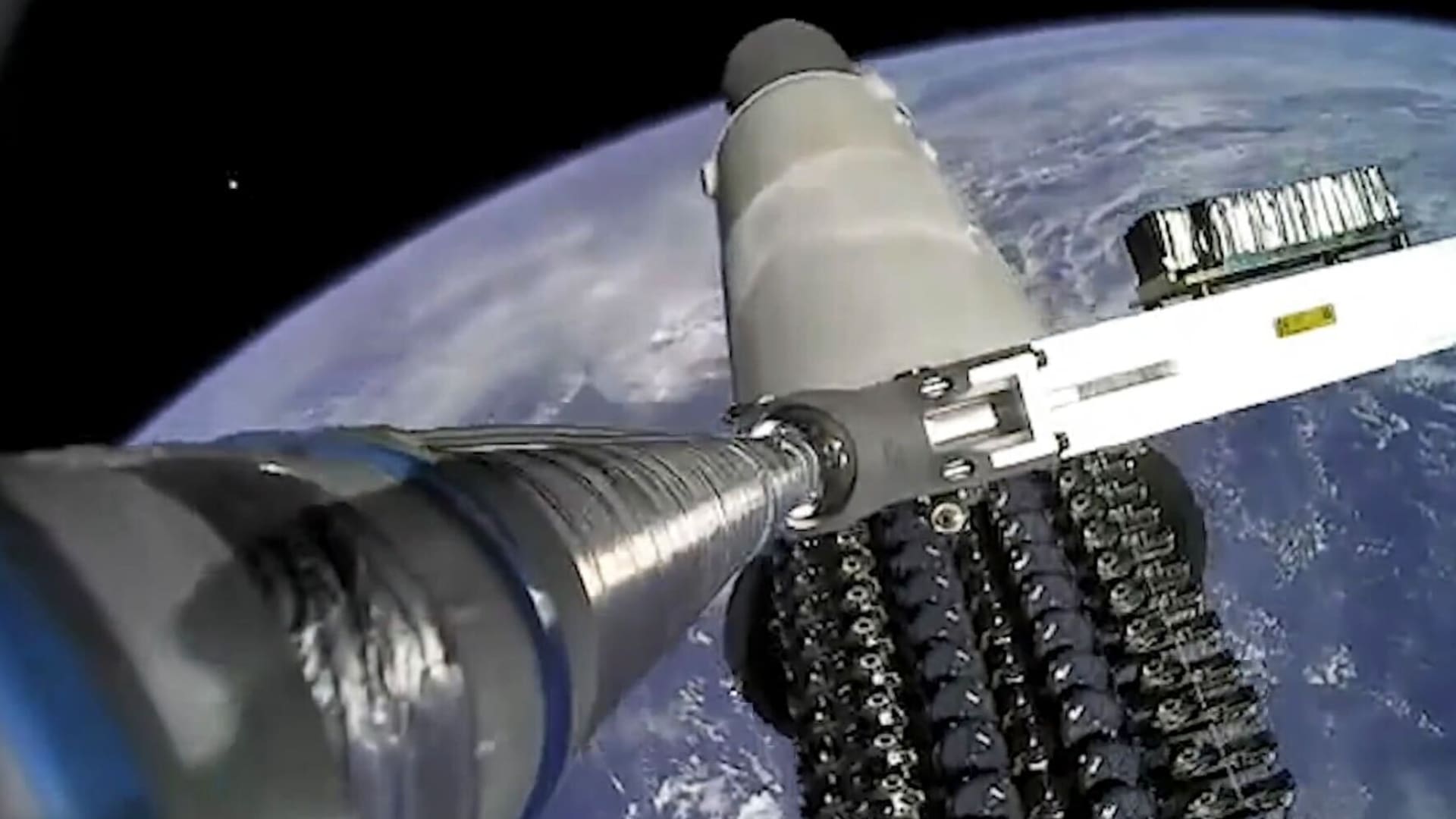
The Falcon 9 rocket’s upper stage will deploy a stack of Starlink “V2 Mini” satellites into orbit.
space x
SpaceX said in the risk factors section of its filing that space is “inherently hostile” and Starlink satellites will be exposed to harsh conditions in orbit that can cause them to malfunction or fail.
Excess space debris can cause a phenomenon known as Kessler syndrome, a catastrophic chain reaction of collisions in space. Scientists cite the increased risk of Kessler syndrome as one reason to oppose SpaceX’s proposal to launch 1 million satellites into orbit.
In response to SpaceX’s FCC proposal, DarkSky, a nonprofit that advocates for reducing light pollution, wrote an open letter to the company, calling on it to adhere to “true satellite invisibility standards,” conduct an environmental assessment before expanding its satellite fleet, and engage the astronomy and environmental communities on its plans.
SpaceX’s proposal would increase the number of satellites in the sky “nearly 70 times,” the group wrote. “Without meaningful oversight, this project has the potential to forever change the night sky as we know it,” DarkSky said.
orbital data center
SpaceX has announced plans to build and launch an orbiting data center consisting of a constellation of satellites equipped with graphics processing equipment and powered by solar power. Earlier this year, Musk said data centers in space would be the cheapest way to train AI, saying, “It’s going to happen within two years, three years at the latest.”
Experts say that even if orbiting data centers become a reality, it will take much longer. One reason for this is that rocket launches still have limited capacity and are expensive. In addition to protection from radiation, data centers in orbit also require cooling systems and chips that can withstand extreme temperatures.
SpaceX said in its prospectus that it plans to deploy space-based data centers as early as 2028. The company’s long-term vision calls for thousands of rocket launches a year, according to the filing.
The company is developing a thermal control system to disperse heat generated by data centers, and said in Wednesday’s filing that it has “already solved the most difficult part of developing an AI computing satellite.”
WATCH: Bezos says 2-3 year schedule for space data center is ‘a little ambitious’

