

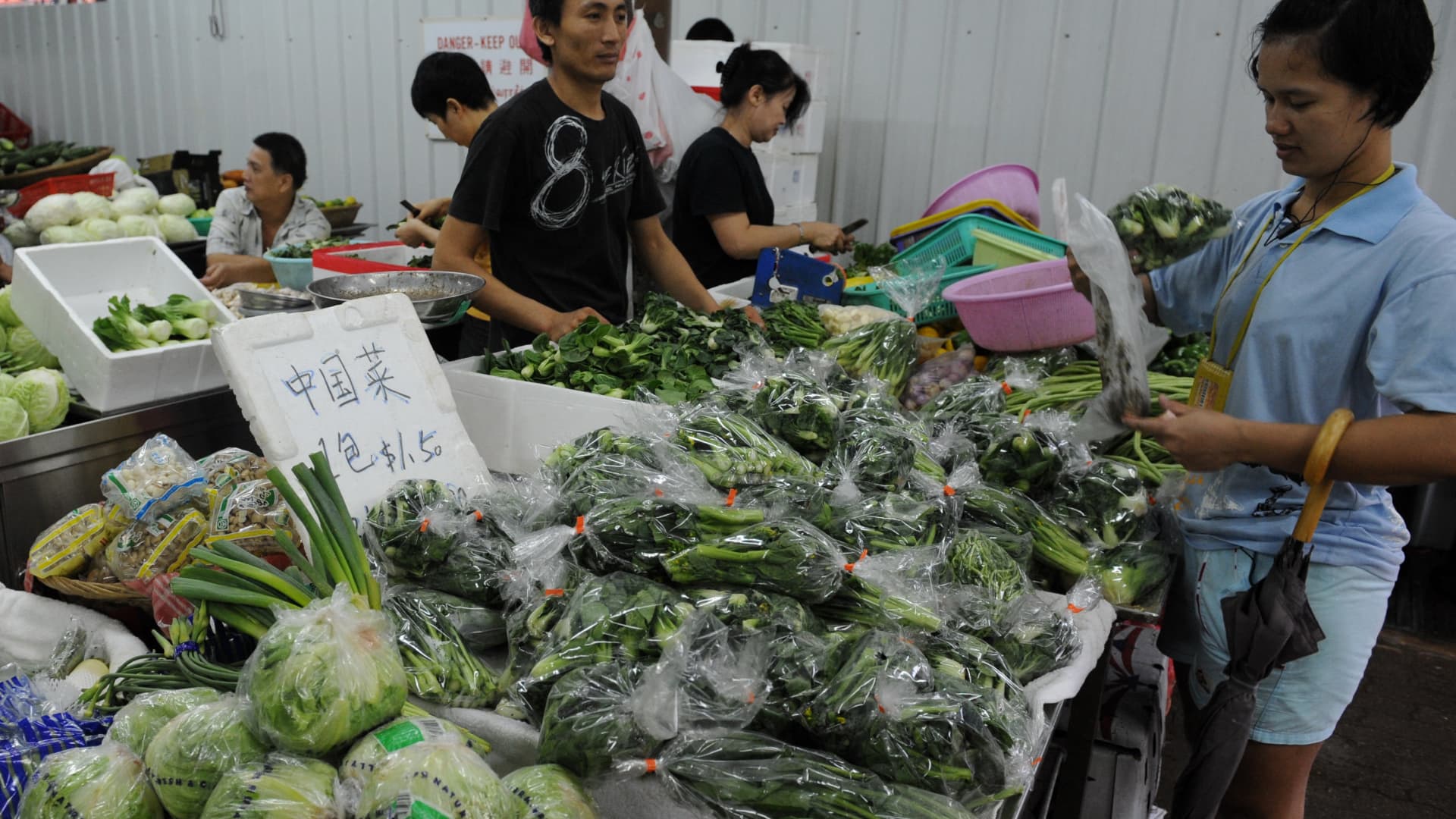
A housewife buying vegetables at a wet market in Singapore (R)
Roslan Rahman | AFP | Getty Images
Singapore said on Monday that consumer prices rose 1.8% in April, weaker than expected, due to weaker increases in services and retail inflation.
Economists polled by Reuters had expected headline inflation to be 2%.
Core inflation, which excludes private transport and accommodation prices, came in at 1.4%, compared to the expected 1.7%.
However, the Monetary Authority of Singapore said the city-state’s import cost pressures are expected to further accelerate and widen in the coming months.
“Increased energy and other input costs resulting from developments in the Middle East will pass through global supply chains, raising production and transportation costs for a wider range of Singapore’s imported goods and services,” a government statement said.
MAS had expected both headline and core inflation to be between 1.5% and 2.5% for all of 2026.
On the same day, Singapore significantly revised its gross domestic product (GDP) growth rate for the first quarter upwards to 6% from the earlier forecast of 4.6%, exceeding the Reuters forecast of 5.1%.
The country’s Ministry of Trade and Industry said Singapore’s full-year growth rate in 2026 will be between 2% and 4% amid energy-related disruptions in the Strait of Hormuz.
In April, the MAS tightened monetary policy for the first time in nearly three years, citing inflation expectations.
Unlike most countries, Singapore does not use interest rates to manage monetary policy, instead guiding the Singapore dollar within a policy band against a trade-weighted basket of currencies.
The Singapore dollar is managed within a set policy band, but the exact level is not disclosed.

