

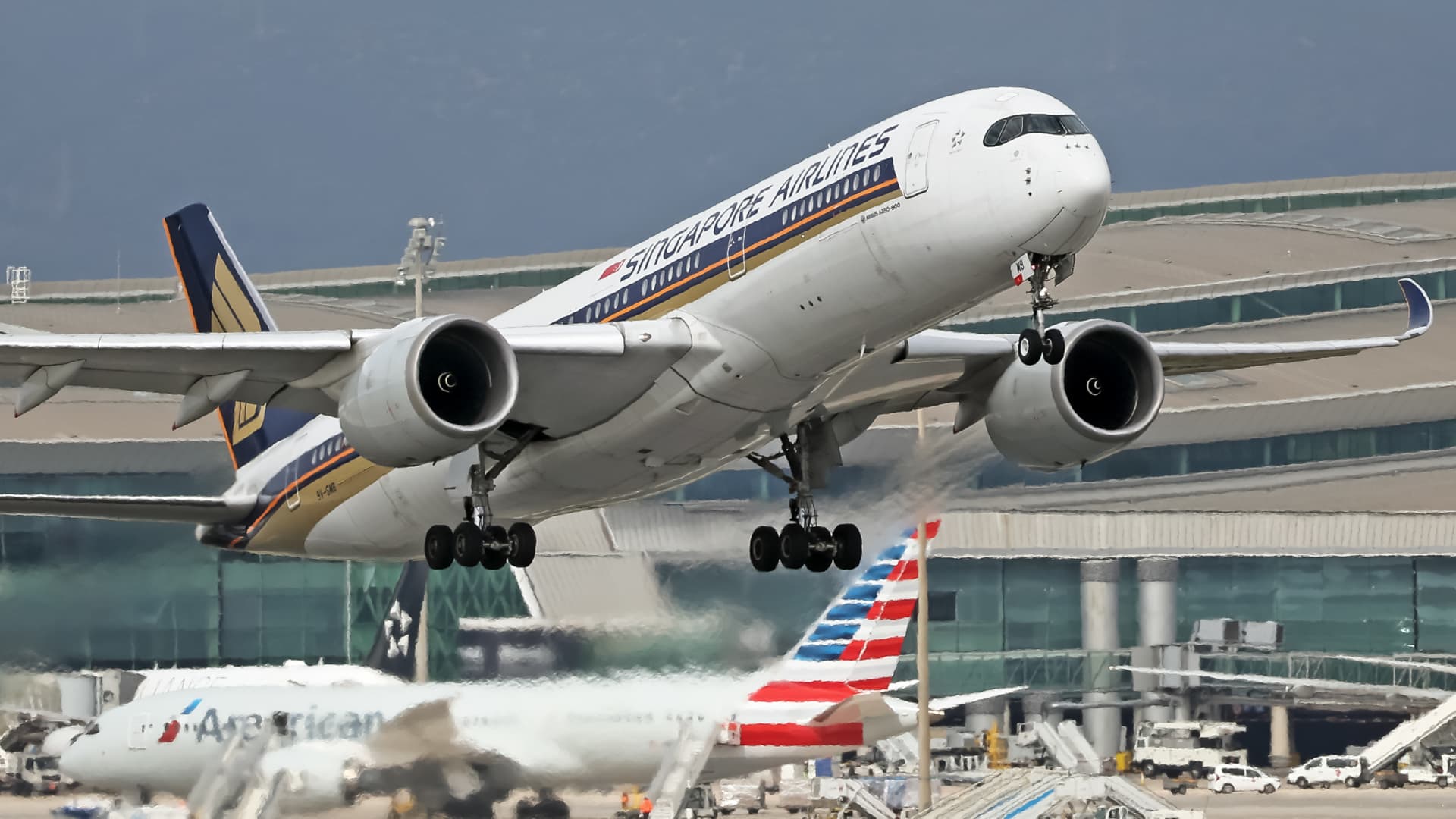
Singapore Airlines Airbus A350-941 taking off from Barcelona El Prat Airport in Barcelona, Spain on April 29, 2026 (Photo by Joan Valls/Urbanandsport/NurPhoto via Getty Images)
Null Photo | Null Photo | Getty Images
Singapore Airlines has dragged down Air India’s profits for about five quarters, but analysts and the airline say the investment will pay off in the long run.
SIA on Thursday reported a record revenue of S$20.5 billion ($16.06 billion) for the year ended March 31, with operating profit rising 39% to S$2.38 billion on higher demand, higher yields and lower net fuel costs for the year.
However, net profit fell 57.4% year-on-year to S$1.18 billion. This was mainly due to Air India’s loss and previous year’s accounting profit.
Singapore Airlines revenue in 2025
Air India is beset by numerous obstacles. Pakistani airspace was closed in April 2025, and in June, Flight 171 crashed, killing more than 250 people.
Now, the Iran war and the company’s connectivity exposure to the Middle East market are wreaking havoc, forcing the company to cancel nearly a third of its flights during the peak travel period of June to August.
“These changes are aimed at improving network stability and reducing inconvenience for last-minute passengers,” Air India said in a statement.
SIA’s venture into India’s fast-growing aviation market is strategic, and “strategic usually means not profitable,” said independent aviation analyst Brendan Sobie. “But obviously last year was worse than anyone imagined.”

CEO Goh Choon Fong said in an earnings call on Friday that SIA continues to support Air India, saying it has made “tangible progress” with its transformation program in areas such as employee training and reducing customer complaints.
“It’s going to be a long game. There are no shortcuts,” he said.
SIA’s India Strategy
SIA entered the Indian aviation market in 2015 by launching Vistara with Tata Sons, the promoter of conglomerate Tata Group.
Vistara will merge with Air India in December 2024, with SIA acquiring a 25.1% stake in India’s flag carrier. As part of the deal, SIA will inject S$360 million in cash into Air India and will contribute up to S$880 million in additional capital in the future.
Air India is seeking at least 100 billion rupees (S$1.47 billion) in financial support from SIA and Tata, Bloomberg reported in April.
Asked whether SIA would inject additional capital into Air India, Goh declined to comment, saying this “needs to be discussed with other shareholders”.
However, it can be difficult to avoid.
“The capital required for this round is likely to be significantly higher than originally anticipated, given the magnitude of the losses and ongoing operating pressures,” Jason Sam, an analyst at DBS Group Research, said before the results were announced.
Sobhi said in an interview with Squawk Box Asia on Friday that SIA “will definitely have to put more money into it. There’s no question about that. It’s just a matter of when and how much money to put in.”
Sam said a larger-than-expected capital injection would begin to constrain its ability to pay dividends as SIA faces increasing earnings pressure.
Sumit Agarwal, a professor at the National University of Singapore, said SIA could sell its stake in Air India to Tata or another buyer because the acquisition would drain it of cash for years.
But with India pouring money into new and improved airports and other infrastructure, “it’s a good bet to be in that market,” Agarwal said. “The demand is there.”
In the long run, “I think this will pay off for Singapore Airlines,” he added.

