

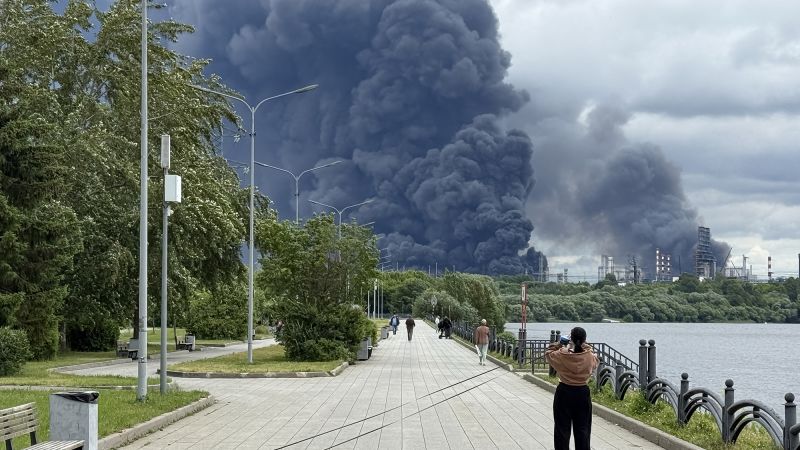
On the streets of Moscow, frustrated drivers wait patiently in long lines of cars and trucks for gas amid a severe national shortage. Many of them told CNN they spent the day in their cars looking for fuel. It was unusual in the capital of the world’s largest energy producer and unexpected in a city long isolated from the effects of the war in Ukraine.
But as the conflict enters its fifth year, the stark reality of what the Kremlin still claims to call a “special military operation” has become impossible for ordinary Russians to comfortably ignore.
Over the past month, Ukraine’s unprecedented drone attacks have been extraordinary in scale and impact.
One night last week, Russia reported intercepting 660 drones in 12 regions, making this one of the largest attacks on Ukraine since Russia launched a full-scale invasion in 2022.
Targets are not randomly selected but carefully selected, including refineries, oil terminals, naval vessels, and weapons factories deep within Russian territory. This is a campaign aimed at bleeding Russia’s war economy and increasing the economic and political costs for the Kremlin by pushing the war further.
And it’s working.
Independent media across Russia have reported growing lines of cars waiting at gas stations as supplies begin to run out, a scene authorities want to hide. Crimea, which was annexed from Ukraine in 2014, declared a state of emergency and suspended fuel sales.

Even for the Kremlin, which often downplays painful setbacks, the harsh reality has become difficult to avoid.
Russian President Vladimir Putin chaired an emergency meeting over the weekend and revealed that the country’s gasoline reserves had dwindled to uncomfortable levels.
“We are well aware of the continuing problems for drivers and businesses,” Putin told the assembled officials, acknowledging that authorities had been neglecting the situation for weeks.
“Unfortunately, there are still queues at gas stations,” he added.
There were other signs that the Kremlin was feeling some pressure. President Putin has revealed that a complete ban on diesel exports is under consideration after his deputy prime minister told reporters that such a ban was not necessary. The Russian leader confirmed that a special committee is currently active on fuel issues.
Putin also warned that agriculture was at risk and said Russia must “minimize the impact of terrorist attacks on civilian targets and infrastructure,” a careful reversal of language for a leader who has downplayed Ukrainian drone attacks as unrelated.
There is no small irony in the fact that for years the systematic destruction of Ukraine’s energy infrastructure (power plants, substations, heating facilities) has been one of Russia’s most deliberate wartime strategies, aimed at undermining civilian morale by making everyday life unbearable. Ukraine now appears to have turned that logic on its head, and the Russians themselves are beginning to sense the end of their strategy.

But it has sparked hope among Western critics in Moscow.
At the G7 summit in France earlier this month, European Commission President Ursula von der Leyen made a statement. “The tide is changing in Ukraine,” she asserted. “The situation in 2026 will be very different from 2025. Russia’s fatigue is clearly showing. Now is the time to double our support.”
Western officials say the Ukraine operation is disrupting Russian fuel and munitions supplies and slowing Russian military efforts on the battlefield.
In a recent report, the Council on Foreign Relations noted that expanded drone operations directly contributed to Ukraine recapturing 78 square miles of territory in February, reversing the trend of Russian gains that had characterized the battlefield throughout 2025.
Even US President Donald Trump’s tone appears to be changing.
At the G7 summit, he told reporters that Russia “should agree.” A few days later, he returned to Washington and spoke in the Oval Office, calling Ukrainian President Volodymyr Zelenskiy “courageous” and someone who was “doing pretty well” in the war. The warm words were especially noteworthy from the president, who has spent much of last year publicly pressuring Kiev to negotiate from a position of weakness.
Zelenskiy has been clear about what he believes drone operations can accomplish. With the right support, Ukraine “could quickly create a situation in which Russia would be forced to choose peace,” he said.

But it may be a mistake to conclude that Russia’s current problems will force the Kremlin to capitulate, at least not yet, and perhaps not soon.
For decades, President Putin has cultivated a relatively fragile image as an uncompromising leader. This fact makes capitulation, withdrawal, or even compromise in Ukraine incredibly unlikely and difficult for Putin to pull off.
With Putin’s invasion killing and injuring well over a million people, according to the best Western estimates, and with sovereignty at stake in four regions of Ukraine that Putin does not yet fully control, any settlement that cannot be portrayed as a decisive victory in Moscow risks causing serious domestic political tensions.
Hawks around Putin continue to insist that he can and should seize the entire Donbas region of Ukraine. Just because a Russian refinery caught fire doesn’t mean this debate will go away.
And while the country’s current fuel shortages are a painful reality, they should not be mistaken as a white flag.
