

Nairobi, Kenya
AP
—
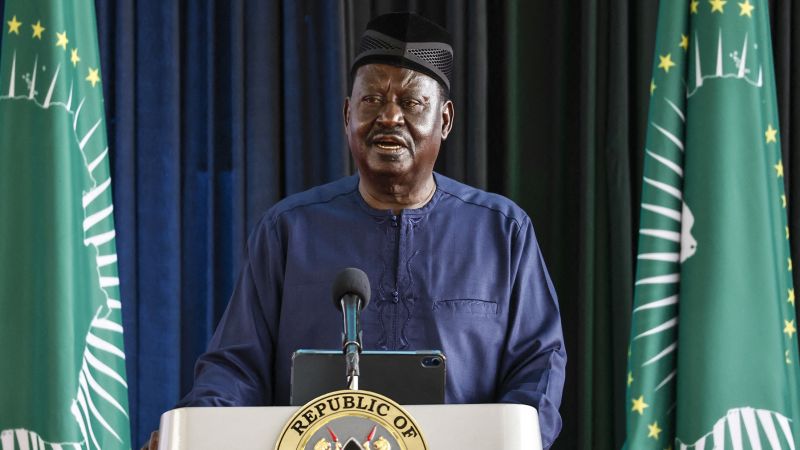
Raila Odinga, Kenya’s former prime minister and longtime presidential candidate who swayed authorities with a populist campaign and had a huge influence on the East African country’s politics, died Wednesday of a heart attack while on a trip to India. He was 80 years old.
His death was confirmed by Devamatha Hospital in the Indian state of Kerala, where he was brought to the hospital after collapsing during a morning walk. A hospital statement said Odinga went into cardiac arrest and did not respond to resuscitation efforts.
Mr. Odinga recently signed a political agreement with Kenyan President William Ruto in which his opposition party will be involved in key government policy decisions and its members will be appointed to the cabinet.
But his ambition was to become president of Kenya, and he ran for office five times in 30 years, sometimes with such support that many believed he might win. The closest he came to becoming president was in 2007, when he narrowly lost to incumbent Mwai Kibaki in a contentious election marred by ethnic violence.
There has always been a tribal influence in Kenyan politics, and Odinga, a member of the Luo tribe of Nyanza province in western Kenya, has spent his political career navigating the landscape in a way that brings him to State House, Kenya’s president’s official residence in the capital Nairobi.
Although he never succeeded, to many he was a respected figure and politician whose work helped lead Kenya away from one-party rule and toward a vibrant multiparty democracy.
Odinga reached the height of his political power in the 2007 presidential election, winning the support of other tribal figures who had merged around him. He drew such large crowds at campaign events across Kenya that many observers believed his time had come.
Mr Kibaki, a member of the Kikuyu tribe, posted good economic data during his first term, but his government was weakened by corruption scandals and looked hopeless to Mr Odinga’s rivals. The official result (44% for Odinga to 46% for Kibaki) was the closest margin in Kenya’s history.
Odinga’s camp rejected the results, due in part to unreliable election officials, and its leaders later said they did not know whether Kibaki had won the election.
After Kibaki’s victory was declared, he was sworn in as president in a bizarre dusk ceremony, which infuriated Odinga’s camp. Almost immediately, protests erupted on the streets of Nairobi, where Mr. Odinga had strong support. Violence then spread to other parts of Kenya, targeting groups along ethnic lines, with Luos and Kalenjin targeting Kikuyu, and Kikuyu mobilizing retaliatory attacks.
Days of violence left hundreds of people dead and shattered Kenya’s status as a stable democracy in a volatile region.
Odinga was never charged with inciting violence, but others, including future presidents Ruto and Uhuru Kenyatta, were. They were among six suspects facing criminal charges in connection with the post-election violence when the International Criminal Court launched an investigation in 2010.
The case was never successfully prosecuted, with charges dropped, dropped, or dismissed amid claims of witness intimidation and political interference.
Odinga himself emerged from the chaos with dignity intact and secured himself the post of prime minister in the national unity government established through the mediation of the international community. He ran for president three more times but lost.
Early activities, detention and exile
Raila Amolo Odinga was born on January 7, 1945 in Kisumu, a large city on the shores of Lake Victoria near the border with Uganda.
The son of Kenya’s first vice president, Jaramogi Oginga Odinga, he attended local schools before leaving Kenya to study engineering in East Germany. Returning to Kenya in the 1970s, he taught at the University of Nairobi and started various businesses, including a successful one selling liquid petroleum gas cylinders.
Odinga first rose to prominence in the 1980s as a political activist fighting against President Daniel arap Moi’s one-party rule. He was implicated in an attempted coup attempt by a group of air force officers to seize power in 1982.
Some of the coup leaders were eventually convicted of treason and executed, and Odinga and his father’s names also came up during the interrogation of some of the suspects. Odinga was charged with treason and spent much of the next decade in detention, although the charges were later dropped.
Odinga described the harsh conditions of his imprisonment and allegations of torture, including assaults by police officers who hit him with wooden table legs. He claimed at the time of the coup attempt that he was involved in educating and mobilizing people to bring about change in Kenya, but that he had never advocated violence.
After his release in 1991, he briefly went into exile in Europe.
Return to Kenya and politics
Odinga returned to Kenya in 1992 and won a parliamentary seat as an opposition member representing the Nairobi constituency. It was during his 20 years as a lawmaker that he emerged as a national figure, gaining overwhelming support from people dissatisfied with government corruption and poverty.
In 1997, he launched the first of several presidential campaigns, which always ended in bitter failure, and some Kenyans began to talk about Odinga’s curse. In 2001, he accepted a government post as Minister of Energy in the Moi government, unsuccessfully aiming for a ticket as the ruling party’s standard bearer.
He was instrumental in the rise of Kibaki, an unpopular economist whom he supported in the 2002 presidential election and rival in the disputed 2007 election.
Despite his advancing age, Mr. Odinga appeared sleepy at campaign rallies, but he never seemed to lose his enthusiasm for politics, and some of his rivals acknowledged that he was a brilliant man who had hoped to retire.
In 2017, Odinga told The Associated Press about civil disobedience after losing his fourth presidential election, calling street protests a constitutionally recognized democratic measure.
“If a regime is undemocratic and does not enjoy legitimacy, then the people are justified in resisting that regime,” he said.
Odinga’s last presidential campaign was in 2022, when he ran against Ruto with support from outgoing President Kenyatta.
He lost again, continued to complain that he had been cheated of victory, and began street protests asserting his constitutional right to demonstrate.
In early 2025, he lost a bid to become secretary-general of the African Union Commission, the body that governs the continent-wide African Union.
Odinga’s survivors include his wife, Aida.
