

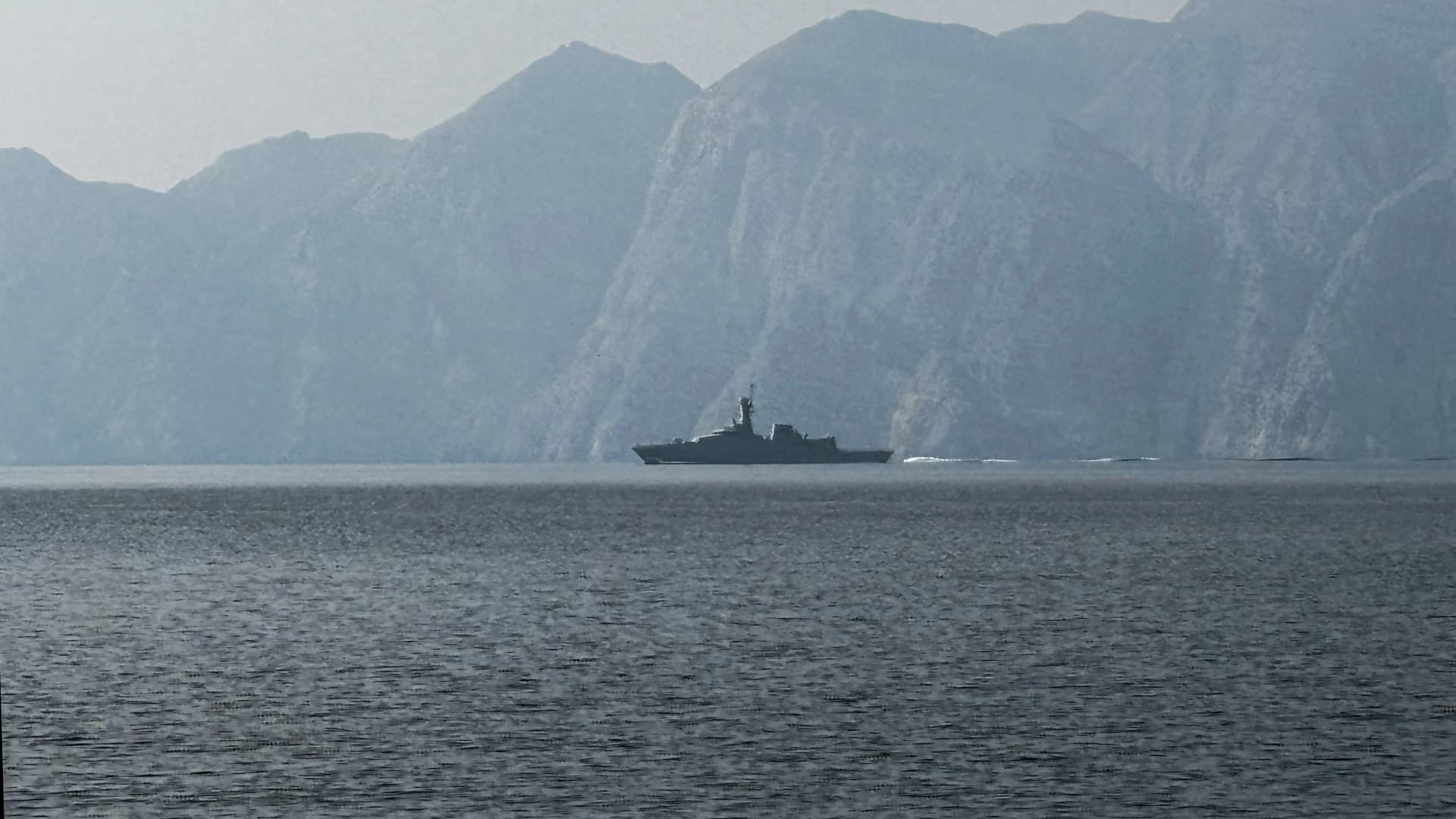
On March 1, 2026, a naval ship is seen sailing through the Strait of Hormuz, a vital waterway through which much of the world’s oil and gas passes.
Sahar Al Attar | AFP | Getty Images
President Donald Trump on Monday rolled out a much-hyped “blockade” of access to Iranian ports in the Persian Gulf, announcing his intentions on social media and vowing to begin the blockade by a specified deadline.
But what exactly does it mean to restrict access to this area? oil What does exporting through the Strait of Hormuz mean and what does Trump want to achieve?
A former senior Pentagon official from the Biden administration said the United States is trying to turn the tide on Iran. Iran has blocked the strait for weeks during the US-Israel war, disrupting global markets and creating bottlenecks that strain the economy. Experts say the aim of the blockade is to persuade Iranian leaders to withdraw and acquiesce to U.S. demands to end the war and restore freedom of navigation in the strait.
“The government appears to be pursuing what’s called a tight blockade, an attempt to prevent ships from entering or leaving ports,” said Michael Horowitz, senior fellow for innovation at the Council on Foreign Relations and a former deputy assistant secretary of defense. “The theory behind the strict blockade of Iran’s ports is to make it impossible for Iran to derive economic benefits from the sale of oil by sea in the strait, and to restrict other countries from doing so.”
Iran is one of the top 10 oil nations, accounting for approximately 4% of the world’s oil. oil Most of the production is sold to China. Shutting down Iran’s oil export capacity could cause significant damage to the country’s economy.
President Trump announced Sunday that he would close the strait, a major escalation after a two-week cease-fire, and there are reports that Iran plans to impose tolls on ships seeking to pass through the waterway. U.S. Central Command later said it would blockade “all national vessels entering or exiting Iranian ports and coastal areas, including all Iranian ports in the Arabian Gulf and Gulf of Oman.”
Ports in other Middle Eastern countries, such as the United Arab Emirates and Saudi Arabia, are also accessible via the strait.
Mark Cancian, a former Marine Corps colonel and now a senior adviser at the Center for Strategic and International Studies at the Department of Defense and Security, said the United States would likely implement a blockade in a manner similar to the one it imposed on Venezuela last year. The United States seized several ships as part of its blockade.
“We will know more once the first boarding takes place, because it will tell us where they boarded the ship, how they boarded the ship, and what happens to the ship after they board the ship,” Cancian said.
He said the U.S. would likely be more likely to intercept ships east of the Arabian Sea straits than in the straits themselves or the Persian Gulf, where Iran has more power to intervene. But Cancian said the U.S. could seize ships there if it wanted.
Boarding itself will likely take place by landing a helicopter on the tanker, but it is also possible that it will take place by boat.
Horowitz said the blockade was likely an attempt by the regime to resolve lingering issues in the Strait of Hormuz as it prepares to withdraw from the Iran war.
“Even if the U.S. wanted to go and take over now, if Iran were charging tolls for ships passing through the strait, that would be an obstacle to the success of that approach,” he said. “Resolving freedom of access to the strait is now essential to how the Trump administration thinks about the conflict, and they see this blockade as a key element in maximizing Iran’s economic pain in the hope that Iran will withdraw.”
Iran trolls President Trump over blockade
Iran took a defiant stance prior to the start of the blockade.
Iranian Parliament Speaker Mohammad Berger Ghalibaf mocked President Trump in Sunday’s X-Post, saying, “Enjoy the current numbers at the fuel pumps. Because of the so-called ‘lockdown’, you will soon miss $4-$5 gas.” The post included an image of a map showing the locations and prices per gallon of gas stations near the White House.
The U.S. military already has what it needs to enforce a blockade of Iranian waters, thanks to months of naval buildup in the region.
“We already have multiple carrier strike groups in the region, and we also have the U.S. 5th Fleet already based in Bahrain,” Horowitz said, adding that the U.S. also has significant submarine and satellite capabilities. “The U.S. military has the ability to effectively monitor the comings and goings of ships, allowing the United States to intercept them and prevent them from selling Iranian oil.”
And Cancian said the blockade itself was “low cost” and was unlikely to add further spending to the increasingly expensive war effort unless open conflict between the two countries resumed.
“You’re not firing a million-dollar missile at someone. Basically all the costs for the ship and the crew are already in the budget,” he said. “And you might make money selling oil. Of course that would be attractive to Trump.”
The impact on oil prices is not yet known
It was not immediately clear how the blockage would affect oil prices and freedom of navigation in the Strait of Hormuz. Oil prices soared after the lockdown was announced and are currently hovering around $100 per barrel.
“The impact of the lockdown is somewhat uncertain at this point,” Horowitz said. “Even if the blockade were effective, it is easy to imagine a world in which traffic in the strait would not increase significantly in the short term, as shipping remains nervous about the Iranian missile and speedboat capabilities that allowed Iran to pressure passage through the strait in the first place.”
Horowitz said Iran still possesses military capabilities that could threaten shipping in the strait. It still has a missile arsenal, drones for one-way attacks, high-speed boats, and small ships that can maneuver and attack.
President Trump acknowledged the threat from speedboats in a post on Truth Social on Monday, saying the United States “doesn’t see them as much of a threat.”
Still, the president said, if a boat “comes close to our blockade, we will immediately eliminate it using the same killing system that we use against drug traffickers on our boats at sea.”
The US has carried out comprehensive attacks on ships that the Trump administration claims are transporting drugs across the Caribbean to the US
Cancian said Iran could launch “kinetic reactions” such as drones, “lay more mines in the strait” or “depend on how crazy you want it to be, you could even blow up tankers.”
Iran’s response options are limited
But he said their options were limited because “they don’t have a navy or an air force and there’s not much they can do to stop a boarding operation.” But Iran could become more aggressive against US mine clearance operations in the Strait of Hormuz, which would put US forces “in Iran’s sight and do things they don’t want to do.”
It is less clear how the lockdown will end. Iran considers the entry of warships near the Strait of Hormuz into a violation of the ceasefire and said it would respond accordingly.
Meanwhile, the United States may need more direct military action to prevent Iran from threatening ships passing through the strait if the blockade fails to achieve its goals, Horowitz said.
“To effectively end the conflict, the United States will need to tell Iran the conditions under which it will stop fighting, and the United States and Iran will probably need to have at least some understanding of the conditions under which the United States may enter into conflict with Iran again,” Horowitz said. “Because if leaders believe that the United States will come after Iran no matter what Iran does, they will continue to fight and continue to threaten the Straits.”
“This makes negotiations very difficult,” he said.
Cancian said the lockdown is one of the “three levers” left in place by President Trump. The second is to remove Iran’s stranglehold on the strait and open it. And the third is what President Trump threatened to do earlier this month, when he nearly accelerated a U.S. bombing campaign targeting civilian infrastructure.
“I don’t know what other influence he has,” he said.
