

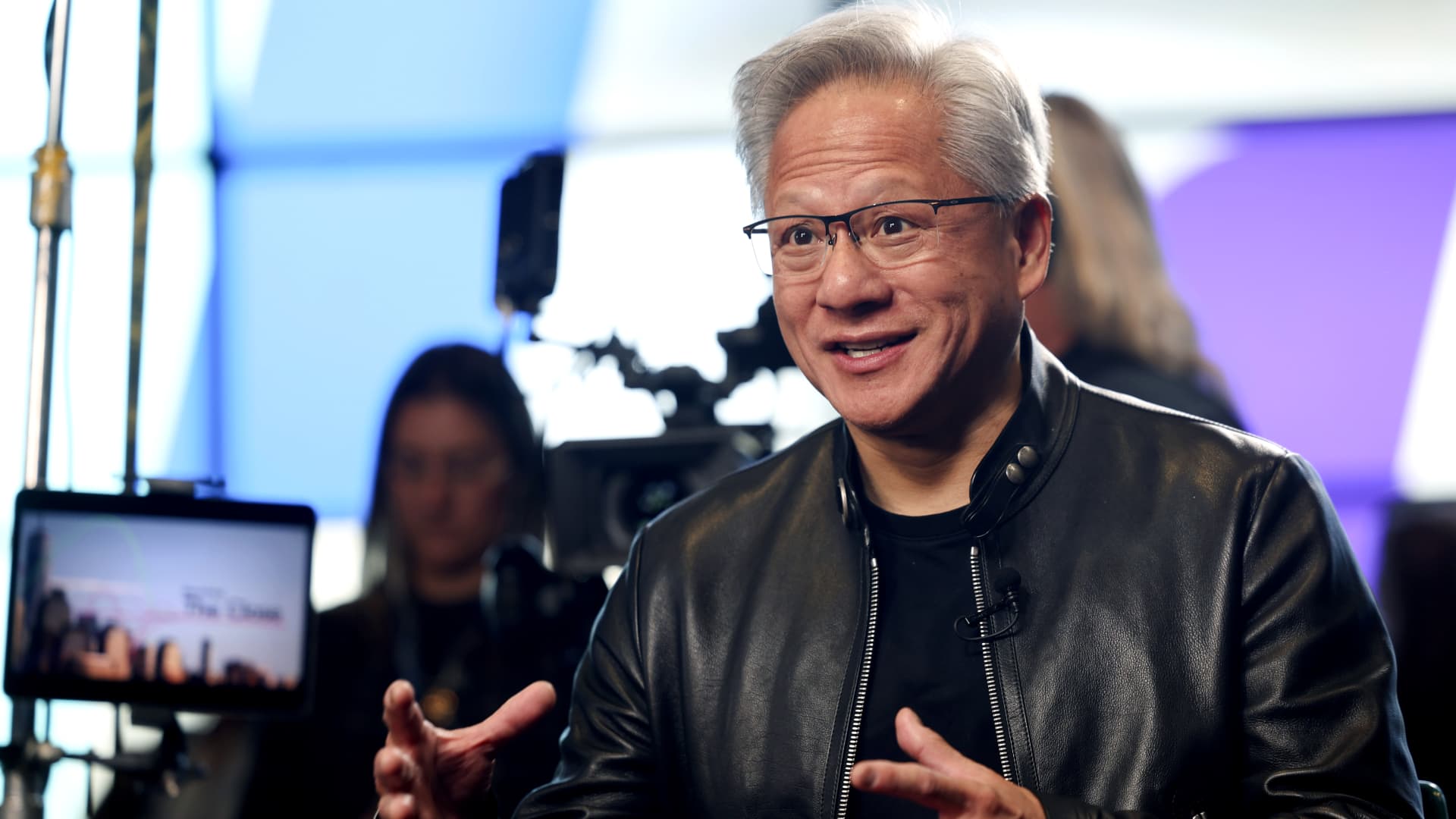
NVIDIA founder and CEO Jensen Huang waves after a welcoming ceremony for US President Donald Trump at the Great Hall of the People in Beijing on May 14, 2026.
Brendan Smialowski AFP | Getty Images
Nvidia CEO Jensen Huang said the company had “significantly conceded” China’s artificial intelligence chip market to Huawei as U.S. export restrictions continue to reshape the global AI semiconductor landscape.
Huang’s comments came as Nvidia reported another blockbuster quarter, with revenue surging 85% to $81.62 billion from $44.06 billion a year earlier. The company also announced an $80 billion share buyback program and increased its dividend.
However, China remained a key flashpoint.
“The demand in China is huge,” Huang told CNBC’s Sarah Eisen. “Huawei is very, very strong. They’ve had a record year and will probably, very likely, have a great year ahead. And their local chip company ecosystem is doing very well because we took that market out.”
“We have essentially ceded that market to them,” he added.
This statement highlights how the US government’s tightening of regulations on the export of advanced AI chips is accelerating the Chinese government’s efforts toward semiconductor self-sufficiency.
The Chinese market once accounted for at least a fifth of Nvidia’s data center revenue. But the Trump administration told Nvidia in April that it needed a license to export chips to China and a handful of other countries, effectively locking the company out of the market.
In an interview with CNBC, Huang struck a cautious tone about the prospect of the Chinese market reopening in the near future, saying Nvidia told investors “not to expect anything” regarding approval to sell advanced chips to China.
The “5-layer cake” of the AI industry
“I don’t have any expectations. That’s why all the guidance, all the numbers, all the expectations we’ve set for our analysts and investors, to invest nothing and not expect anything,” Han said.
Still, he suggested Nvidia remains eager to return if conditions improve.
“We are very happy to be able to contribute to the market,” said Huang. “We have a lot of customers, we have a lot of partners, and we’ve been there for 30 years.”
Huang was a last-minute addition to President Donald Trump’s China summit last week, but the trip gave little clarity on whether Nvidia’s H200 chips would be allowed in the country.
Reuters reported last week that some Chinese companies, including Alibaba, had received approval from the U.S. Department of Commerce to purchase H200 chips. tencentByteDance, JD.com.
Still, the U.S. trade representative said chip export controls were not part of the discussion during last week’s talks with China, suggesting a major easing of sales restrictions from the 2000s may still be a long way off.
Nvidia is also aggressively expanding its supply chain in preparation for what Huang described as significant growth opportunities related to the broader AI economy.
“The idea of building (a) company many times larger is not out of the question,” Huang said, adding that Nvidia is investing heavily across what he calls the “five-layer cake” of the AI industry, spanning energy, chips, infrastructure, models and applications.
Huang said Nvidia’s top priority for its growing cash pile is to support suppliers amid surging demand.
“We’re growing hundreds of billions of dollars at a time, so we need to support our supply chain to help us grow,” he said.
— CNBC’s Sarah Eisen and Katie Tarasoff contributed to this report.

