

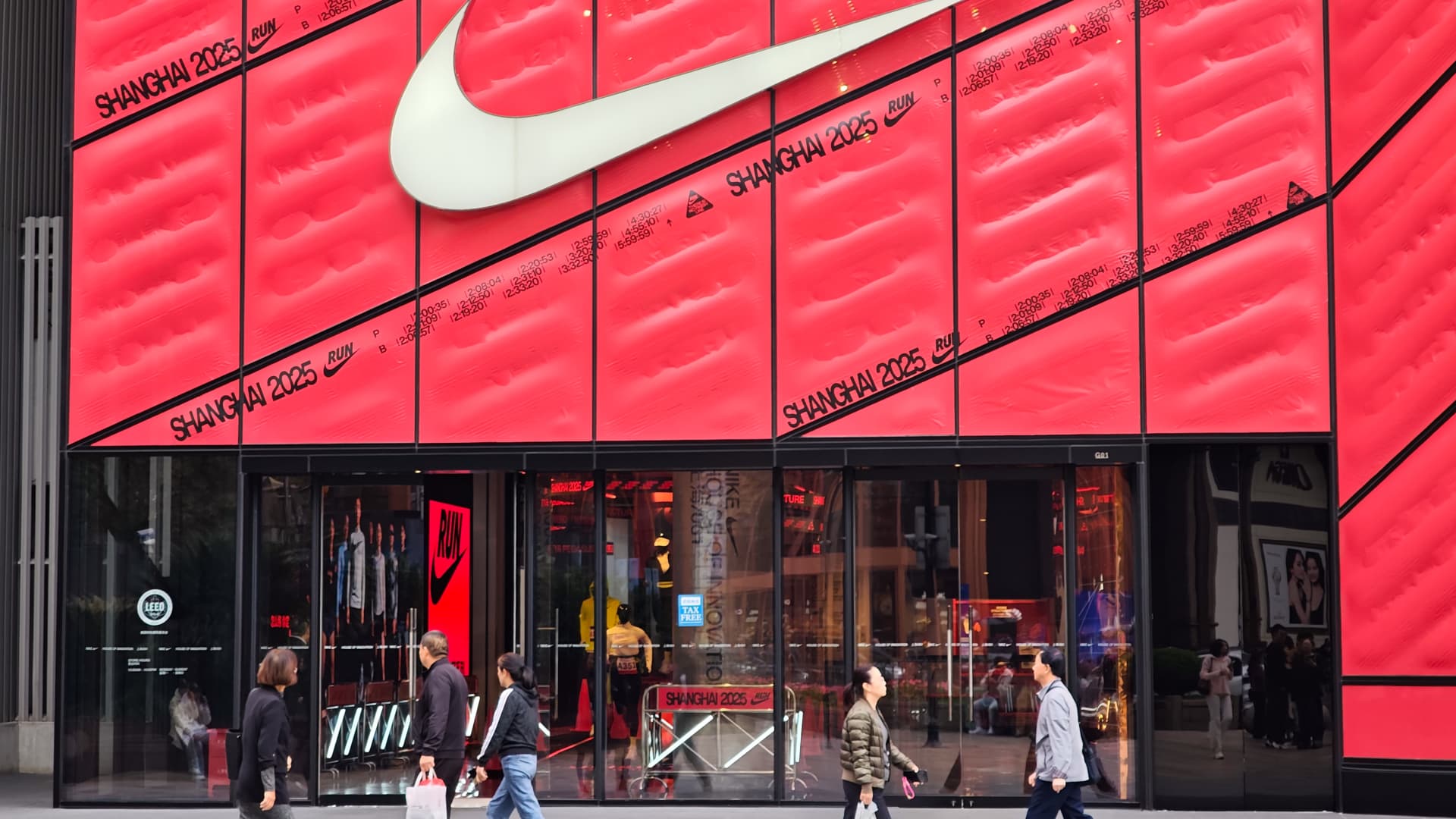
Nike flagship store on Nanjing Road sidewalk in Shanghai on November 4, 2025.
Photo | Future Publishing | Getty Images
nike The sneaker giant plans to close thousands of online retailers in China starting in January, the company announced Tuesday, as it looks to clean up its cluttered digital market and put the region back on a growth path.
Starting next year, Nike’s online presence will primarily shift to the retailer’s official website and app, as well as stores operated on Tmall, Jingto.com and Douyin, which are some of China’s largest online marketplaces and social platforms.
Consumers can now purchase Nike through all of these channels, as well as thousands of other online storefronts leveraging Nike’s network of local brick-and-mortar partners and sub-distributors. While the vast digital network has given consumers widespread access to Nike products, it has also led to inconsistent branding and pricing, hampering the company’s efforts to reverse declining sales in the region.
“These new flagships will serve as Nike’s single elevated destination within these ecosystems, with clearer product presentation, stronger storytelling and more connected consumer behavior,” Kathy Sparks, Nike’s new vice president and general manager for Greater China, said in a letter. “This is about enhancing the platform where consumers start and end their shopping journeys, and ensuring those experiences are direct, consistent and unmistakably Nike.”
“This is not about reducing access; it’s about reducing fragmentation and enhancing consumer behavior,” she said. “Brands are stronger when the experience is consistent.”
Nike’s plan to scale back its online footprint is aimed at creating a better, more consistent experience for consumers and taking back control of prices online. But there are also concerns that this could lead to a significant drop in income in a region that has already shrunk by around 30% over the past five years.
News of Nike’s plan to block online distributors first surfaced late last month in local media reports in China. In response, BNP Paribas equity analyst Laurent Vasilescu wrote that the move was reminiscent of Nike’s unfortunate decision to cut off wholesalers in North America, which contributed to the collapse of market power in the region and a sharp decline in sales and profit margins.
“This strategy gave space to competitors and was disappointing for Nike. We believe the same approach could do the same in China,” Basilescu wrote last month, adding that BNP maintains an underperform rating on the company. “We don’t think Nike has a problem with distributors. Rather, we think it has a problem with product issues that apply to other markets.”
The changes are also expected to hit Nike’s brick-and-mortar partners in the region, which have expanded their online presence in recent years to grow their own businesses.
Still, Top Sports, Nike’s largest distributor in mainland China, said it supported the company’s decision.
“Top Sports has been working with Nike for 27 years, based on the principles of mutual benefit and shared growth,” Yu Wu, CEO of Top Sports, said in a statement. “This adjustment will bring some pressure on our business in the short term. However, in the medium to long term, we strongly believe that this direction will help promote a healthier, more orderly and more sustainable retail ecosystem in China, while further improving the consumer experience and the attractiveness of our products.”
“Looking to the future, we will continue to work closely with Nike, leveraging our strengths in offline retail operations, local consumer services, and deep market development beyond urban demographics,” Wu said. “Through our new concept sports store and high-quality brick-and-mortar retail experience, we will provide Chinese consumers with a richer and more meaningful sports experience.”
