

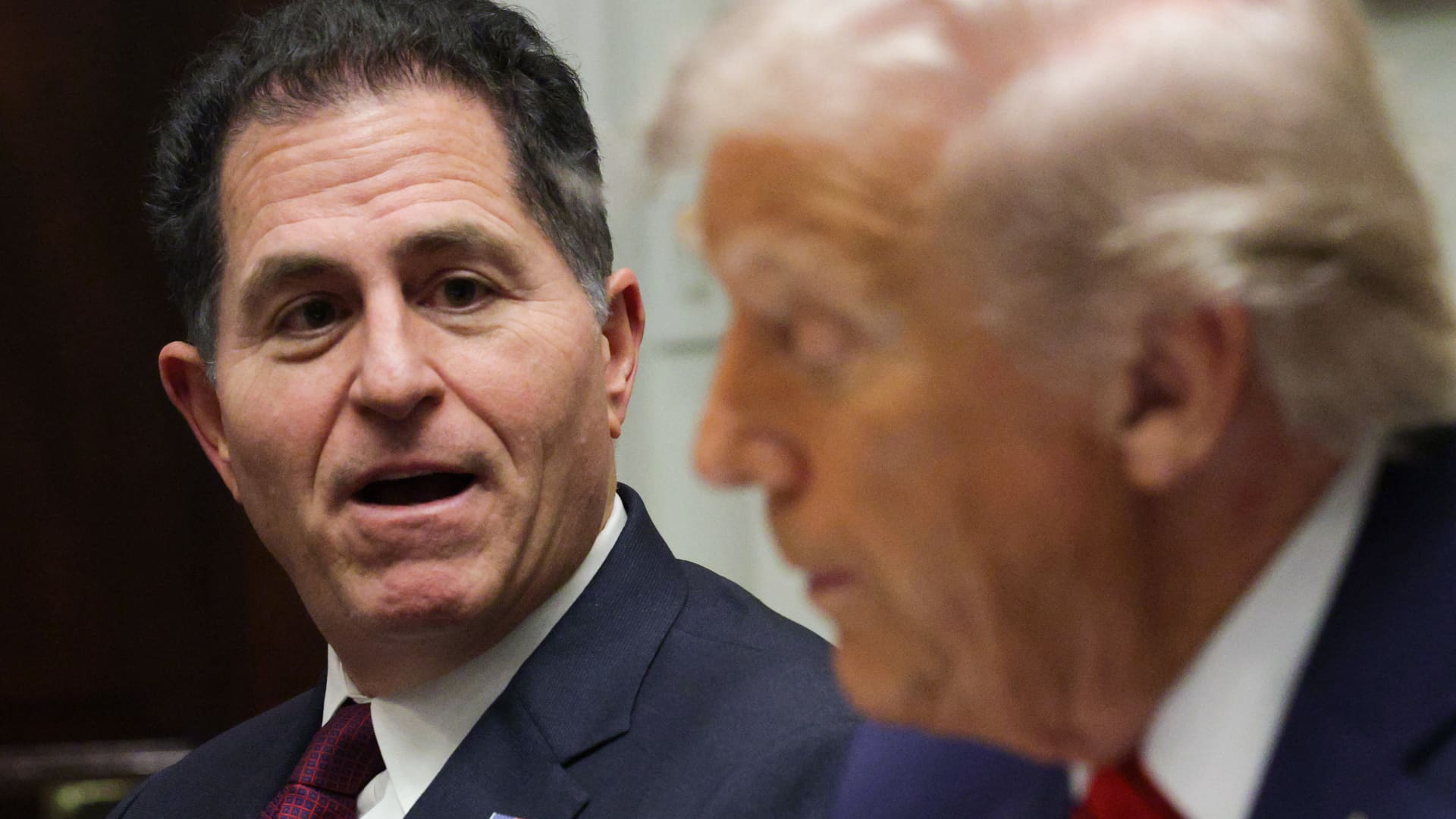
Dell Technologies CEO Michael Dell (left) speaks during a roundtable discussion with US President Donald Trump in the Roosevelt Room of the White House on December 10, 2025 in Washington, DC.
Alex Wong | Getty Images
Michael Dell was an early supporter of President Donald Trump’s second term. Currently, his hardware company is Dell Technologies is coming off its best month on Wall Street since returning to the public markets in 2018.
Since President Trump returned to the White House last year, Michael Dell attended the president’s “American Investment Roundtable” event in June 2025. In December, President Trump introduced the computer executive and his wife, Susan Dell, when he announced a $6.25 billion gift to the Trump accounts of 25 million American children. This month, President Trump advised Americans to “take the plunge and buy Dell.”
On Wednesday, the company won a $9.7 billion contract from the U.S. Department of Defense to provide a suite of software to the U.S. military. The deal was awarded after what the Pentagon claimed was a competitive process, but some experts within the government have doubts about the deal.
The Pentagon contract, awarded to Dell Federal Systems, a company specializing in government affairs, has raised eyebrows as a potential payoff for donations to the Trump account.
“In a word, it looks terrible,” said Greg Williams, director of the Center for Defense Information, part of the Government Oversight Project. “Their very public solicitation of donations for all kinds of projects of the president creates a very strong interest that they are in the business of soliciting donations of various kinds in exchange for access to the president and outcomes that the president can influence.”
The dynamic represents an effort by companies to curry favor with a second-term president, and departs from norms of corporate philanthropy and corporate wooing of the White House.
“What’s new here is that they’re not giving through an intermediary or a nonprofit or some type of intermediary permanent institution, which is how philanthropy typically works,” said Megan Tompkins Stange, an associate professor at the University of Michigan’s Ford School of Public Policy. “Instead, they’re donating directly to this branded effort that bears Trump’s name.”
Even before the agreement with the Department of Defense was signed, Dell Technologies has soared in value, with its stock nearly tripling in the past year. The company is currently valued at over $200 billion.
Michael Dell, the company’s chairman and CEO, was one of the business leaders President Trump turned to in 2017 at the start of his first term. In 2018, five years after Michael Dell and private equity firm Silverlake took Dell private, Dell Technologies went public on the New York Stock Exchange in a reverse merger. Dell expanded in 2016 with the acquisition of data center equipment company EMC.
Trump bought between $1 million and $5 million in Dell stock on February 10, according to a government ethics report. The stock price ended the day at $126.01. He also purchased substantially smaller amounts of Dell stock on three other occasions in March, according to the filing.
Dell Technologies’ stock price began rising in late February after the company announced that its revenue rose 40% year-over-year, the fastest pace since the reverse merger. Executives said AI server sales rose 342% as so-called neoclouds snapped up Dell servers equipped with graphics processing units to run generative artificial intelligence models. The company benefited from higher prices, increasing profits by 47%.
Currently, 3.6% of Dell’s revenue comes from consumers through laptops, desktops, monitors, and webcams.
On Thursday, Dell announced another impressive quarter of results, with total revenue up nearly 88% and AI server revenue soaring 757%. Shares soared 39% to $441.56 in extended trading Thursday night. If Mr. Trump continues to hold the shares he purchased on February 10, he would earn a paper profit of between $1.5 million and $7.5 million.
Excluding Thursday’s after-hours movement, Dell’s stock price has risen about 179% over the past year, while the S&P 500 index has risen 28% and the Nasdaq has risen about 41% in the same period.
Michael Dell founded Dell in 1984. He is Dell Technologies’ largest individual shareholder, with shares worth about $6 billion as of Thursday’s close, according to FactSet.
The Dells were prominent philanthropists even before their donations to the Trump account, starting a foundation in 1999 to help children living in poverty through better health care, education and economic opportunities. Michael Dell told CNBC in December that he was interested in seeding a children’s investment account in 2021 after hearing about the idea from Altimeter Capital’s Brad Gerstner years before the account bore Trump’s name.
While the $6.25 billion gift is consistent with the Dells’ philanthropic priorities, it is significantly larger than any donations they have made in the past. Donations to the Trump account were more than double the foundation’s total donations, a foundation spokesperson previously told CNBC.
Tompkins-Stange, who focuses on the role of wealth, power and philanthropy in influencing public policy, said the donation is a stark departure from the way the Dells and other technology philanthropists often support philanthropy. The Dells’ donations will go to statutory programs and not to nonprofit organizations or other intermediaries.
“Traditionally, many technology philanthropists often want to avoid government programs because they are seen as more bureaucratic and less agile. They would rather use other means of influence,” Tompkins-Stange said.
Susan Dell and Michael Dell attend the 12th Annual Mack, Jack & McConaughey Gala at ACL Live on April 25, 2024 in Austin, Texas.
Rick Kahn | Getty Images
According to Tompkins-Stange, many technology philanthropists prefer to use metrics to measure the impact of their giving and hold nonprofits accountable. Instead, the Dell family is contributing $6.25 billion with the assumption that these investment accounts will grow meaningfully over time, she said.
“This is almost unprecedented in technology philanthropy,” she says. “This is essentially an investment in a long-term strategy with no benchmarks. No one will be evaluating the impact of this money on children on a quarterly basis.”
The White House praised the Dells and their donation.
“President Trump’s sole interest is doing what’s best for the American people,” White House Press Secretary Khush Desai said in an email. “His ardent admiration for the Dells is rooted solely in the more than $6 billion in patriotic contributions to Trump accounts by 25 million working-class American children.”
The Dells continue to grow their endowment, announcing in April that they would donate $750 million to build a new medical campus at the University of Texas at Austin, Michael Dell’s alma mater. The latest announcement brings the couple’s philanthropic commitments to more than $10 billion.
Asked in April why he and his wife made such large gifts in a matter of months, Michael Dell told CNBC that he was able to devote more resources to a long-standing cause.
“The themes we’ve been working on are pretty much the same themes we’ve been working on for decades,” he said in April. “Obviously, the scale has increased because we have a better ability to have a greater impact. It’s probably a lot less complex than that.”
Dell Technologies and the Michael and Susan Dell Foundation did not respond to requests for comment for this article.
According to Bloomberg, Michael Dell’s net worth has nearly quadrupled in the past five years to $196 billion. Most of his profits have come in the past two years thanks to AI-driven tech gatherings.
But Tompkins Stange said donations through the Dells’ foundation have not grown at a pace commensurate with their wealth. She also noted that the donations in the Trump account are made by the Dells, not the foundation.
“This has no buffer between donors and the government, and it’s very closely aligned. It’s very directly tied to the president in a way that we’ve never seen before. I think that’s interesting, because there’s no longer any concern even about the appearance of fraud,” she said.
The administration is also soliciting private investment to fund things like the White House banquet hall, which the president commissioned without Congressional funds or approval. Many major technology companies have donated to the effort.
