

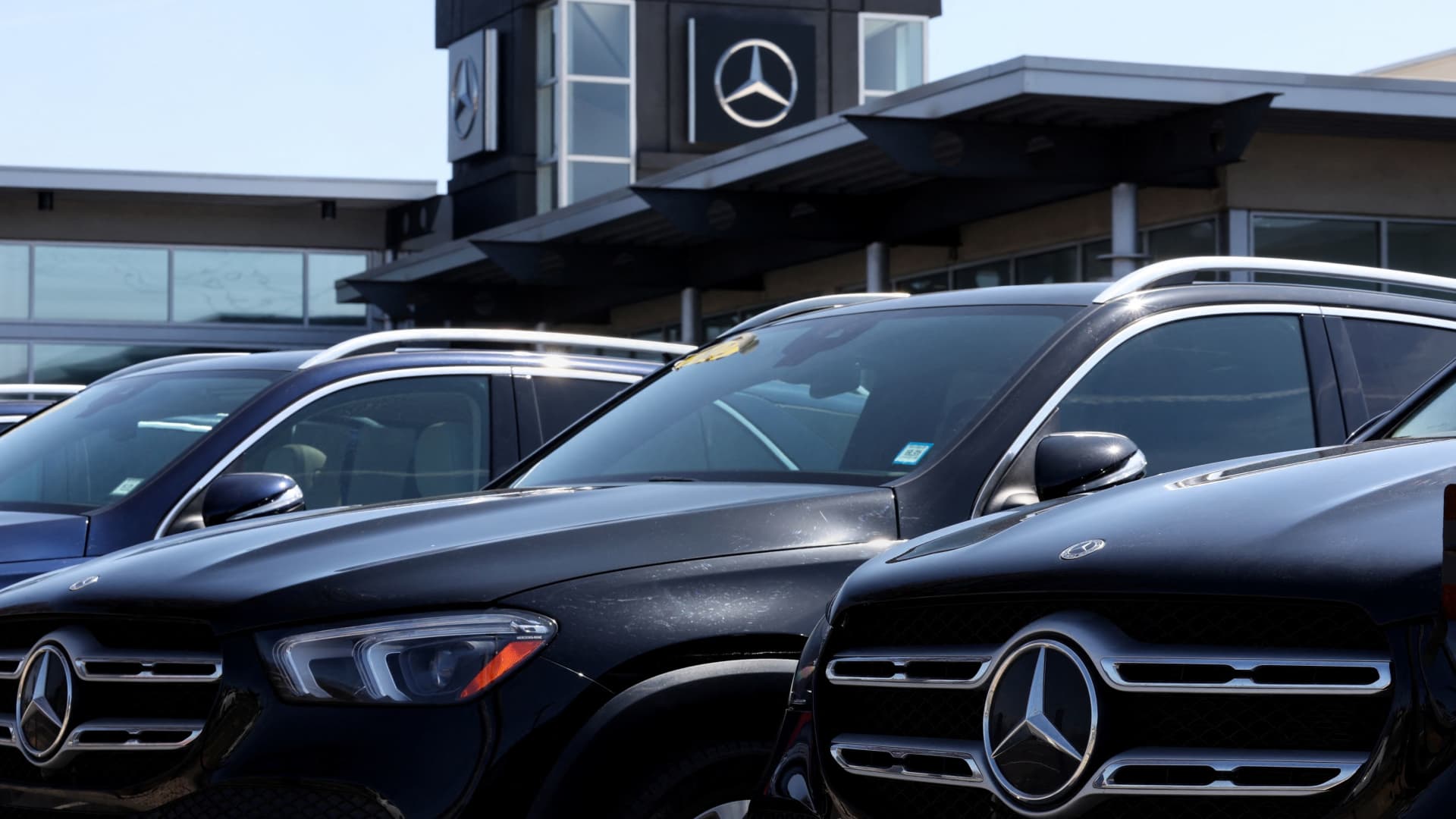
A Mercedes-Benz vehicle is parked at a dealership in Copiague, New York, on April 2, 2025, the day U.S. President Donald Trump is scheduled to announce new tariffs.
Shannon Stapleton Reuter
mercedes benz A bill moving through Congress could lock them out of the U.S. auto market and ban them from manufacturing or selling new cars in the country.
A new bipartisan bill aimed at limiting China’s involvement in the U.S. auto market could trickle down to Mercedes-Benz unless the bill changes or the German automaker’s largest shareholder sells its stake.
The bill, the Automotive Modernization Act of 2026, would prohibit automakers with “direct or indirect equity interests of foreign enemy governments,” such as China, from importing, selling, or manufacturing vehicles for sale in the United States.
Mercedes-Benz’s largest individual shareholder is Chinese state-owned automaker Beijing Automotive Corporation (formerly Beijing Automobile Industry Group), with a 9.98% stake. The potential impact of this law on automakers has not been previously reported.
Several people familiar with the bill spoke to CNBC and cited a gray area in the bill that, depending on interpretation, could ban Mercedes-Benz from operating in the United States.
Two people, who agreed to speak on condition of anonymity because they feared repercussions or were not authorized to speak publicly, said they believe the bill as currently written would ban the company.
“The wording is clear,” said a former auto policy adviser and lobbyist consulted on the bill.
Energy and Commerce Committee Press Secretary Daniel Kelly confirmed the details of the bill. He declined to comment directly on the potential impact on individual companies, including Mercedes-Benz.
A Mercedes-Benz spokesperson declined to comment on the bill, but told CNBC on Friday that the company has two large assembly plants in the United States and employs more than 10,000 people.
Foreign ownership limit
The bill comes as lawmakers from both parties seek to block Chinese automakers from gaining a foothold in the U.S. market, even though Chinese ownership already has infiltrated parts of the global auto industry.
The bill, sponsored by House Energy and Commerce Committee Chairman Brett Guthrie (R-Kentucky), is currently a House-only initiative with no companion in the Senate. It also includes exemptions for Chinese-backed companies, but does not apply if they are directly or indirectly owned by the Chinese government.
Automakers that have manufactured passenger vehicles in the United States for at least five years by January 1, 2026 may be eligible for an exemption. However, the bill states that this exemption does not apply to companies that have a “direct or indirect equity interest in a hostile foreign government.”
China is listed as a foreign enemy along with Russia and North Korea.
The bill would prohibit companies with such ownership from manufacturing, selling, or importing automobiles into the United States for five years after enactment.
It’s unclear where the ownership language came from or whether Mercedes-Benz was unintentionally targeted, but Chinese ownership has become a major concern for U.S. politicians. Last year, the Trump administration signed a deal to continue operating social media platform TikTok in the United States through the creation of a new entity in which China’s ByteDance will retain just under 20% ownership.
BAIC is a Chinese government-owned company, but the bill also includes restrictions on companies that are “controlled” by a foreign adversary, defined as a 15% stake held by “an individual or a combination of foreigners.”
Mercedes-Benz’s second-largest individual shareholder is Chinese billionaire Li Shufu, founder and chairman of China-based Geely Automobile, operating through his Tenashiou3 Prospects investment company. The stake represents 9.69% of Mercedes-Benz’s stock.
Together, Shufu and BAIC own a 19.67% stake in Mercedes-Benz Group AG, the parent company of the automaker and its brands and financial services.
Steven Ezell, deputy director for global innovation policy at the Information Technology and Innovation Foundation, a Washington, D.C., think tank focused on industrial competitiveness that has studied Chinese automakers, said Mercedes-Benz poses less of a national security risk than Chinese-controlled automakers.
“If Mercedes is included in the bill, I think there will be unintended consequences that will lead to the loss of jobs and benefits,” Ezell said.
Another recently introduced law includes a similar 15% ownership provision. The bill, the Connected Vehicle Security Act of 2026, was introduced in the Senate by Sens. Bernie Moreno (R-Ohio) and Elissa Slotkin (D-Mich.), and in the House by Rep. John Moolener (R-Mich.) and Rep. Debbie Dingell (D-Mich.). However, exemptions under this law have not yet been determined.
The 15% ownership clause could also affect other Chinese-owned automakers, including smaller manufacturers such as Volvo, Faraday Future, Lotus and Karma Automotive, depending on exemptions.
“Details matter”
Mercedes-Benz’s largest factory in the United States is located in Tuscaloosa, Alabama. The company announced Friday that the massive facility has produced more than 5 million vehicles since production began in 1997. The company also says it has produced more than 450,000 passenger vans at its South Carolina facility, which began production in 2006.
German automakers’ lobbying efforts have been minimal and bipartisan in recent years, according to public records, but they also lobby through at least two trade associations for automakers to which they belong.
Automotive Innovation Alliance CEO John Bozella said in a letter to Mr. Guthrie and Energy and Commerce Rep. Frank Pallone (D.N.J.) last week that the bill represents “significant progress on several policy priorities that the U.S. auto industry shares with committee members.”
Bozzella wrote that China’s strategy to “dominate global auto manufacturing” poses “a clear and present danger to the U.S. economy and national security.”
He said the organization representing nearly every major U.S. automaker will continue to work with lawmakers to get policy right, adding that “details matter.”
The lobbying group declined to comment on the bill’s potential impact on specific automakers.
Auto’s Drive America, another lobbying group for foreign automakers including Mercedes-Benz, also declined to comment on its potential impact, pointing to previous statements about the Connected Vehicle Security Act that it supports the “overall goals of this bill” while ensuring “it does not cause unintended consequences that could pose challenges to U.S. manufacturing.”
The new bill adds to previously enacted restrictions on the import and sale of connected cars with software from countries such as China starting with the 2027 model year and hardware from those countries starting with the 2030 model year.
Connected cars have internet access and wireless connections to other cars and trucks, and supporters say the technology can make roads safer.
Volvo, which is majority owned by Shufu’s Geely Automobile, said on Tuesday it had received special permission from the U.S. government to circumvent a federal ban restricting connected car software and hardware linked to China.
Volvo acknowledged the special powers but did not immediately respond to questions about the other bills and their potential impact on the company.
Volvo Cars sold 121,600 vehicles in the United States last year. Mercedes-Benz sold 303,200 passenger cars and 12,400 vans domestically during the same period.
