

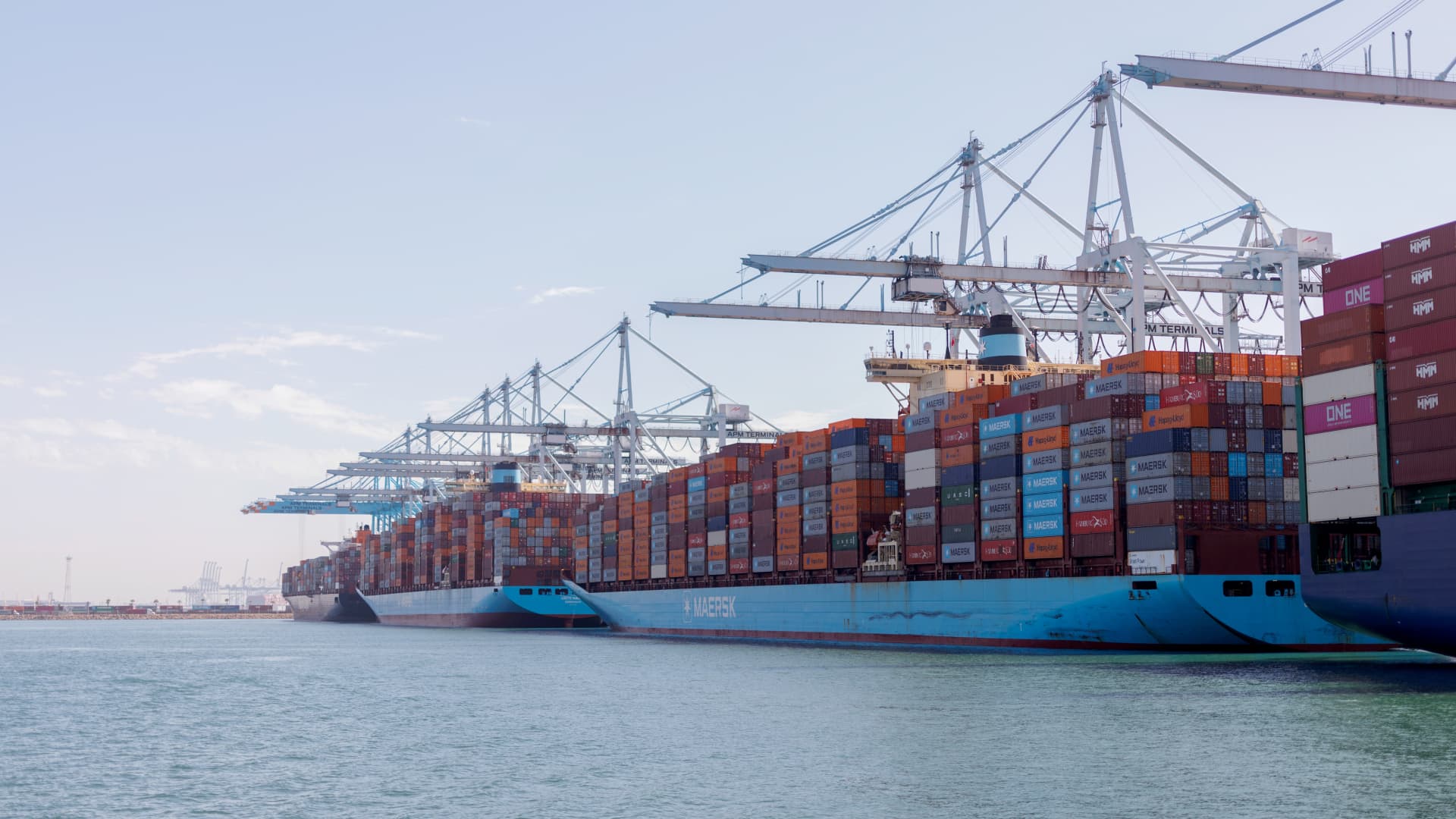
Maersk and HMM container ships dock at the Port of Los Angeles on Wednesday, September 24, 2025 in Los Angeles, California, USA.
Bloomberg | Bloomberg | Getty Images
The war between the US and Iran has triggered a “new alarm” for global trade. maersk Chief Executive Officer Vincent Clair warned on CNBC on Thursday that the impact could worsen in the coming months.
Speaking on CNBC’s “Squawk Box Europe” after Maersk released its first-quarter results, Clark said the group faces intense cost pressures that must be passed on to customers.
Maersk shares were recently trading down about 7.2%, narrowing their earlier decline. After Maersk reported a sharp decline in profitability, Clark gave an interview to CNBC in which there was no change in guidance but warned about the impact of ongoing conflicts in the Middle East.

maersk stock
“We are a very energy-intensive industry, and that creates a whole new situation that we now have to deal with,” he said. “That will have a significant impact on the second and third quarters.”
Oil prices have soared as the Middle East war intensifies, and prices remain elevated due to continued uncertainty surrounding the closure of the Strait of Hormuz. There are also growing concerns that rising oil prices will lead to higher inflation rates in many countries.
On Thursday, global benchmark Brent crude oil futures fell 2.2% to $93.01 per barrel amid hopes that Washington and the Iranian government are close to agreeing a peace deal.
“What this energy shock means is that as long as oil remains near $100 a barrel, it will cost us about $500 million more every month. That’s significant,” Clark told CNBC. “There’s a lot we can do to reduce costs, but there’s a lot we need to do to pass those costs on to our customers, because it’s just too much of an increase in costs that we can’t bear.”
He added that the conflict raises questions about how long the shipping industry and consumption can remain resilient.
“As some of these costs reach the end consumer, will we see demand destruction at the consumer level? And will that ripple through the supply chain, causing demand to slow down in the second half of the year?” he asked.
“That’s certainly something we’re watching very closely because it suddenly changes the equation of how this crisis impacts global supply chains, especially our industry.”

The Danish company, widely considered a global trade bellwether, reported earnings before interest, taxes, depreciation and amortization (EBITDA) of $1.75 billion for the first three months of this year.
This was down 35% year-over-year, but in line with consensus estimates compiled by LSEG.
Sales decreased 2.6% from the previous year to $13 billion, exceeding expectations of $12.5 billion. Maersk said the downturn was due to pressure on the marine sector from lower freight rates and higher costs due to increased volumes.
About a week into the Iran war, Maersk suspended two major shipping routes connecting the Middle East, Asia and Europe. The decision was made to protect personnel and ships.
The shipping giant kept its full-year outlook unchanged, saying it expected real EBITDA growth in 2026 to be in the range of 4.5% to 7%. It said its outlook reflected industry overcapacity due to new ship deliveries and different scenarios for when the Red Sea and Strait of Hormuz would reopen this year.
However, Maersk reiterated the impact of the Iran war on its business and the global economy and called for efforts to strengthen its supply chain.
“Geopolitics is a dominant force shaping the macroeconomic outlook and the trade and logistics environment,” the company said in its earnings release, adding that the Iran war had brought “additional uncertainty.”
The Strait of Hormuz, a key waterway for commercial shipping, has been effectively closed since the conflict began on February 28.
“There is currently a fragile ceasefire in place in both Iran and Lebanon, negotiations are progressing slowly, and traffic in the Strait of Hormuz remains at a near-standstill. The conflict is already weighing on sentiment and consumer confidence has deteriorated,” Maersk said on Thursday.
The company said that even if oil prices remain in the range of $90 to $100 per barrel through 2026 and the dispute is resolved soon, global container demand is still expected to grow by 2% to 4%.
However, it added that the balance of risk is “toward the downside and the possibility of further adverse outcomes cannot be ruled out.”
“Energy and transportation disruptions in the Strait of Hormuz are rapidly reshaping global supply chains,” the shipping giant added in the report. “Following recent tariffs on U.S. imports, this dispute represents another wake-up call to implement new tools to strengthen supply chain resilience and develop new strategies to mitigate future disruptions.”
