

Hope has returned to five people trapped deep inside a flooded cave in Laos. For more than a week, they huddled in a dark, muddy stream more than 260 meters from the cave entrance, wondering if anyone would ever find them.
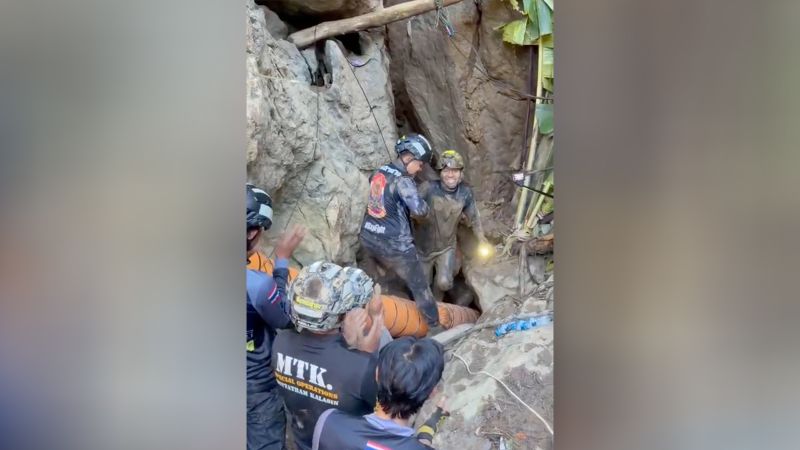
Help finally came on Wednesday, after days of starvation, when rescuers emerged from the darkness and illuminated the narrow, rocky cave with headlamps.
“There are people here now who are here to help,” said Norased Parasin, a professional cave diver from Thailand and part of the multinational rescue team fighting against the heart-stopping hours.
“What’s important is that you’re alive. It’s okay, it’s okay, you did a great job. Don’t cry.”
One of the trapped men, whose name was Ing, told the rescue team’s camera: “Don’t worry, mom. The rescue team has arrived. We’re safe. We miss mom and dad very much. We’ll be able to get out tomorrow or the day after.”
Celebrations spread to the ground as desperate loved ones and rescue workers rejoiced that they had survived the dangerous search.
Finnish diver Mikko Persi, who is taking part in the operation, toasted the team’s “amazing job” in an Instagram post.
But he warned that a high-stakes withdrawal lay ahead and “it will not be easy.”
According to an investigation by the US think tank Stimson Center, Laotian officials said five people entered the cave last Wednesday, lured by the promise of gold deposits, a speculative object that has proliferated in recent years.
Torrential rain caused flash flooding in the cave, blocking the men’s exit. The remaining two people are believed to have entered the cave first, unrelated to the five, and are still missing.
On the ground, a Laotian-led rescue operation quickly took shape. After news of the men’s disappearance spread, the internationally renowned A-Team of cave divers rallied in the landlocked Southeast Asian country, according to Bungkham Luangras, president of the Lao People’s Volunteer Association.
Among them were Kenkad Bonkawon from neighboring Thailand and Paasi from Finland. It was a reunion of sorts for the brave divers. Eight years ago, both played a key role in a dramatic Thai cave rescue that ultimately saved 12 boys and their soccer coach.
In what is now a hot and humid early summer in Laos, their team trekked four kilometers through dense jungle to search for the missing man, about 55 kilometers east of Vang Vieng, a lush and scenic backpacker hotspot.

Confined spaces and toxic gases
One piece of good news for the team is that the players are on a high ledge “benefiting from continuous airflow,” according to the state-run Lao News Agency.
Another is that, apart from severe starvation, the men generally seem to be in good health.
But beyond that, rescue workers face countless challenges as they try to extricate people from the cave, whose entrance slopes downward at a 45-degree angle.
Kenkado said the length of the rope rescuers used to search for the group indicated they were at a depth of about 260 meters.
“It’s so narrow that you have to lean sideways, crouch low and crawl on your belly to get through,” he added.
To get inside, his team navigated muddy passageways and underground streams, using cables to guide their way. Sometimes they just put their heads and shoulders above the water, other times they slipped through the cracks without their gear.
Video footage showed the team climbing up the shaft using ropes and crawling through tunnels that were at times narrowed to just 60 centimeters, the width of an average refrigerator.
One of the recent issues is hydrogen sulfide. Hydrogen sulfide, a foul-smelling gas produced by decomposing bat droppings indoors, caused some crew members to faint, Kenkado told CNN.

Rescuers say the best option is to drain the cave so the five people can crawl out.
“There were rooms along the route they were taking where people could stop and rest. The victims know that if the water level rises, they will have to evacuate to a safer location,” Kenkad said.
Because air is limited along the route, Kenkad said oxygen tanks will be needed, as well as specially adapted cave stretchers in case the villagers become too weak.
“If we can pump out all the water, we might be able to get everyone out today,” he told CNN on Thursday.
Excavation teams stationed several kilometers from the cave have been working in recent days to build an access route, said Bunkam, whose volunteer association was appointed by the government to oversee the mission.

The goal is to set up a large generator as close to the entrance as possible on Thursday, while pumping water, food and medicine inside for the trapped group.
“If successful, we could be able to pump water out of the cave more quickly and potentially halt backup plans that would have forced victims to jump,” Bunkam told CNN.
“It would be very difficult for them to do that.”
It is difficult to overstate the remoteness of operations in Laos.
The cave is located in central Saisombun province, an hours-long drive from the nearest city over muddy roads during the rainy season. Rescuers with all their equipment had to walk four kilometers over difficult terrain to reach the cave entrance.
Remarkably, the cave team communicates via a LAN internet cable that they have managed to reach deep into the cave, giving clear instructions for people not to cross paths on one-way streets.
In this regard, Khengkad said he gained confidence from his experience conducting a cave rescue in northern Thailand in 2018.
At the time, a young soccer team was trapped deep in the Tham Luang Nang Nona cave system in northern Thailand’s Chiang Rai province for 18 days after it was similarly flooded by similar heavy rains.

“I observed the operational structure used in Tham Luang and adopted the same system here,” he said.
When the five villagers come out of the cave, their recovery begins.
Throughout their ordeal, they ate, slept, and survived entirely within the cave, so their health and memory will need to be evaluated once they resurface.
Their families are still missing and waiting for news.
