

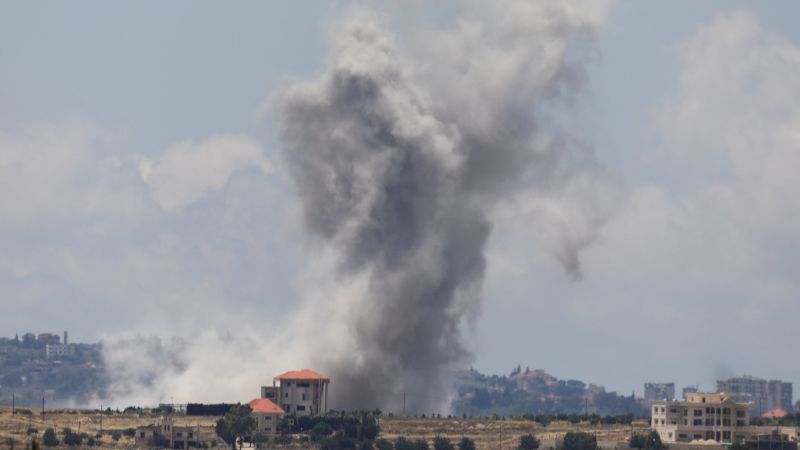
Israeli forces have captured the Crasaider-era Beaufort Castle in southern Lebanon, which they have not occupied for 26 years, as they further expand their incursions into neighboring territory.
The capture of the castle, located near the city of Nabatieh and about 9 miles (14.5 kilometers) from the Israeli border, came after several days of heavy fighting in the area.
“This operation is focused on establishing operational control of the Beaufort Ridge and Wadi al-Saluki areas,” an Israel Defense Forces (IDF) statement on Sunday said, adding that it aimed to dismantle Hezbollah infrastructure in both areas.
Built by the Crusaders some 900 years ago on a high cliff overlooking the Litani River, the castle has long been considered a strategic stronghold in southern Lebanon and was occupied by Israeli forces in past conflicts.
“The operation began several days ago, during which a significant number of IDF ground soldiers launched offensive operations aimed at expanding the front line of defense,” the IDF said.

“Hezbollah terrorists controlled military and combat operations from Beaufort Ridge and carried out numerous attacks,” the report said.
On Saturday, Lebanese state news agency NNA reported Israeli air strikes and “heavy shelling” in the area around the castle. Hezbollah also claimed to have destroyed an Israeli tank near the castle.
Three days ago, the city of Alnoun condemned Israeli bombing in the area and called on international organizations to protect the castle, NNA reported.
“This is a clear message to our enemies: Those who threaten Israeli civilians will lose their strategic assets one by one,” Israel’s Defense Minister Israel Katz said on Sunday.
And Israel’s far-right Finance Minister Bezalel Smotrich said he would “continue to demand and promote the principles of permanent territorial control and exceptional military strikes…For every drone that explodes, 10 buildings in Beirut must collapse.”
Beaufort Castle has been rated by UNESCO as “one of the best-preserved examples of medieval castles in the Near East.” It was also one of 34 Lebanese cultural properties granted interim enhanced protection (the highest level of immunity against any attack or use for military purposes) by UNESCO at the end of 2024 after Israel’s ground invasion of Lebanon.
The castle was the site of fierce fighting between Israeli forces and the Palestine Liberation Organization during Israel’s occupation of southern Lebanon in 1982. According to UNESCO, it suffered “significant damage” during the 18-year occupation before Israeli forces withdrew in 2000.
Clashes between Hezbollah and Israeli forces have escalated despite a US-brokered ceasefire between Israel and the Lebanese government in April.
Israel has expanded its operations in recent days, moving deeper into Lebanese territory, with Prime Minister Benjamin Netanyahu announcing on Friday that Israeli forces had crossed the Litani River, which runs about 15 to 20 miles (30 kilometers) north of the Israeli border.
The IDF said in a statement on Sunday that it had expanded “operations against Hezbollah targets north of the river” and “additional areas.” In recent days, a series of evacuation orders have been issued for villages north of the Litani River.
Escalating fighting between Israel and Hezbollah could jeopardize the agreement between the United States and Iran, which claims to include a ceasefire in Lebanon. US President Donald Trump told Netanyahu last week that he supports “freedom of action against threats on all fronts, including Lebanon,” an Israeli official told CNN.
CNN’s Eugenia Yosef, Eyad Kurdi and Tim Lister contributed reporting.
