

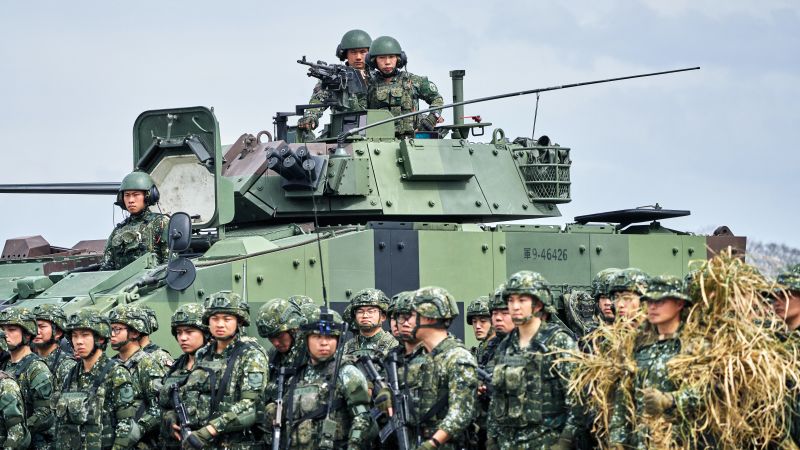
Following a summit between US President Donald Trump and Chinese leader Xi Jinping earlier this month, there has been a big focus on US support for Taiwan and arms sales to the US government.
On the first day of the talks, President Xi issued a stern warning to the US side that Taiwan, the most important unresolved issue between the US and China, could become a “very dangerous situation” if not handled properly.
President Trump has delayed signing a $14 billion arms deal with Taiwan that was recently approved by Congress, claiming it is a “very good bargaining chip” in negotiations with Mr. Xi.
Meanwhile, acting US Navy Secretary Hung Kao said the deal was delayed because the Pentagon is making sure it has enough weapons to fight a war with Iran.
But Taiwan’s Ministry of Defense said last week that it had not received any notification from the United States about any delays in arms sales.
Amidst the confusion and contradictory statements surrounding the issue, here is an overview of the process and laws governing U.S. military sales to Taiwan, a democratically governed island of 23 million people that Beijing claims as its own.
Mr. Xi has not ruled out using force someday to take control of Taiwan.
The United States is bound by Congressional legislation to provide Taiwan with the means to defend itself.
In 1979, the administration of US President Jimmy Carter switched diplomatic recognition from Taipei (whose government is still officially called the Republic of China (ROC)) to Beijing, known as the People’s Republic of China (PRC). This move ended the Mutual Defense Treaty between Washington and Taipei, much to the chagrin of the US Congress, which quickly passed the Taiwan Relations Act asserting its role in cross-strait relations.
Congress believed Carter had gotten a “bad deal,” according to the Brookings Institution think tank.

“They felt that Mr. Carter had left Taiwan extremely vulnerable by acceding to China’s demands to sever diplomatic relations with Taiwan and abandon the mutual defense treaty,” Brookings said.
The Taiwan Relations Act stipulates that Taiwan’s future must be determined by “peaceful means” and that the United States shall provide Taiwan with “weapons of a defensive nature that will enable it to maintain an adequate self-defense capability.”
Last week, Pentagon Chief Press Secretary Sean Parnell said, “Our Taiwan policy remains unchanged, and the United States remains committed to our long-standing commitments under the Taiwan Relations Act.”
A joint U.S.-China communiqué issued in 1982 states the U.S. intention to gradually and ultimately reduce arms sales to Taiwan until a peaceful resolution is reached, but while U.S. officials have long disputed this idea, China interprets this language as a binding commitment and has stressed that the U.S. has never agreed to set a date to end such sales and will not consult with China beforehand.
Since 1979, Taiwan has purchased tens of billions of dollars of U.S. military systems, ranging from big-ticket items such as destroyers, frigates, fighter jets and main battle tanks to smaller items such as anti-aircraft and anti-tank missiles, computer systems and logistics support.
However, few people quickly reached the island.
“Defense sales often take years to complete, and in fact, may never reach full delivery,” said Jeff Abramson, senior adjunct fellow at the Center for International Policy.
“Typically, weapons are not already manufactured when they are first sold; they are ordered, and the timing of their delivery may depend on industrial production capacity, the U.S. military’s need for the weapon, which may be prioritized, others who may receive the weapon with higher priority, or simply because circumstances have changed between order and delivery,” he said.
In Taiwan’s case, this has resulted in a significant backlog of approximately $30 billion in undelivered weapons, according to an April 2026 report from George Mason University’s Taiwan Security Monitor (TSM) project.
TSM assistant director Joe O’Connor detailed several deals that have either been completed this year or have been delayed for years.
He said an order for 291 small ALTIUS-600M loitering weapons built in 2024 was completed in 21 months, while an order for 108 Abrams tanks built in 2019 took 81 months to fulfill, with the final units arriving in Taiwan last month.
And Taipei is still awaiting delivery of the F-16 jets it ordered in 2019, with production and flight testing only recently beginning, O’Connor said.
Taiwan’s Ministry of Defense announced that as of April this year, five of the 23 major US arms sales over the past 10 years had been fully delivered. Three items have been partially delivered and the remaining 15 items are still in production.
Weapon systems delivered in the past decade include TOW-2B and Javelin missiles, main battle tanks, Phalanx naval defense systems, and fuel tankers.
There has been growing debate within Taiwan in recent years that Taiwan’s military procurement is overly focused on expensive, big-ticket items that take far too long to produce and could be vulnerable to China’s much larger and better-equipped military.

Instead, many are pushing for a so-called “Porcupine Strategy,” in which Taiwan employs domestically designed, cheap and easy-to-produce asymmetric weapons such as drones and anti-ship missiles.
According to TSM’s report, domestic production of asymmetric weapons could be a possible solution for Taipei, as the backlog of weapons deliveries is almost evenly split between asymmetric weapons and traditional weapons.
Raymond Green, the de facto US ambassador to Taiwan, previously said there was a “miscommunication” about the extent of the delays and that the “vast majority” of current delays are related to the F-16V program.
Trump’s recent delay in signing the $14 billion deal has had little impact on Taiwan’s military preparedness, analysts say, citing such a diverse and long-standing delivery record.
The agreement appears to focus on air defense and counter-drone countermeasures, and includes systems such as the Patriot missile and the National Advanced Surface-to-Air Missile System.
These are systems of great value not only to the U.S. military but also to allies and partners around the world, O’Connor said, and President Trump’s delays could put Taiwan’s order on the back burner.
As a result of the war with Iran, the United States, Israel, and many U.S. allies in the Gulf region have depleted their own expensive anti-aircraft missile batteries, often attacking relatively inexpensive Iranian drones, and these stockpiles will also need to be replenished.
However, in any case, it is likely that the Patriot will not be delivered for several years. Analysts say this is a harbinger of a U.S. arms production crisis that will affect all customers.

The production lead time for the advanced PAC-3 MSE interceptor is 24 months for the missile and 30 months for the solid rocket motor, according to a paper by the Foreign Policy Research Institute.
“Such a schedule is due to physical industrial constraints, such as the long curing times required for solid rocket motors and complex processes that can take years to qualify new component suppliers,” the paper says.
This means that even if President Trump were to approve the deal today, Taiwan would not be able to field new Patriots until 2028 at the earliest.
“Even emergency responses proceed at a pace that is strategically meaningless in the short term,” the FPRI paper states.
O’Connor said an area where signing delays could pose a more pressing problem is in planning, where anticipated arms purchases are embedded in reform and modernization efforts.
He also noted that delays in orders for new weapons will not affect those already under contract, and that “contracts appear to continue regardless of whether future sales are paused.”
Of course, it is subject to change at any time. As the acting secretary of the Navy pointed out in a Congressional hearing, the United States needs to replenish its weapons stockpile depleted by the Iran war. Taiwan will probably put that on the backburner.
Abramson said at CIP that the circumstances that govern the importance of weapons packages will change over time.
“As with almost all situations, other activities to de-escalate the situation will have a greater impact than the delivery of weapons,” he said.
CNN’s Wayne Chang contributed to this report.
