

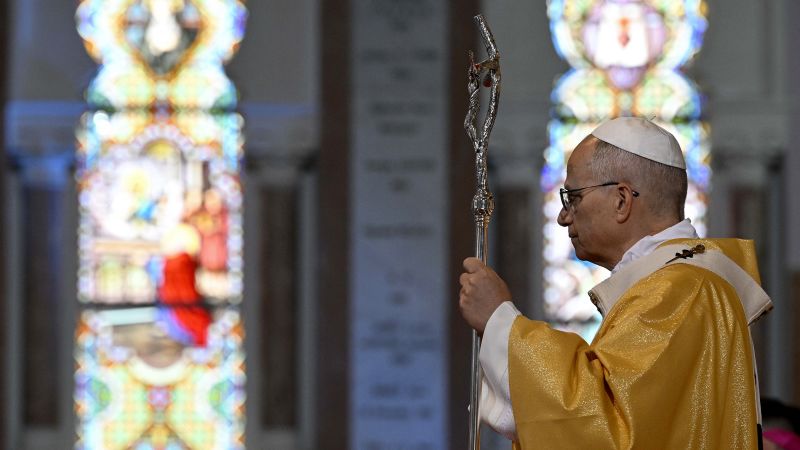
On Monday, Pope Leo, who was flying to Algeria at the start of a landmark African tour, had a choice. We can either ignore Donald Trump’s extraordinary social media attacks overnight, or we can tackle them head-on.
In the end, he chose the second option and took the highly unusual step of criticizing the Trump administration. Speaking to reporters on the papal plane, the pope said he was not afraid of the regime and would continue to strongly oppose war.
“I don’t believe the message of the gospel should be abused as some people are doing,” he said, adding, “Too many innocent lives are being lost…I believe someone has to stand up and say there’s a better way.”
Leo’s comments define him as Trump’s most visible international challenger and set off an unprecedented clash between the first American pope and the American president, who has launched repeated broadsides against him.
But the Chicago-born pope, known for his gentle, understated style, chose not to fight this battle. Having spent much of his adult life in the Order of St. Augustine, whose monks and nuns emphasize unity and community and take vows of poverty, chastity, and obedience, his priorities are unity and bridge-building.
Rather than coming into office with a rapid succession of executive orders and news-making initiatives, the pope has spent much of his first year in office listening to people and making gradual changes. He also emphasized the importance of multilateral institutions such as the United Nations and respect for international law, as the US president has indicated that he is not bound by the norms of international law.

See in photos: Pope Leo’s visit to Africa
Although he is more reserved than his predecessor, Pope Francis, the U.S. military operation in Iran brought out Leo’s inner steely spirit and willingness to be outspoken. He chose to personally mention Trump by name — something popes rarely do. Although he did not name other members of the Trump administration, his comment that “God does not listen to the prayers of those who wage war” seemed to hint at U.S. Secretary of Defense Pete Hegseth’s eagerness to frame the Middle East conflict in religious terms.
Popes calling for peace and opposing war are not new. Pope John Paul II strongly opposed the 2003 US-led invasion of Iraq. But things are different for the American pope. Pope Leo XIV speaks English as a native language, something he hasn’t done since the 12th century, and his words reached American audiences, the White House, and beyond. Leo is also known in the Vatican for his “poker face.” There is a certain inscrutability about him that makes his words difficult to read, and his careful, deliberate style perhaps gives his words more weight.
During his time in Africa, Leo continued to speak out, saying his stay in Africa provides a message of peace that the world needs to hear. At a peace conference in Bamenda, Cameroon, Leo gave a speech that had global impact.
“The world is ravaged by a handful of tyrants, but held together by many cooperative brothers and sisters,” he said.
“Woe to those who manipulate religion and the very name of God for their own military, economic, and political gain, and drag what is sacred into darkness and filth.”
Tensions between the Pope and President Trump have been gradually dissolving even before the latest clash. Last year, before the conclave to elect Pope Leo, the president caused an uproar by posting an AI image of himself as the Pope. There, there was an echo of an AI image President Trump posted and later deleted depicting himself as Jesus-like shortly after attacking the Pope. It’s also surprising that, even though the cardinals elected the first American pope in the Catholic Church’s 2,000-year history, President Trump – as far as public records show – has not had direct contact with Leo since then.
Instead, Vice President J.D. Vance, who became Catholic in 2019, attended Leo’s inauguration and handed him an invitation to visit the United States. The Vatican has announced that the pope will not visit the United States in 2026 and will instead spend July 4, the 250th anniversary of American independence, on the southern Italian island of Lampedusa, a major landing point for migrants. It is difficult to imagine the Pope returning to the United States while President Trump is in office.
On Tuesday, Vance echoed the controversy, saying the pope needs to be “careful” when talking about theology and keep the “just war” theory in mind when talking about the Iran war.
Vance’s reference to just war theory is impressive. This teaching, developed over centuries, is frequently used by military analysts as an ethical and moral standard for armed conflict. One of its main architects is St. Augustine of Hippo, the spiritual father of the Catholic order to which Leo belongs. While in Algeria, the pope made a personal pilgrimage to the places where Augustine was bishop in the late 4th and early 5th centuries, and noted that the people did not see the war in Iran as justified.

In an editorial published the day after Vance’s remarks, Vatican News argued that Catholic teaching has “demonstrated how difficult it is to claim that there is a ‘just war'” in recent decades, especially in the “atomic age.”
Editor-in-chief Andrea Tornielli argued that Leo XIV, while “faced with the madness of escalating conflict and unwarranted spending on rearmament,” continues to walk “along the path blazed by his predecessors, calling for peace, dialogue and negotiation with both realism and prophetic clarity.”
“Empires come and go”
But Vance’s criticism of the Pope is likely to be taken more seriously by the Vatican. A convert to Catholicism, he has already used the teachings of St. Augustine to defend the Trump administration’s crackdown on immigration. Meanwhile, Leo has criticized the treatment of immigrants in the United States.
“From the time he entered the church, Vance has been aligned with a cadre of far-right philosophers, theologians and commentators who claim to be the true interpreter of Augustine’s City of God,” Catholic author and scholar Dawn Eden Goldstein told CNN.
She said Pope Leo’s “undeniable expertise in Augustinian thought poses a direct threat to the vice president’s and his postliberal friends’ efforts to present themselves to Catholics as an authoritative interpreter of the church’s social and political teachings.”
Leo became pope just months after Trump’s reelection as president. Previously, the idea of having a pope from the United States was considered impossible because the cardinals did not want an alliance between the church and the world’s dominant powers. But Trump’s return to the White House has changed the cardinals’ view of the United States on the world stage. It opened the door to breaking with tradition, and Robert Prevot’s long experience in Latin America made him an attractive figure.
This historic decision was similar to that of the 1978 conference that elected John Paul II. The first Polish pope, and the first non-Italian pope in 400 years, was elected at the height of the Cold War and later played a key role in the collapse of communism in Eastern Europe.
“This incident reminds us of Harold Macmillan, who said that of the three institutions no reasonable person should attack, it’s the Vatican,” said Gerald O’Connell, Vatican correspondent for Catholic media outlet America Magazine and an experienced observer of church affairs. “I think the Vatican is aware of the rise and fall of empires and views this through the lens of history.”
