

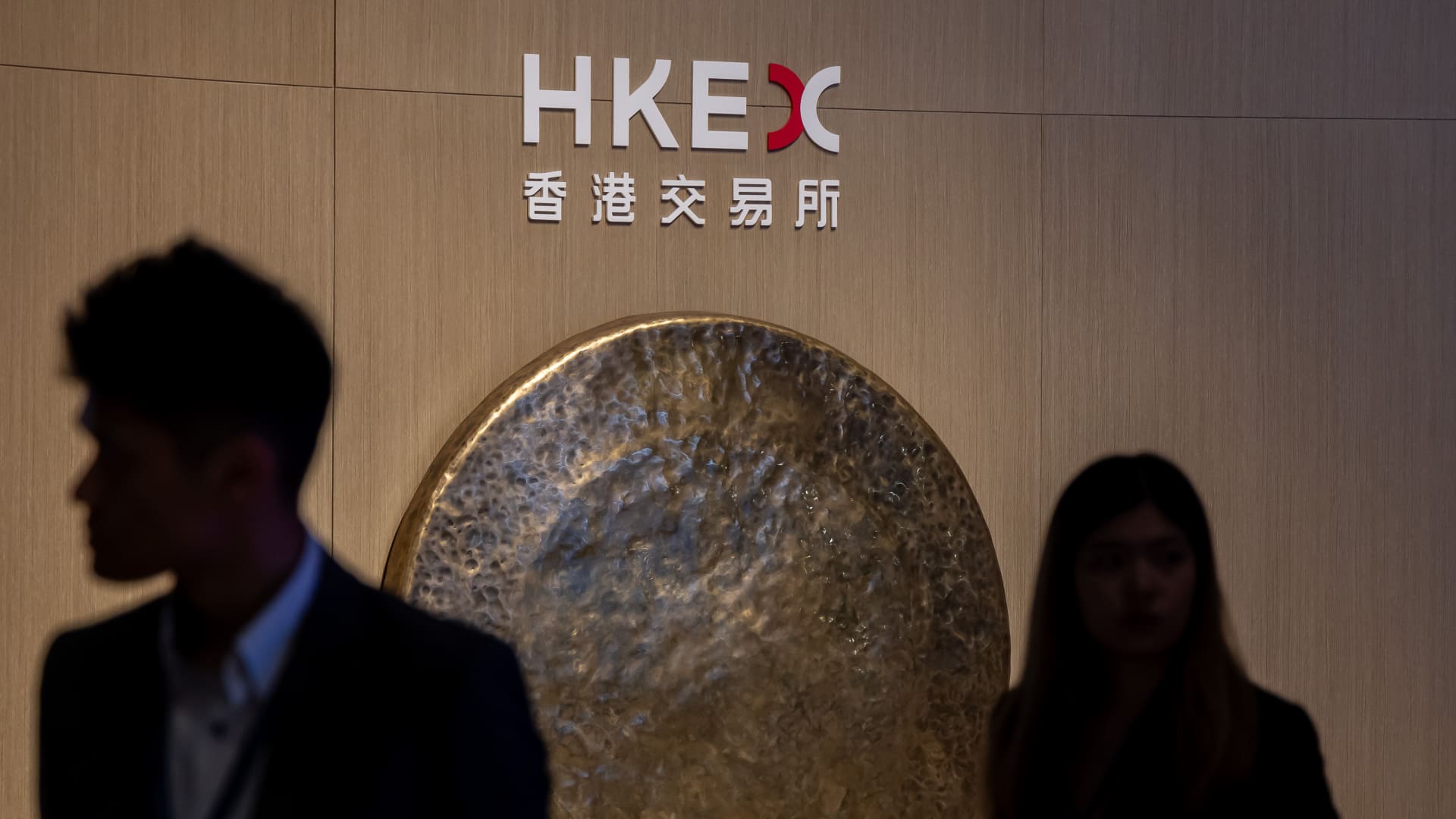
The gong at the listing ceremony for Contemporary Amperex Technology Co. Ltd. (CATL) at the Hong Kong Stock Exchange in Hong Kong, China, Tuesday, May 20, 2025.
Bloomberg | Bloomberg | Getty Images
BEIJING — Hong Kong may be the world’s top market for initial public offerings, but it also suffers from a growing trend of poor stock performance from initial public offerings.
KPMG said the Hong Kong exchange ranked No. 1 in the world in terms of IPO funds raised last year, ahead of the New York Stock Exchange and Nasdaq, which ranked second and third respectively, and noted that its strong momentum in 2025 will continue in the first quarter of this year. As of Thursday, more than 600 companies were waiting to list on the Hong Kong exchange, according to its website.
However, Hong Kong IPOs have generally underperformed. According to Chinese financial data firm Wind Information, of the 179 stocks listed since January 2025, about half have fallen in the past three months. By comparison, the benchmark Hang Seng Index declined modestly over the same period, while the FTSE Renaissance Global IPO Index rose more than 10%.
The performance gap is even worse for participants in Stock Connect, a program that allows mainland Chinese to invest directly. Of the 33 Hong Kong-listed stocks that joined Connect on March 9, more than half of the stocks more than doubled in price from their IPO to the last trading day before joining. Eight companies, including AI startup Deepexi, have soared more than 300% during this period.
Since then, the group of eight companies have all fallen more than 10%. Deepexi is down 51% as of June 3rd.
Beijing is paying attention. The government-run Securities Times reported on May 29, the latest update on concerns over the sudden rise and subsequent fall in some Hong Kong IPOs.
Leonid Mironov, portfolio manager at Gabekal, pointed out that many H-share listings in Hong Kong already trade as A-shares in mainland China. He said that after stocks entered the Connect program, capital retreated into A shares, which are often cheaper.
Ding Wenjie, investment strategist for global capital investments at China Asset Management, said the firm has noticed that some funds in Hong Kong are leveraging connect inclusion as a way to generate additional profits.
Goldman Sachs predicted this spring that companies would raise about $60 billion in Hong Kong listings this year, nearly double the $36 billion raised in 2025. The investment firm on Wednesday downgraded Hong Kong’s H shares in favor of mainland China’s A shares to increase exposure to artificial intelligence hardware.
Benjamin Cavender, managing director of China Market Research Group, told CNBC that low fees, weak funding and increased competition mean “parts of China’s financial sector are undoubtedly under pressure.” “This is probably more focused on short-term performance.”
The Hong Kong Exchange said in a statement to CNBC that stock price performance is affected by a variety of factors.
Next up is market testing. Knowledge Atlas TechnologyZhipu, the company behind the AI model Zhipu, is one of the hottest stocks expected to start trading in Shanghai via Connect on Monday, while the same AI company mini max I might join later this summer. Both companies were listed in Hong Kong in January.
