

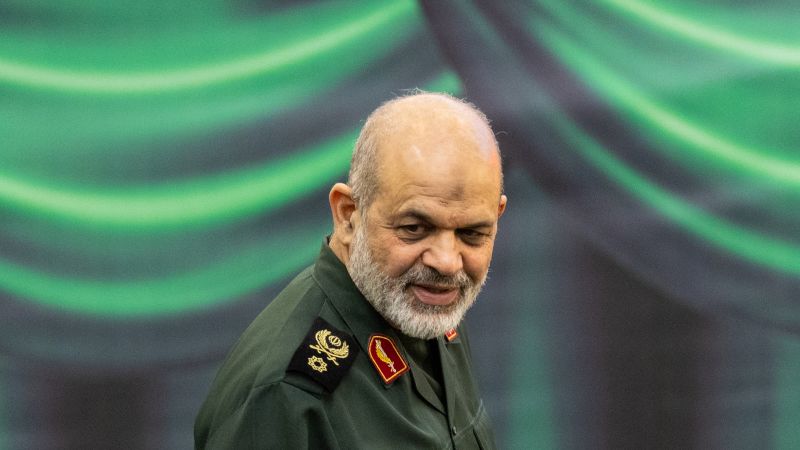
As negotiations over Iran’s war draw the line, a notorious Iranian commander who is sanctioned by the United States and wanted by Interpol is helping the Iranian government plan its next move.
Brigadier General Ahmad Vahidi, commander of the Iranian Islamic Revolutionary Guards Corps (IRGC), assumed the post after his predecessor, Mohammad Pakpour, was killed in a US and Israeli airstrike on February 28, the first day of the war.
Vahidi, who has been sanctioned by the United States for his role in cracking down on protests in the country and wanted by Interpol for his role in the Argentina bombings three decades ago, is one of the most vocal opponents of compromise with the United States, and experts say he is even more extreme than Pakpour.
“He’s influential, but (he’s) part of the system,” said Ali Baez, Iran project director at the International Crisis Group. “Decisions were made by consensus and Mr Vahidi’s voice was undoubtedly very loud in the room.”
Vahidi’s emergence as one of Iran’s top decision-makers shows that US and Israeli efforts to decapitate the country’s leadership have not produced a more moderate ruling class. Under Vahidi’s leadership, the Revolutionary Guards have effectively blocked traffic at the world’s most important oil crossing, but Tehran’s demands on Washington now exceed those in previous negotiations.
Dany Citrinowicz, head of Israel’s military intelligence agency’s Iranian branch, told CNN that Vahidi is a “very dominant” and “radical” person who is deeply committed to the principles of the Islamic revolution.
“You can’t agree to anything without passing him by,” Citrinowicz said. “If we don’t get what we want, he’s one of the people who says if Trump wants to go back to war, he’s welcome.”
US President Donald Trump said he intended to attack Iran again this week and threatened to reignite war if Iran did not comply with the deal. He later said he would wait to see if negotiations progress, but warned that “the clock is ticking.”

“Iran is in the final stages. We’ll see what happens,” President Trump told reporters Wednesday morning of efforts to secure a deal.
“We’re either going to make a deal or we’re going to do something a little bit messy,” he continued. “But I hope that doesn’t happen.”
Prime Minister Vahidi warned on Wednesday: “If there is further aggression against Iranian soil, the fire that was previously promised and confined within the framework of a limited regional war will now explode in flames that will cross all borders and territories.”
“It will be a devastating blow,” he told the TV program “X,” according to Iranian media.
The general does not make many public appearances, but on Thursday images of Vahidi meeting with Pakistan’s interior minister were circulated in the media. Iranian media debunked the image, saying Vahidi had not met Pakistani officials and that the photo dates back to 2024.
While officials such as Parliament Speaker Mohammad Bagher Ghalibaf and Foreign Minister Abbas Araghchi are usually seen as the public face of Iran’s negotiations with the United States, some experts say Vahidi is likely behind the scenes advocating for some of Iran’s most aggressive policies.
Iran has so far refused to accept any offer that amounts to surrender from its perspective. After weeks of back-and-forth proposals, Iran’s latest offer does not represent a major concession on a key deadlock point, officials said, adding that the issue of nuclear enrichment remains at the heart of the impasse.
Experts say that since the Iran war began, Tehran has been led by a small faction of Revolutionary Guard bloodlines that emerged from the rubble of the 1980s Iran-Iraq war. Vahidi is one of the most important players.
Baez “has become a very important figure, but within the institutional constraints of the Islamic Republic,” he said, adding that he is particularly influential when the country is at war.
It remains unclear how much of an obstacle he will pose to reaching a deal with the United States.
The Institute for the Study of War (ISW) in Washington, D.C., said in April that “Mr. Vahidi’s intention to abandon U.S.-Iran talks indicates that he is prepared to resume war if necessary.” But Baez said there was no evidence so far that Vahidi would be an obstacle.
Born in Shiraz in 1958, Vahidi’s ideology was shaped by war and conflict with the West. He joined the Iranian regime at its inception after the 1979 revolution and was appointed Deputy Director of Intelligence in 1981.
According to Iranian media, he previously studied electronics and industrial engineering.

“He was formed by the Revolutionary Guards,” Sitrinowitz said. The Revolutionary Guards Corps is designated by the United States as a foreign terrorist organization.
He is wanted by Interpol for his role in the 1994 bombing of a Jewish community center in Buenos Aires, Argentina, which killed 85 people. He is also reported to have had contact with Israelis during the Iran-Contra affair in the 1980s. The case involved an Israeli-backed U.S. plan to sell arms to Iran and use the proceeds to fund the Nicaraguan anti-communist rebel group known as the Contras.
He was the first commander of the Quds Force, the elite force of Iran’s Revolutionary Guards, and over the years held several positions in the Revolutionary Guards and Iranian Armed Forces, including deputy chief, minister of defense, and minister of interior.
In 2022, Vahidi was sanctioned by the U.S. Treasury Department’s Office of Foreign Assets Control for his violent crackdown on protesters following the death of 22-year-old Mahsa Amini, who died in custody after being arrested by the morality police on suspicion of flouting Iran’s Islamic dress code.
“Mr. Vahidi warned Iranian women that government security forces would punish ‘violations’ related to hijab compliance,” the US Treasury said, adding that he openly threatened demonstrators and defended brutality in suppressing ongoing protests.
An ominous cloud hangs over Vahidi after several of his predecessors, including former Quds Force commander Qasem Soleimani, were assassinated by the United States and Israel.
“He’s a wanted person,” Citrinowicz said. “He’s a force to be reckoned with.”
