

tehran, iran —
The chances of a peace deal between the US and Iran depend on whether the Trump administration agrees to release $24 billion in frozen Iranian assets, a senior Iranian official told CNN on Friday, warning that the US would “enter a dark corridor” if fighting resumed.
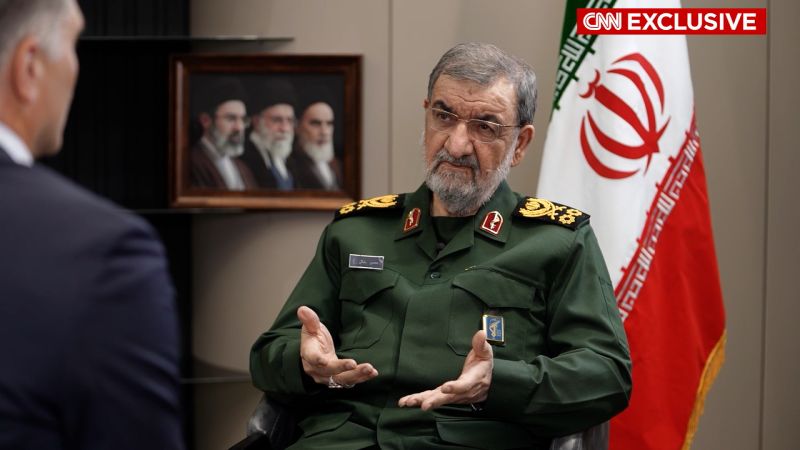
Mohsen Rezaei, a military adviser to Supreme Leader Mojtaba Khamenei, told CNN in an exclusive interview in Tehran that “the negotiations are at a stalemate and (US President Donald) Trump has to break the deadlock.” “The ball is in Trump’s court.”
Iran is reportedly demanding the release of $12 billion in frozen funds as soon as an interim agreement with the United States is signed, and an additional $12 billion at a later stage.
U.S. officials are concerned that lifting the freeze on funds at this stage could remove important influence over the administration. Trump has called for any deal to appear much stronger than the 2015 nuclear deal and to avoid anything that could be interpreted as handing over “pallets of cash,” a phrase he brought up to criticize then-President Barack Obama’s decision to provide financial compensation to Iran.
In a rare interview with CNN, Rezaei shed light on thinking within Iran’s strategic decision-making circles about Iran’s postwar vision, the fate of the Strait of Hormuz, and how Iran would act if it were attacked again. His comments carry weight because he remains closely connected to Iran’s security services and is widely seen as close to the country’s current supreme leader, who has not been seen in public since he was injured and killed in an Israeli attack on the first day of the war.
Rezaei said:
Release of frozen Iranian assets: The Trump administration’s possible release of funds would provide “new horizons for the future” for Iran and the United States, he said, framing the demand as a confidence-building measure. “If he (President Trump) wants to reach a deal with Iran, this $24 billion is a test of the trust that Iran wants in President Trump. This is a test that America will have to go through and the door will be open,” he said. “This is our own money, not America’s money.”
Warning against return to war: Rezaei warned that if the United States resumed the conflict, Iran could “prolong the war” beyond the Persian Gulf and expand its military operations from the Strait of Hormuz to the Indian Ocean, the Bab al-Mandab Strait, the Red Sea and the Mediterranean Sea. “It will give a new dimension to the war by attacking other US military bases that it has attacked in the past,” he said, adding that “war is unlikely.”
Regarding the possibility of a meeting between President Trump and Ayatollah Khamenei: Although he did not answer questions about Ayatollah Khamenei’s health or his role in national policy-making, he ruled out the possibility of a meeting with President Trump. “That’s not going to happen. We’re in the first phase of negotiations, and Mr. Trump halted the negotiations. That’s not going to happen.” Trump said this week that he “seems to get along well” with Khamenei and that he was “honored” to meet him.
Reiterating Strait of Hormuz sovereignty claim: Rezaei said Iran and Oman have sovereignty over the vital waterway, through which a fifth of the world’s oil and liquefied natural gas passed before the war, and therefore jointly control the strait. He said Iran would charge maintenance fees because Iran should not bear the costs of managing the strait, and he declined to characterize requests for tolls for ships in the strait as tolls.
A veteran member of the Revolutionary Guards, Rezaei participated in the Iran-Iraq War and led the unit from 1981 to 1997, helping to make it one of the Islamic Republic’s most powerful organizations. He is a hard-line pragmatist with deep roots in Iran’s security establishment, later joining the Expediency Council that advises the supreme leader and serving as vice president under former President Ebrahim Raisi. Mr. Rezaei also ran for president four times, but never won.

During the 40-day US-Israel war against Iran that began in late February, the Islamic Republic targeted 12 countries in the region and retaliated by attacking military facilities, energy infrastructure, and civilian facilities. Tehran also reportedly fired a missile at Diego Garcia, a joint U.S.-British military base in the Indian Ocean about 3,000 miles from Iran, in a clear demonstration of its reach.
In an interview with CNN, he questioned the durability of the nuclear deal with President Trump, citing his withdrawal from the 2015 Iran nuclear deal and his strategy of “ambiguity” in negotiations.
Rezaei said Iran is preparing for a possible invasion of its territory by the United States if negotiations fail. “Then the world will understand Iran’s true capabilities, because our land forces are many times larger than our missiles.”
He characterized the war as Iran’s first victory over its enemy in the Islamic Republic’s 47-year history.
“Iran has always lost in previous wars, but this is the first time Iran has won a war,” he said.
Editor’s note: CNN operates only with permission from the Iranian government but maintains full editorial control of its reporting.
