

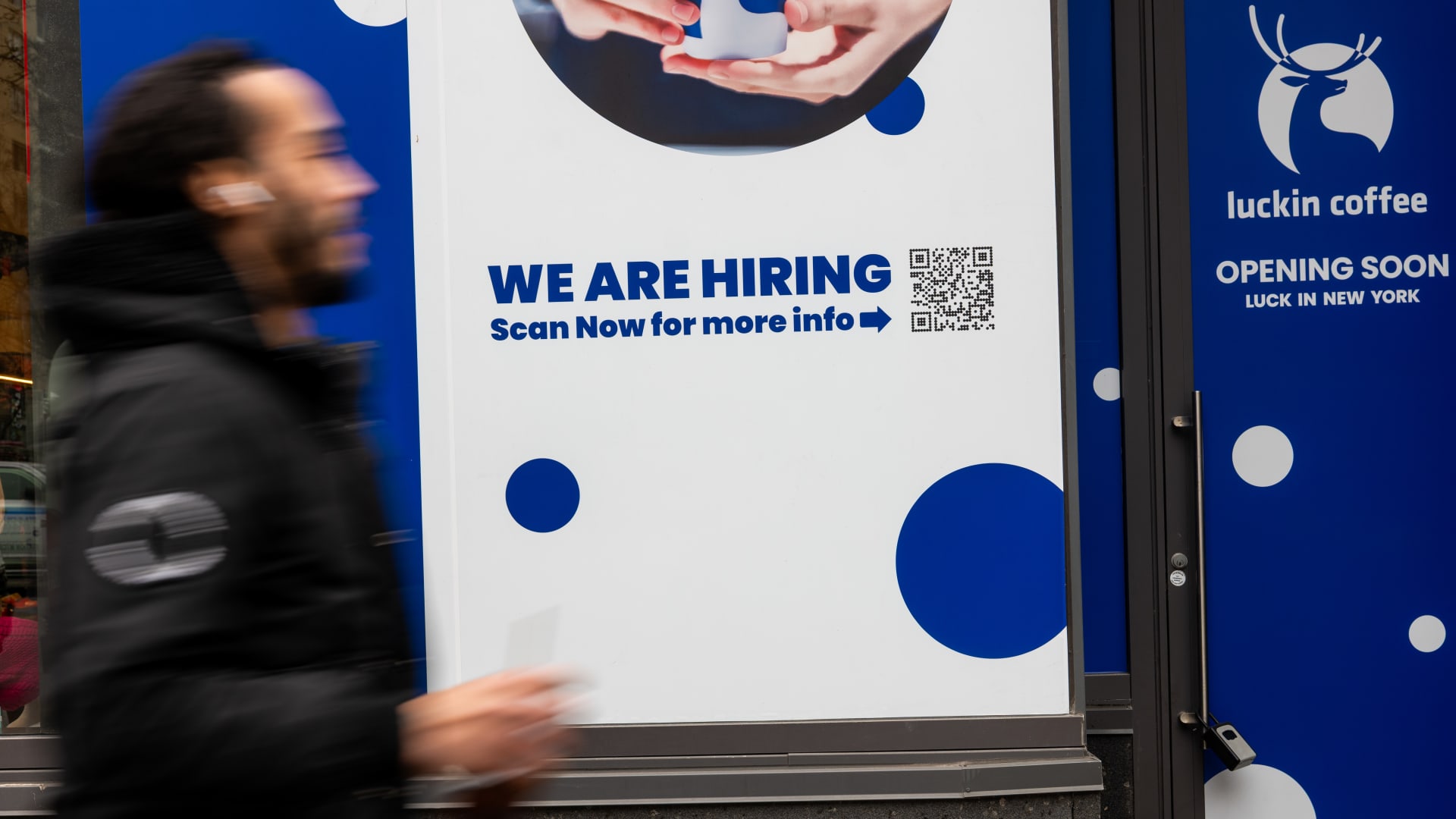
A “Now Hiring” sign hangs in the window of a business in Manhattan, New York City, on January 9, 2026.
Spencer Pratt | Getty Images
Federal labor market data released Tuesday suggests the frozen U.S. job market may be starting to thaw, but labor economists say the economic fallout from the Iran war threatens to stall that momentum.
“Is the employment recession finally over? There are encouraging signs,” Heather Long, chief economist at Navy Federal Credit Union, said in an email.
“The big concern is that a war with Iran could halt much-needed progress in the labor market,” she wrote.
Job market ‘may be stabilizing’
For more than a year, the labor market has been in a so-called “small hiring, small firing” mode, characterized by low rates of hiring, firing, and voluntary resignation of workers.
The result is a frozen market that offers few opportunities for job seekers and new entrants to the labor pool, a change from the “Great Retirement” era of 2021 and 2022, when job openings hit record highs and record numbers of workers left their jobs in search of new opportunities, economists said.
But Nicole Bashaw, a labor economist at ZipRecruiter, said there have been signs of increased activity recently, likely a byproduct of companies feeling more certainty about economic policies such as tariffs and interest rates.

Employers’ hiring rate jumped to 3.5% in March 2026, up from 3.1% in February, the fastest hiring pace in two years, according to data released Tuesday by the U.S. Bureau of Labor Statistics.
Matthew Martin, senior U.S. economist at Oxford Economics, said in a research note on Tuesday that looking at the three-month average of the employment rate, it “has remained roughly flat year-to-date, suggesting that it may have bottomed out after four years of decline.”
There were also hirings in industries other than health care “for the first time in a while,” Long wrote.
Hiring is spread across several industries, with employers in the transportation, warehousing and utilities sectors adding 108,000 jobs in March, professional and business services adding 165,000 and lodging and food services adding 124,000, according to the BLS.
“After a difficult year in which employment outside the health care sector was nearly non-existent, the labor market appears to be becoming increasingly stable,” Long wrote.
Additionally, the turnover rate rose slightly from 1.9% in February to 2% in March, according to BLS data. Because workers typically leave their jobs to take new jobs, economists generally consider turnover rates to be a rough indicator of confidence in finding a new job.
Additionally, a separate BLS report issued in April found that while 2025 was the worst year for job growth, excluding recessions, in more than 20 years, employers added 178,000 new jobs in March, the highest monthly total since 2024.
“I would say the labor market is heating up again,” Bashaw said. “We’ve been in very frozen, stagnant conditions, but those conditions are easing and starting to warm up again.”
“The big asterisk is the impact of the Iran war and the high price of gasoline on the labor market,” she said.
The impact of the Iran war on the job market
Premium gasoline prices of more than $6 per gallon and diesel fuel prices of more than $7 per gallon are displayed outside a Shell gas station on April 14, 2026 in West Hollywood, California.
Patrick T. Fallon | AFP | Getty Images
The ongoing conflict in the Middle East is causing an oil supply shock and causing widespread increases in energy prices.
According to the U.S. Energy Information Administration, the average price of gasoline in the U.S. has risen from $2.94 a gallon on Feb. 23, just before the war began, to $4.45 a gallon as of Monday, an increase of about 51% in about two months.
Although it is “too early to see any negative spillovers” from the war in federal labor market statistics released Tuesday, higher oil prices threaten to reduce household purchasing power and reduce consumer demand, Martin wrote.
Additionally, the increased uncertainty “will likely cause companies to further reduce their hiring appetite,” thereby “delaying a sustained recovery in hiring rates,” he wrote.
“A US/Israel-Iran war will test the labor market,” Martin wrote.

Economists say there are also some worrying signs in the job market that temper some optimism.
For example, while the overall unemployment rate in the United States is relatively low by historical standards, the percentage of unemployed people considered “long-term unemployed” has been rising over time.
According to BLS data, about 25% of the unemployed were long-term unemployed as of March, meaning they have been out of work for at least six months. This is up from a recent low of about 18% in February 2023.
“Many unemployed people are facing an environment of low employment and are trying to get back into the labor market, but it’s hard to find a door to do so,” said Corey Stahl, senior economist at job site Indeed.
Overall, job seekers have reason for both optimism and concern, he said. He said the U.S. job market has been able to remain “very stable” despite a number of headwinds.
But “the longer (the war) goes on, the more it will weigh on the economy,” Staehle said.
