

Havana, Cuba —
Cuba’s president says his country does not want war with the United States, but has vowed that Cubans will defeat American forces if attacked.
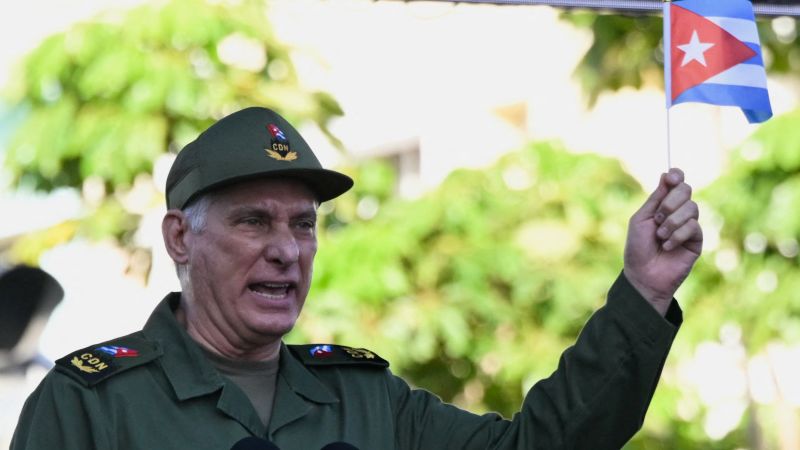
Miguel Diaz-Canel, dressed in military uniform, addressed a crowd of government supporters Thursday to commemorate the 65th anniversary of the start of the U.S.-backed Bay of Pigs invasion. The failure to oust Fidel Castro by a unit of CIA-trained Cuban exiles led Cuba’s revolutionary leader to publicly declare support for socialism for the first time, sparking a Cold War conflict with the United States that continues to this day.
One of the CIA’s most notable failures, the Bay of Pigs fiasco of 1961, has since been cherished by Cuban officials as a David versus Goliath moment that solidified support for Castro’s revolution.
Referring to rising tensions with the Trump administration, Diaz-Canel told the audience, “We must be ready to resist serious threats, including military aggression. We are not seeking it, but it is our duty to prepare to avoid it, and if it proves inevitable, it is our duty to prepare to defeat it.”
“As long as there are women and men willing to sacrifice their lives for the revolution, we will win,” Diaz-Canel added.
“We don’t want to be an American colony,” shouted a group of government supporters in the crowd.

The Cuban leader made the comments three days after US President Donald Trump once again threatened the communist-held island with a military attack.
President Trump on Monday referenced the Iran war and said, “When this is over, I might stop in Cuba.”
The saber conflict between the United States and Cuba has reached a climax after a U.S. military operation in Caracas in January captured Venezuelan leader Nicolas Maduro, a staunch ally of the Cuban government.
During the operation, U.S. forces killed 32 Cuban soldiers and intelligence officials who were part of the secret force protecting Maduro. Since his arrest, the Trump administration has blocked all oil shipments to Cuba, except for one Russian oil tanker, which Trump said was allowed to enter the island in March over humanitarian concerns.
Under the oil blockade, Cuba’s already struggling economy has come to a near standstill. Power shortages now persist throughout the day in many parts of the island, hospitals are unable to treat thousands of patients, and fuel is becoming increasingly scarce.
The Trump administration has called on the Cuban government to open the communist-ruled island politically and economically. He also said that some Cuban officials, including Diaz-Canel, should resign as part of the deal.
U.S. authorities have contacted members of the Castro family to reach an agreement with Raul Castro, who left office in 2021 but is still seen as the ultimate power broker in the island’s hermetic political system.
Asked about her family’s role in the negotiations at Thursday’s ceremony, his daughter Mariela Castro, a member of the island’s parliament, told CNN: “My father closely follows all the news and participates in all the analyzes for decision-making.”
Raul Castro will turn 95 in June, but he has kept a low profile in recent months.
“The years haven’t weighed him down that much,” said Mariela Castro, who was standing near the front of the crowd and listening to Diaz-Canel’s speech. “He’s put on a little bit of weight. His mind is still active. He’s very dedicated and his experience is invaluable.”
Asked about the threat of a US attack on the island, Mariela Castro said: “We are not alarmed.”
“We’re busy,” she said. “We are making preparations.”

