

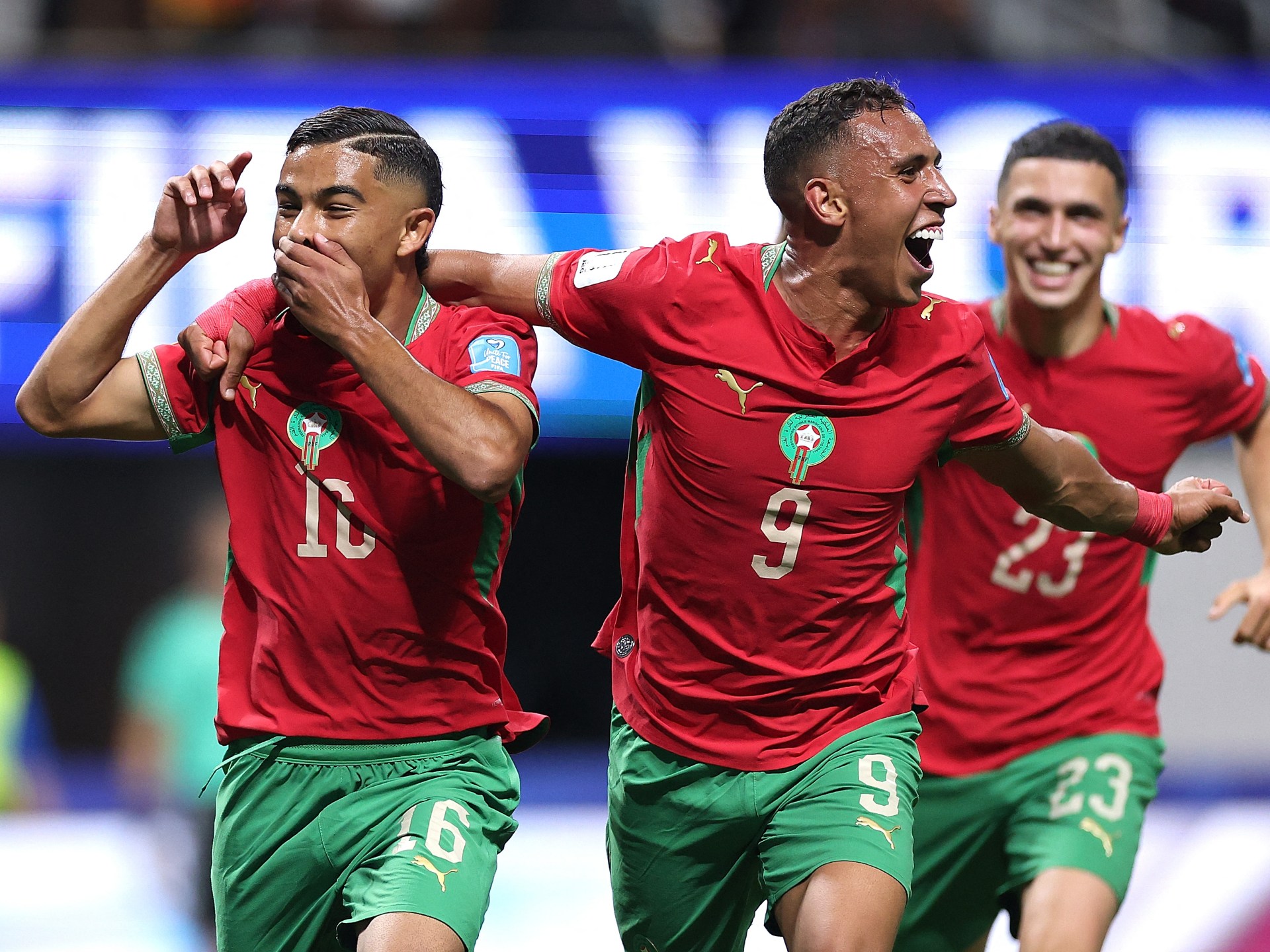
Morocco’s historic run at the Qatar 2022 World Cup will be remembered with the emotional, powerful and unforgettable footage of their quarter-final victory over Portugal. The towering header that was Youssef En-Nesyri’s winning goal against Cristiano Ronaldo’s team, Hakim Ziyech’s incredible dribbling that spun the 2016 European champions, and Sufjan Boufal’s goal. He danced on the pitch with his mother during a heartwarming celebration after the game.
Four years have passed since then, and not one of these players has played in the North American World Cup.
In fact, all that remains from this monumental tournament are Achraf Hakimi, Nousser Mazraoui, Azzedine Unahi, Bilal El-Kanous and the goalkeeper.
Walid Reglagi, the famous coach at the time, was also fired.
Despite the drastic changes, Morocco are yet to lose a match, defeating the Netherlands in a tense penalty shootout on Monday to advance to the round of 16.
Comparisons between the classes of 2022 and 2026 were inevitable. They started late in the group stage, and it was pointed out that while Morocco four years ago had topped their group, this time they were unable to beat Haiti and Scotland by a wide enough margin to jump past Brazil in Group C.
To truly impress the critics, the current generation may need to match or even improve on their 2022 semi-final run.
Morocco 2022: Experience and defensive tactics
In 2022, the tactical plan was simple yet effective.
Reglagi was appointed on an emergency basis after Bosnian coach Vahid Halilhodzic had a falling out with several players.
With less than three months until the start of the World Cup, Leguraghi selected his players and implemented a tactical plan. Realizing that time was not on his side, he kept things simple.
“Reglagi’s team was more defensive,” Mohammad Al-Faeh, an analyst at Jordanian Premier League side Al Ahly SC, told Al Jazeera.
“He had at his disposal older, more experienced players from the big teams in Europe.”
Despite his technical ability, the team showed no interest in dominating possession during the Qatar 2022 tournament under coach Regulagui. In fact, their highest percentage of possession came in the only game they lost, the semi-final against France.
Reglagui’s Morocco were not as negative as other teams using the same tactics. They set up their backline halfway between goal and midfield, rather than locking deep in the so-called low block, but gave away the ball in order to lure their opponents into a trap.
En-Nesyri, the 2022 squad’s striker, has won plaudits for his relentless work rate, preventing opposing centre-backs from making easy passes into the midfield and forcing the opposition into wide areas.
A large area of the pitch was filled with outstanding players. Full-back Nousser Mazraoui, who is part of the 2026 squad, and Hakimi teamed up with the wingers, looking to win the ball and mount dangerous counter-attacks.
Morocco were very effective in blocking services into the central area of the pitch, which inhibited their opponents, especially Portugal in the quarter-finals, where they lost 1-0, by dropping deep to receive the ball and inhibiting their attacking ability.
But what happened when Morocco played against lower-ranked teams?
For the second consecutive African Cup of Nations (AFCON), Morocco was eliminated in the round of 16 (2023), and in the 2025 tournament, which it hosted, they lost 1-0 and were unable to lift the trophy.
The final was particularly tough, with Senegal’s goal canceled in the final minute and Morocco awarded a penalty.
The enraged Senegalese marched off the pitch. Morocco missed the penalty and lost the match 1-0, but the on-field result was declared invalid and Morocco received a 3-0 forfeiture from CAF, becoming AFCON champions.
The result was then reversed and Morocco were declared champions under controversial circumstances.
To make matters worse, Morocco faced allegations during the tournament that the referees favored Morocco. The hosts requested and accepted a change of referee before the quarter-final match against Cameroon, but were unable to achieve that objective.
Morocco in 2026: Belief in youth and aggression
Despite the controversial AFCON victory, pressure continued to mount on Reglagui as fans compared the first team to a young and successful Moroccan team.
Under junior team coach Tarek Sekhtioui, Morocco won the bronze medal at the 2024 Paris Olympics, as well as lifting trophies at the 2024 African Nations Championship and the 2025 FIFA Arab Cup with completely different teams.
Similarly, Mohamed Ouhabbi also achieved success with the youth team, winning the 2025 FIFA U-20 World Cup.
In a moment of déjà vu, a last-minute change of manager was made ahead of the World Cup. With Regulagi absent, Ujabi came on board with the goal of playing more expansive, rather than defensive, football.
According to Alfay, team selection has been the biggest indicator of change.
“Ujavi has appointed a lot of young players,” he added, “partly because he knows them, but also because they fit his tactical approach.”
Oujabi rely on lesser-known, mobile players who constantly change positions and rotate around the pitch.
The young side made an immediate impact at the World Cup with their nimble movement, scoring an impressive 1-1 draw in their first match against Brazil.
Experts believe this is all part of a long-term plan.
“I think Morocco made this change with an eye on the World Cup in 2030,” Maher Mezahi, a North African soccer journalist, told Al Jazeera.
In fact, the average age of Morocco’s starting eleven remains just under 26 years old. The outfield starters are no older than 30, and half are under 25.
In the Round of 32 match, Morocco forced the Netherlands to abandon their style of play and deploy five defenders to neutralize Morocco’s fluid movements.
According to Mezahi, the change is a “tacit admission” that Morocco are the stronger team.
“This result proves that the 2022 World Cup was no fluke and also proves that replacing Reglagi with Ujabi was the right decision,” Mezahi added.
From fairy tale darlings to divisive competitors
The AFCON 2025 finals sparked a major change in the atmosphere among proponents of neutrality in Africa and the Arab world.
Support for the Atlas Lions has fallen to an all-time low.
In Africa, Morocco was seen as wielding too much power within the Confederation of African Football (CAF).
The country, with its glittering new stadium, has served as a stand-in for African countries unable to host matches due to instability or a lack of facilities that meet CAF requirements.
For the past four years, Liberia, Niger and Congo have all played Morocco in home qualifiers in Morocco rather than on their respective home soil, allowing the 2030 World Cup co-hosts to avoid the infamous away fixtures.
However, the result of the match against Brazil in this World Cup had the amazing effect of winning back some of the neutral supporters who had been alienated.
For the first time, an Arab and African team competed against one of the world’s soccer powers, winning the tournament five times.
Morocco also solidified their position as the strongest Arab and African team in their second World Cup in four years.
Nine out of 10 African teams and three out of eight Arab teams have advanced to the finals, but only four remain.
In the darkness, Morocco reminded African and Arab fans why they can still win soccer matches and heal broken hearts, just like they did four years ago.
This time, for his debut goal against Haiti, a video of Nousser Mazraoui putting his arms around Cessime Yassin and telling him to pray and be thankful to Allah has gone viral. It was touching to see the players maintain strong ties to their religion and culture despite being born and raised in a foreign country.
Moms are back too. Ismail Saibari, who scored the winning penalty for Morocco against the Netherlands, ran to the stands and tearfully hugged his mother.
One of the heroes of 2022, Yassin Bono, won the hearts of fans with his famous smile during a tense penalty shootout, but he didn’t look fazed at all.
A lot has changed for the Atlas Lions since the last World Cup in Qatar. Despite their ups and downs, more supporters are looking to jump on the Moroccan bandwagon as they once again push towards the final stages of the tournament.
It is a testament to their consistency that Morocco will start Saturday’s round of 16 game against Canada as the favorites. If they achieve their desired result, the African giants could face France, their archrival in 2022 and a strong team for this World Cup, in the quarter-finals.

