

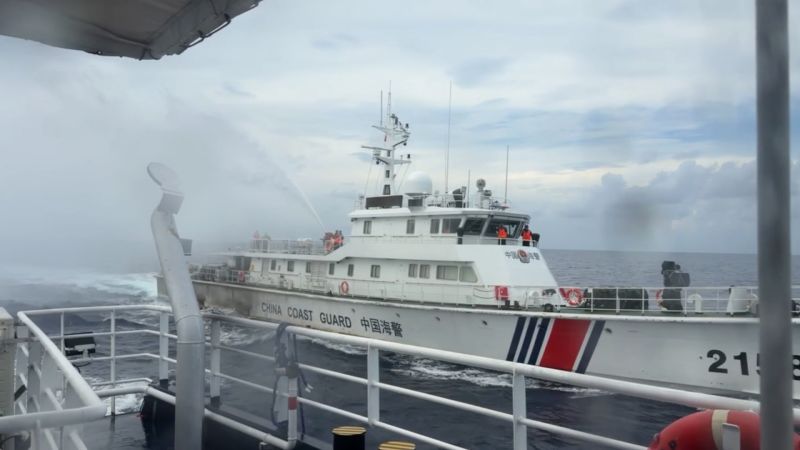
Chinese ships fired water cannons at Philippine ships, including one carrying a CNN crew, near a dangerous flashpoint in the South China Sea on Friday. It was the third tense clash in the disputed waters this week.
Other than the rich fishing grounds of the lagoon and surrounding waters, there doesn’t seem to be much of note about this shoal. But this corner of the world is a deceptively dangerous geopolitical hotspot.
With unfettered access to one of the world’s most important shipping lanes, a mutual defense treaty between the Philippines and the United States, and China’s steady push to solidify its claims in the disputed territory, a single navigational error or mistaken fire could spark a serious conflict.
CNN was given exclusive access to a vessel belonging to the Philippine Department of Fisheries and Aquatic Resources on a mission to refuel local fishermen near Scarborough Shoal, a sandbar claimed by both Beijing and Manila.
As the Philippine ship neared the shoal on Friday, several large Chinese Coast Guard vessels came close enough for CNN’s crew to see the faces of the officials on board.
The Chinese Coast Guard warned through a megaphone, “Please leave immediately…or we will take decisive action according to the law.” The Chinese ship continued to circle the Philippine ship as water cannons hit it.
Although the South China Sea dispute has been overshadowed by wars elsewhere in recent years, it remains a major potential flashpoint for global conflict. Multiple governments vie for sovereignty over the waterway, a vital economic corridor through which a third of the world’s maritime trade passes each year.
The Philippine ship finally canceled its mission and returned to port on Friday, citing a developing typhoon in the area. Once their ships turned away, tensions dropped dramatically, but hours later Chinese Coast Guard ships could still be seen in the distance tailing the Philippine ship.
Philippine authorities later said there were a total of 15 Chinese vessels belonging to the Chinese Coast Guard and its so-called “maritime militia.” The Philippines had 10 ships, three of which were coast guard ships. A small Philippine government propeller plane also flew low over the ship during the mission.
The Philippine Coast Guard said its vessels were “subjected to a series of water cannon attacks and dangerous operations by the Chinese Coast Guard.” CNN said a Chinese vessel came within 7 meters (about 23 feet) of the Philippine vessel, creating a “grave risk of collision.”
Meanwhile, Chinese state television reported that the China Coast Guard “on Friday took enforcement action in accordance with the law against several Philippine vessels that engaged in illegal activities in the waters under Chinese jurisdiction around Huangyan Island (the Chinese name for Scarborough Shoal).”
Asked by CNN’s Mike Valerio to respond to Friday’s incident, Beijing Foreign Ministry Spokesman Lin Jian said: “It is lawful and lawful for China to take the necessary measures to protect its rights and security, which are professional, standard and beyond reproach.”
Also known as Bajo de Masinloc in the Philippines, the shoal is an uninhabited rock with a central lagoon located 140 miles (220 kilometers) west of the Philippine main island of Luzon and approximately 530 miles from China’s Hainan province.
China, the Philippines and Taiwan all claim sovereignty over Scarborough Shoal, but China has maintained near-constant coast guard presence in nearby waters since 2012, effectively controlling it.

Friction has increased throughout this week.
The first was at Second Thomas Reef, a rocky stretch of the Spratly Islands that is also disputed by Manila and China.
The Philippines maintains a small force in shallow waters aboard the stranded World War II-era ship BRP Sierra Madre. The Philippine military said on Monday that a Chinese Coast Guard ship was dispatched and a small boat approached the Sierra Madre Mountains. In response, the Philippines launched two hard-hulled inflatable boats to escort the Chinese ship.
A video from the Philippines shows eight Chinese soldiers on a boat ramming a small Filipino vessel. The blows appear to be carried out using wooden batons and oars. According to the Philippine military, two Filipino soldiers were injured and evacuated for treatment.
Chinese authorities later claimed that the Philippine ship had rammed and “violently” attacked the crew, and accused the Philippines of spreading false information.

The second crash occurred a few days later. On Thursday, the Chinese Coast Guard said it had chased away two Philippine vessels for “intruding” into waters near Scarborough Shoal.
The Philippine military later said that the Chinese vessels used water cannons and dangerous navigation techniques to try to stop them from resupplying Filipino fishermen around the shoals. No injuries were reported and the Philippine ship continued its mission.
The US focused on both rounds. After Monday’s incident, the State Department condemned China’s “dangerous and aggressive” moves. And on Thursday, Secretary of State Marco Rubio struck a similar tone.
“We have a role to play and we will not abandon our allies. We have made that abundantly clear,” he said on the sidelines of the ASEAN conference in Manila.
The Philippines is a Mutual Defense Treaty ally of the United States, which means that the U.S. government has a legal obligation to come to Manila’s aid in the event of an attack on Manila territory or, in some cases, on Philippine vessels at sea.

Uneasy tensions were evident even before Friday’s incident. The 30-meter (90-foot) Philippine ship CNN was sailing through the South China Sea overnight in the pre-dawn darkness when it spotted the shadow of a Chinese Coast Guard vessel. The ship was nearly four times that long at 111 meters (364 feet), reflecting the size and power of China’s maritime forces.
The Philippines and China are not alone in their dispute over 1.4 million square miles of South China Sea territory. Vietnam, Malaysia, Brunei and Taiwan also claim parts of the waterway’s 250 islands, reefs and atolls.
An international tribunal ruled in 2016 that China had no legal basis to claim historic rights to large parts of the South China Sea. Chinese leader Xi Jinping rejected the ruling at the time and continued building military facilities, airstrips and artificial islands in the disputed waters anyway, despite pledging not to do so during a 2015 White House visit.
Management of these features and their surrounding waters has become even more important this year in light of what has happened in the Persian Gulf.

Iran successfully closed off the Strait of Hormuz, the Gulf’s entrance, after attacks by the United States and Israel, cutting off up to 20% of global oil trade and vital supplies ranging from agriculture to computer chip manufacturing. Analysts are concerned about the impact a similar conflict in the South China Sea could have on the global economy.
And these types of conflicts have become more common in recent years as the Chinese government has taken a more aggressive stance. In one particularly violent encounter in June 2024, a Chinese coast guard officer brandished an ax at Filipino troops and slashed a rubber dinghy.
China’s coast guard has stepped up its presence, with its vessels spending 993 sailing days around Scarborough Shoal in June alone, almost as many days as they spent in all of 2025, according to a study by the Asia Maritime Transparency Initiative at the Center for Strategic and International Studies.
The United States also added ships to the region, moving a U.S. Coast Guard vessel that had been deployed to Bahrain before the start of the Iran war to the eastern Pacific Ocean.
