

Beijing —
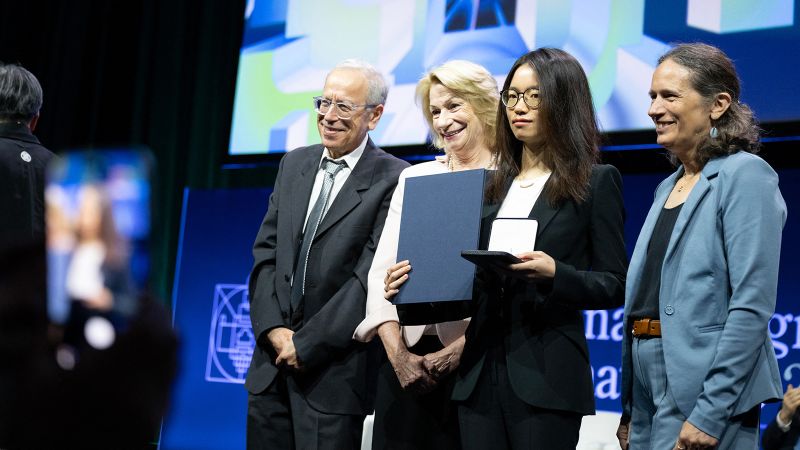
For the first time, two Chinese people have been awarded the prestigious Fields Medal for their achievements in mathematics. The award was hailed across China as a milestone in the country’s efforts to solidify its role as a science and technology powerhouse.
On Thursday, Wang Hong and Deng Yu were named among the four recipients of the International Mathematical Union’s top award, which is given every four years to outstanding mathematicians under the age of 40. This year’s other two winners come from Canada and the United States.
Wang, 35, is the third woman to win the award in its 90-year history.
Chinese social media is abuzz with celebrations of their achievements, with the top two trending topics on China’s X-style Weibo on Friday morning discussing the victory.
State media and other news sites were filled with articles about Mr. Wang and Mr. Deng and what their success meant for the country. This is despite the fact that both men pursued academic careers outside China after studying at Peking University, a top-ranked research university in Beijing.
“This is a landmark achievement for Chinese mathematics,” he said on social media, drawing thousands of views. “This is the realization of a dream shared by generations of Chinese mathematicians: to build China into a mathematical powerhouse.”
Other posts hailed Wang’s win as a breakthrough for women in STEM fields, while another social media commentator called it “a harsh slap in the face to those who have long preached that boys are better at math than girls.”
Wang, who grew up in Guilin in southern China and is now a professor at New York University and France’s Haute-Etude Scientific Institute, received the award for his work solving decades-old problems in harmonic analysis and geometric measure theory.

Deng, 37, a University of Chicago professor who grew up in the technology hub of Shenzhen, won the award for his advances in partial differential equations.
The outpouring of pride and excitement testifies to the importance of academic ability in China. In China, top scientists can achieve celebrity status and students annually take one of the world’s most competitive and difficult university entrance exams.
This also speaks to China’s long-standing desire to rank high in modern scientific and technological achievements. This ambition is prompting major investment from the Chinese government to recruit top talent to universities and fund groundbreaking research.
China’s leaders are looking to establish the country as a dominant force not only in cutting-edge technology but also at the forefront of basic and theoretical science as part of a so-called “national rejuvenation.”
A commentary in state media on Friday picked up on this, writing: “There has long been a fixed mindset in Western academia: China excels in competitive and applied mathematics, but lacks original breakthroughs in cutting-edge fundamental theory.”
“The emergence of Wang Hong and Deng Yu finally bridged this gap, becoming a new standard in Chinese mathematics and effectively breaking down the prejudice,” it added.
Chinese state media reported that Deng Xiaoping and Wang were the first Chinese nationals to receive the award.
Another Chinese-born scientist, Xintong Yau, won the award in 1982, although he did not have Chinese citizenship at the time. Australian-born Chinese mathematician Terence Tao also won in 2006.
In an interview with Chinese state media published on Thursday, Yau, now a professor at Beijing’s Tsinghua University, said Wang and Deng Xiaoping’s award fulfilled a decades-long aspiration in China’s mathematics community, and said he hoped they would return to China to teach.
“We’re very hopeful that they’ll come back, because that’s important to China,” he said, adding that in the future, “scholars trained entirely in China will also be able to win the Fields Medal.”
China has long grappled with retiring its best and brightest to institutions such as the United States, seeking to reverse a phenomenon known as “brain drain” as the prestige of its own institutions grows.
Both Deng Xiaoping and Wang continued their advanced studies abroad. Deng Xiaoping transferred from Peking University to the Massachusetts Institute of Technology (MIT) as an undergraduate, and received his doctorate from Princeton University in 2015.
A graduate of Peking University, Wang studied for a master’s degree in France and received a doctorate from the Massachusetts Institute of Technology in 2019. French President Emmanuel Macron personally called Wang to congratulate her on her award.
In a comment shared by NYU after the award was announced, Wang credited her success to “outstanding colleagues” at every stage of her career.
“Moments like this are never just for one person; they are the culmination of years of chance encounters and unexpected questions that point you in the right direction,” she said.
In an interview with Chinese media National Business Daily published on Thursday, when asked why young Chinese mathematicians are increasingly gaining international fame, Deng Xiaoping attributed the reason to “accumulation of knowledge and experience.”
“After all, Chinese mathematicians have already done a lot of good work in recent years, so it is expected that one day someone will become widely known.”
