

Cangzhou, China —
Hundreds of miles away from where Chinese leader Xi Jinping will roll out the red carpet for President Donald Trump this week, a shadowy ecosystem has been operating for years, pumping billions of dollars into Iran’s economy and now supporting its survival against the United States.
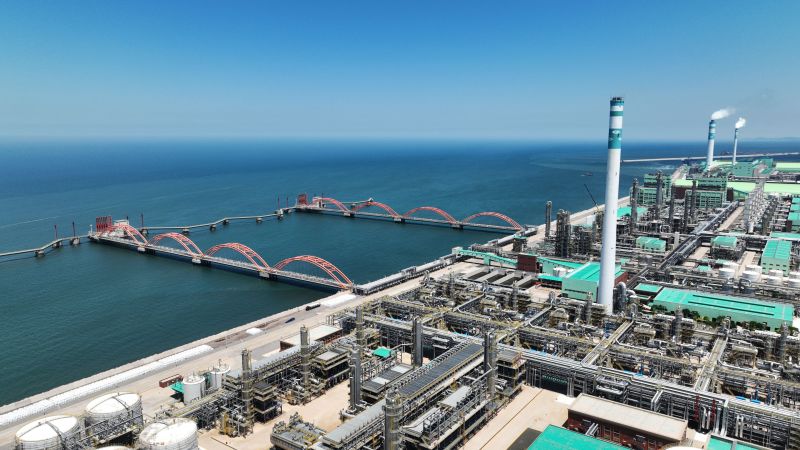
These are the ports, pipelines and refineries of Shandong province and its borderlands, where vast structures of oil storage tanks and the outline of long, slender chimneys jut out from the barren coastal plain.
Here, so-called “teapot refineries” – small independent oil companies operating with permission from the Chinese government – quietly process U.S.-sanctioned Iranian crude oil to produce gas, diesel and petrochemicals for the world’s second-largest economy.
Now, as the U.S. government seeks to cut off Iran’s financial lifeline and force it to surrender to end months of war, these activities are being pushed out of the corner and onto the negotiating table between Presidents Trump and Xi.
Tensions over trade have deepened as Beijing seeks stable relations with the United States, while also maintaining close economic and diplomatic ties with Iran.

On the eve of President Trump’s departure for China, the U.S. Treasury Department blacklisted 12 people and entities for their role in enabling the “sale and shipment of Iranian oil” to China.
Earlier this month, the Chinese government ordered companies to ignore U.S. sanctions on refineries, shortly after the U.S. added new facilities to its list of refineries. Far away in the Arabian Sea, the U.S. Navy is tracking so-called “shadow tankers” carrying this crude oil from Iran. In many cases, they are later imported by traders in eastern China.
Treasury Secretary Scott Bessent recently accused China of funding Iran’s terrorist network with energy purchases.
That attention was clearly felt earlier this week along a desolate road lined with refineries just north of the border between Shandong and Hebei provinces.
Security was tight around the facility run by Hebei Xinhai Chemical Group, a refinery that was sanctioned by the United States a year ago.
Masked security guards stood outside the entrance gate to the processing facility, which is spread over several blocks in the industrial port area.
Several vehicles, including some with company logos, began following the CNN team on the public road in front of the facility, attempting to block the team from filming even outside the windows. Other facilities the team passed in the area did not appear to have similar levels of security.
The company makes gas, diesel, and chemicals such as asphalt, which is used to make blacktop pavement.
Last May, the US government accused Hebei Xinhai of purchasing oil “in connection with the Iranian military.” The company also announced that it was importing hundreds of millions of dollars worth of crude oil in a shadow fleet of tankers, including tankers licensed to transport Iranian products. Hebei Xinhai declined an interview request from CNN.
The company is included in a growing U.S. blacklist.
Four other Chinese refineries have been targeted by sanctions since last year, most within a few hours’ drive of each other in this coastal energy hub.
Shandong’s industry was born decades ago to extract from the Shengli oil fields in the Yellow River delta, but now imports heavily from abroad and processes about a fifth of the oil China consumes.
And what are their import sources? Analysts say crude oil is often subject to sanctions.
“These are small plants that operate on low margins and high sales,” said Erica Downs, a senior fellow at Columbia University’s Center on Global Energy Policy. “They’ve been able to survive because of the discounts they’ve had over the years on Venezuelan, Russian and Iranian oil.”
The one exception to the profile of sanctioned companies so far is Hengli Petrochemical, a much larger refinery in Dalian, a port city across the Bohai Sea from Shandong province. The company was hit last month by U.S. sanctions, which signal the U.S. government’s intention to go after major companies.


A U.S. Treasury document describes Henry as “one of Iran’s largest customers for crude oil and other petroleum products.” The company, which developed the facility on the outskirts of Dalian with government support, denied the allegations in public documents.
China does not allow imports of Iranian crude oil based on customs data, and the origins of imported crude oil are already unclear upstream. But the Chinese government has also rejected U.S. sanctions and ordered companies not to comply with U.S. sanctions on its refineries.
China’s Foreign Ministry on Tuesday pointed to comments by a spokesperson who said the government “firmly opposes illegal unilateral sanctions” in response to a CNN question about Iranian oil purchases.
The structure of China’s oil industry allows independent companies and teapot refiners to take on risks and even maintain operations almost entirely domestically despite U.S. sanctions. Meanwhile, China’s large state-run energy companies, which are deeply entrenched in the international financial system, can generally remain compliant, Columbia University Downs said.
In Xinhai, Hebei province, the source of the oil being processed by the facility was not clear a year after it was blacklisted.
But business clearly continued to move, from the heavily staffed front gate to the tankers rolling down the nearby road.

As the historic global oil shock caused by the US-Iran war drags on, independent refineries appear to be becoming central to China’s energy security, despite a US military blockade to prevent oil-laden tankers from leaving port.
Iranian oil is primarily processed through these independent refineries, which before the war accounted for about 13% of China’s seaborne imports. That likely cost an estimated $32.5 billion last year, and Iran expects to pay about two-thirds of that after fees, said Muyu Xu, senior oil analyst at Kpler.
But last month, that share jumped to 18% after Iran disrupted exports from other countries across the Strait of Hormuz, Xu said.
“From the Chinese government’s perspective, they really want to maintain a stable supply of fuel and ensure energy security. So they are looking at teapot refineries. They know that teapots can still get raw materials,” she said.
Four ports along the Yellow Sea coast in Shandong province and Dalian shipped an average of more than 1.5 million barrels of Iranian crude oil a day between March and April, according to analysis firm Vortexa.
Analysts also say imports have fallen slightly after the U.S. blockade of Iranian ports, but that is due to price rather than availability, as tens of millions of barrels remain in floating storage on tankers far east in the Strait of Hormuz.

Many of these barrels are located near the Singapore Strait in an area known as the Eastern Outer Port Limit (EOPL) anchorage.
It has long been a key node in the circuitous, U.S.-sanctioned secret trade in oil from Iran to China.
Oil is typically transported from Iranian ports to places like EOPL by a network of ships known as the “shadow fleet.” Shadow fleets are often obsolete collections of ships that use evasion techniques to disguise their operations and the origin of their cargo.
Dozens of boats roam EOPL with their tracking devices turned off, passing U.S.-sanctioned oil between them to further obscure the origin of the cargo.
The ships that receive the oil then head to ports such as China, labeling the product as export from third countries such as Malaysia and Indonesia.
At least seven ships loaded Iranian crude oil at this location last month and headed to ports in Shandong province, according to data provided to CNN by Kupler.
But unclear origins and transfers give Beijing the freedom to claim it is not receiving Iranian oil.
Satellite imagery helps tell a more complete story.


CNN identified one transfer last month in which the Iranian-flagged Harvey was berthed alongside another tanker, the Haun Kayo, inside EOPL. This location coincided with the transfer of fuel.
Harvey’s ownership data provided by shipping tracker Marine Traffic links Harvey to the state-owned National Iranian Oil Company.
A few weeks later, in late April, the Harvey headed west toward Iran, where it reconnected with the guided-missile destroyer Rafael Peralta, this time reinforcing the U.S. blockade.

Video released by the U.S. Navy showed a U.S. warship approaching the large ship, which CNN determined was the Harvey, and U.S. Central Command said it intercepted the tanker “as it attempted to sail toward an Iranian port.”
Images from the encounter show the tanker sailing at sea, likely having already unloaded its cargo, indicating the U.S. Navy is closing in on the empty vessel.
Approximately three days later, marine traffic data revealed that a Hungkayo was found wandering near the pier in Yantai Port, Shandong Province, off the coast of eastern China.
It then disappears, goes dark on the tracking system, and reappears three days later in the same location along the pier.
This is a period that coincides with the transfer of oil to port terminals and the completion of seaborne shipments of suspected Iranian crude oil to China.
