

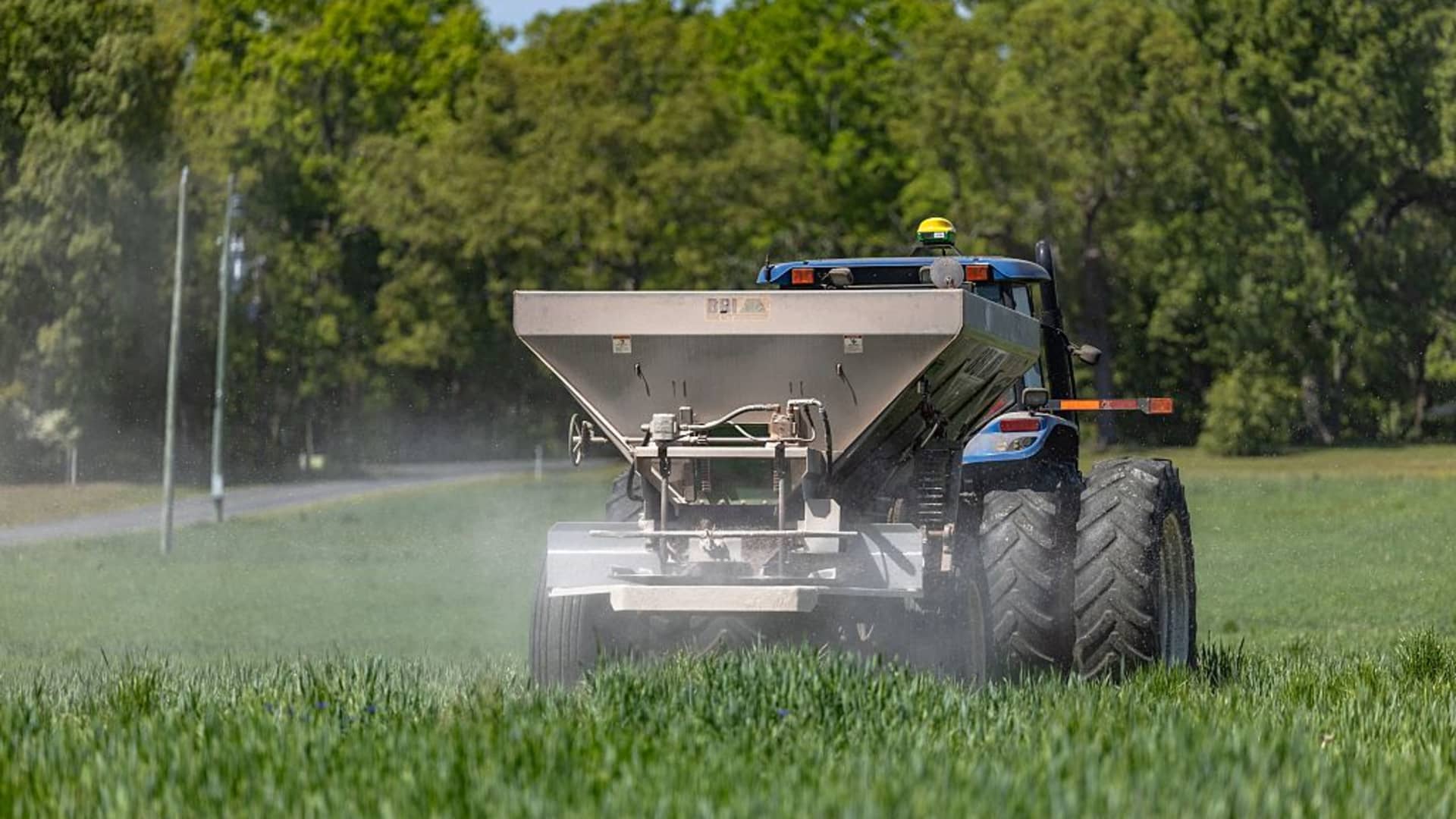
Fertilizer is applied to a field in China Grove, North Carolina, on April 10, 2026.
Grant Baldwin | AFP | Getty Images
On the farm in Goldsboro, North Carolina, where her husband’s family has worked the land for generations, Lorenda Overman faces familiar hurdles, but also new pressures she couldn’t have predicted just a few months ago.
“We’re constantly battling weather, disease and insects,” Overman said. “Input prices have been at record highs for the past three years, but they have increased further in the last six to eight weeks.”
Fertilizer prices are skyrocketing due to transportation disruptions caused by the Middle East war, and the rising costs are spreading across U.S. agriculture just as spring planting begins. Farmers are being forced to reduce inputs, rotate crops, and reconsider planting rates, potentially impacting the supply of certain crops in the U.S. and around the world.
New survey data from the American Farm Bureau Federation shows that fertilizer availability and affordability are critical issues this growing season. The survey, conducted from April 3 to April 11, found that six out of 10 people, or nearly 58%, said their financial situation has worsened due to rising input and fuel costs.
The majority of farmers say they cannot afford all the fertilizer they need. In the Midwest, nearly half (48%) said they could not afford the fertilizer they needed. The proportion was at least 66% in the Western, Northeastern and Southern regions.
Overman said he didn’t order fertilizer in advance, which is common in the industry, because his farm struggled to make ends meet last year and was hoping prices would drop once this year’s planting season began.
“We can’t wait for (the Strait of Hormuz) to reopen and for those ships to get here before we buy these inputs,” Overman said.
Fertilizer and nitrogen costs on her farm jumped from $139 an acre last year to an unexpected $217 an acre this season.
She is one of many farmers currently preparing for a less profitable growing season and rewriting their books to cushion the blow from rising commodity prices.
This could affect farmers’ profits as well as their ability to grow regular quantities of staple crops.
Southern farmers and crops hit hardest
Farmers across the United States are struggling with rising costs, but the impact is not evenly distributed across the country.
Farm Bureau data shows producers in the South are most at risk, with just 19% pre-booking fertilizer ahead of the season, far below the Midwest, where 67% secured supplies early. This timing gap is important. Farmers who did not purchase in advance are now facing higher prices.
Seventy-eight percent of farmers in the South say they can’t afford all the fertilizer they need, compared to 48% in the Midwest.
This is particularly concerning given the composition of the crop. More than 80% of rice, cotton and peanut producers say they cannot afford the necessary inputs. These crops will be most susceptible to reduced yields this season compared to soybeans, which tend to have lower nitrogen requirements.
That’s why farmers like Overman say they’re adjusting their planting strategies this year.
“We’re going to reduce our corn acreage and plant a crop that’s a little less dependent on fertilizer and nitrogen, which is soybeans,” Overman said. “I’m also going to spread that fertilizer a little thinner.”
Tommy Salisbury, an Oklahoma farmer and leader of the Farm Bureau’s Young Farmers and Ranchers Group, said the fertilizer price hike came at an inopportune time for farmers.
“The fertilizer increase we were talking about happened right before our spring plans. It couldn’t have come at a worse time,” Salisbury said. “We already had a budget in place.”
Salisbury also plans to reduce acreage of milo, a corn-like grain, and switch to soybeans to offset rising costs. To make matters worse, crop prices are low enough that higher costs are no longer profitable.
“We’re paying input prices for 2026, but the crop prices we’re getting are in the 70s and 80s,” he said.
All of this poses a threat to yields in 2026.
When farmers reduce fertilizer use or change acreage, they risk lower crop yields and overall production. Large parts of the South, Northeast and West are unable to get enough fertilizer for their crops, and the Department of Agriculture suggests these risks are increasing.
Advocacy groups aim to meet with the White House in the coming months to press for more aid for farmers.
