

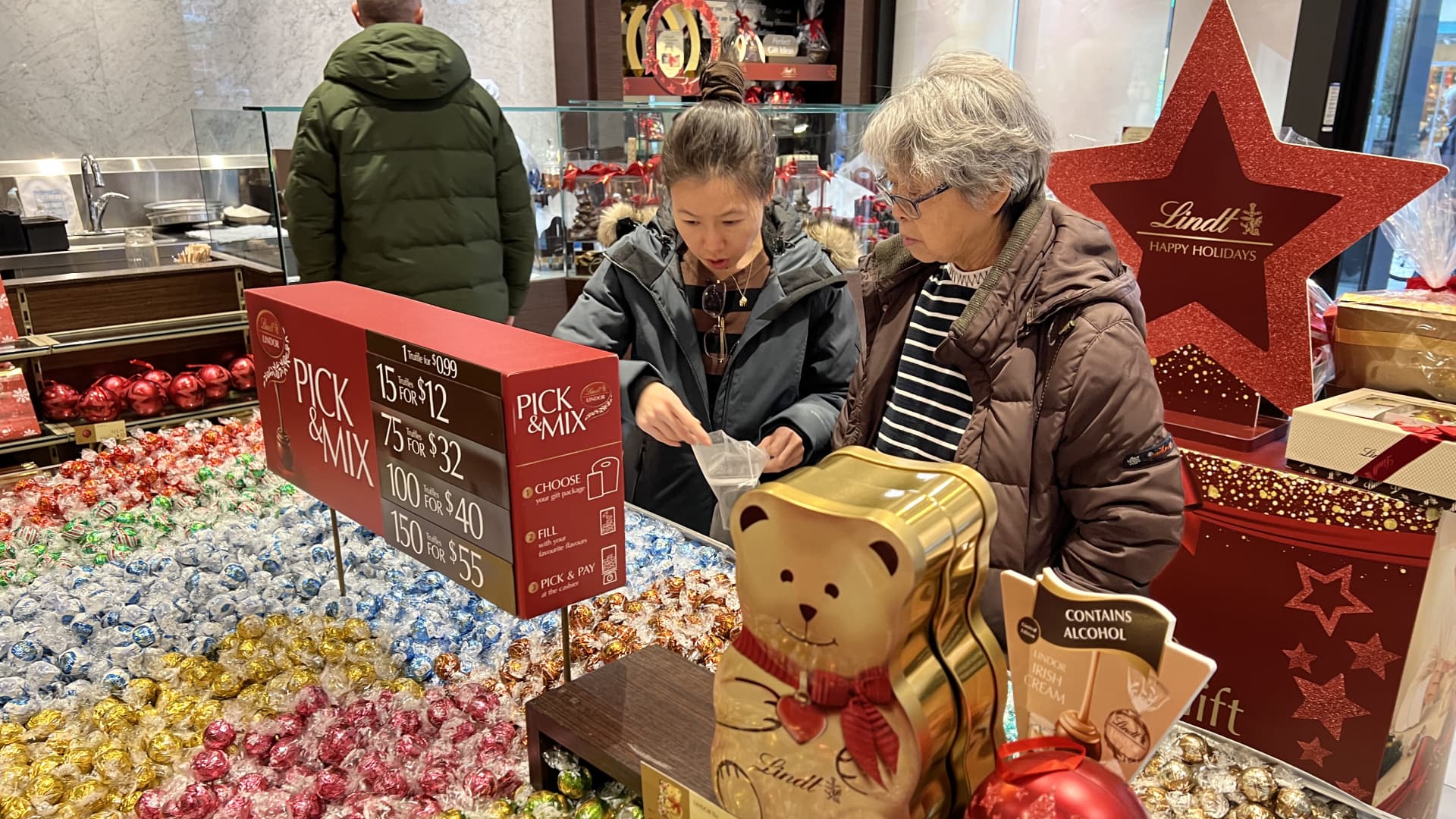
At the Lindt & Sprüngli Chocolate Shop, people choose from an assortment of fine Lindt chocolates.
Null Photo | Null Photo | Getty Images
After record highs, cocoa prices are starting to calm down, but don’t expect cheap candy just yet, as the world’s biggest chocolate makers turn to social media-inspired products and other strategies to win back shoppers.
Cocoa prices have reached record highs over the past two years as bad weather and a poor cocoa harvest pushed up chocolate prices and dampened consumer confidence.
However, the price of cacao now appears to be declining.
cocoa futures The last traded price was $5,327 per tonne, a decline of 34% over the past year. This commodity has soared to around $12,000 per tonne by the end of 2024. Cocoa prices have typically hovered around $2,000 to $3,000 for the past 20 years.

Cocoa futures for the past 5 years.
Swiss chocolate giant barry callebaut, linzand nestle All of them pointed out that soaring cocoa prices were a drag on profits.
Lindt said on Monday that there was an 11.8% price increase across the group and fewer shoppers bought chocolate in the first half of this year, leading to a 7.5% decline in chocolate sales.
“Record cocoa prices necessitated unprecedented price increases across the industry, while geopolitical uncertainty, inflation and weak consumer sentiment weighed on demand,” the group’s CEO Adalbert Lechner said on a conference call with analysts. “The Middle East crisis has added further headwinds by weakening tourist flows from Asia and the Middle East to Europe.”
Barry Callebaut, the world’s largest chocolate and cocoa supplier, said that although global consumers bought 4.4% less chocolate in the third quarter compared to the same period last year, its overall sales volume increased 5.7% in the quarter, the first positive turnaround in two years. Additionally, market corrections earlier this year accelerated global cocoa sales by 18%.
Meanwhile, food and beverage company Nestlé said rising cocoa and coffee prices hit its underlying operating profit in the first half of the year, which fell 2.8%. The company’s confectionery business accounts for 9.7% of total sales. Nestlé expects to benefit from lower cocoa prices.
What is happening to cocoa?
The main reason for the fluctuations in cocoa prices was a poor cocoa harvest in West Africa, which was further exacerbated by weather patterns related to El Niño and climate change, leading to tight supplies.
El Niño is a weather phenomenon of warmer-than-average temperatures that occurs in the Pacific Ocean every two to seven years. A December analysis by Dr Tanya Lander, a researcher on the future of food at the Oxford Martin School Programme, said the rise in cocoa prices in 2024 was mainly due to a “strong” El Niño that brought drier, hotter weather and unusual rainfall in West Africa.
“It is therefore not surprising that El Niño has been linked to cocoa crop failures in both Ivory Coast and Ghana (where 60-70% of the world’s cocoa beans are produced),” Lander wrote.
A farmer cuts cocoa pods and collects the beans inside on a farm in Azaghieh, Ivory Coast, Friday, November 18, 2022.
Bloomberg | Bloomberg | Getty Images
Climate change and rising temperatures are also contributing, making 2024 the hottest year on record. UBS analysts said in an early July note on Lindt that the recent heat wave across Europe could also dampen consumer enthusiasm for chocolate.
Analysts said heatwaves and rising temperatures could impact chocolate demand in some of Lindt’s core European markets, with sales in Europe excluding Eastern Europe falling in the four weeks to June 14.
However, Barry Callebaut said that while a strong El Niño was confirmed in 2026 and 2027, creating a downside risk to supply, a large surplus in 2025-2026 would act as a buffer, resulting in a very different situation to 2023-2024.
Analysts at UBS expect Lindt to hedge against favorable cocoa prices in 2027, which could reduce costs by up to CHF 500 million.
Meanwhile, US President Donald Trump’s reciprocal tariffs have had a short-term but significant impact, causing price hikes and supply chain disruptions. More recently, Lindt’s travel retail business has also suffered around the world as the Middle East conflict has reduced tourist flows.
Premium chocolate, social media trend
With cocoa prices expected to recover, chocolatiers are looking to win back their core customer base by reinventing the format of their luxury products and paying close attention to social media trends that appeal to young people.
Lindt launched a Dubai-style chocolate bar in December 2024 to capitalize on a viral social media trend. global retailer walmart To Trader Joe’s, shake shackDubai chocolate is now available at Harrods.
Lindt Dubai Style Pistachio Knafa Chocolate Bar on display in Newmarket, Ontario, Canada on September 20, 2025.
Null Photo | Null Photo | Getty Images
Lindt CEO Lechner said the company plans to expand its “social media presence” to create a seamless journey between inspiration, discovery and purchase.
“The exceptional success of our Dubai Style Chocolate launch demonstrated the growing power of social media in building awareness, engagement and demand for our brands,” Lechner said on the earnings call.
“This strategy will help you reach new audiences and strengthen relationships with younger consumers.”

Nestlé CEO Philippe Navratil echoed this view, saying on a conference call with analysts on Thursday that the company plans to invest more in influencer marketing, which will also change the way the brand promotes itself.
“More digital, more social, more organic, more fun. Capitalizing on how young consumers interact with the world,” Navratil said.
Both Barry Callebaut and Lindt are focusing on consumer interest in premium products for the remaining six months of the year, but rather than raising prices, they are tweaking the way they offer their products.
“Expanding our pricing structure allows us to attract new consumers, increase purchase frequency and offer more touchpoints with the Lindt brand without compromising our premium positioning,” Lechner said.
Lechner noted that Lindt has selectively reduced prices in key markets such as Germany and Switzerland, particularly over the Christmas period, to support consumer demand during the most critical period. Meanwhile, Barry Callebaut and Nestlé have not mentioned any price cuts.
Instead, Barry Callebaut is also focusing on fine chocolate, expanding its premium specialty chocolate products while growing its gourmet business, which supplies chefs and bakers.
