

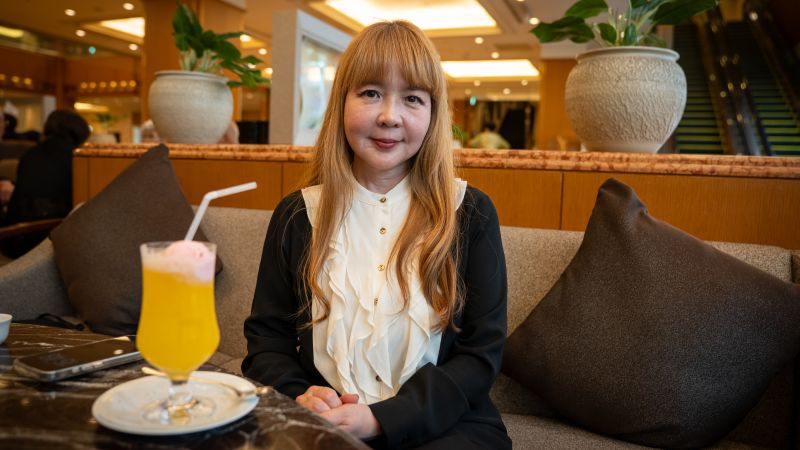
Eiko Toyama has been waiting for 32 years to break up with her husband.
During their marriage, she said, she did all the housework and childcare at her Japanese home and supported her family financially. Her husband “wanted to control everything” from her social life to her professional ambitions, leaving her feeling trapped and miserable. Still, she did her best for her two children.
That finally changed when she turned 60. Her adult sons no longer needed her. And her husband was healthy and not yet old enough to need care. It was a rare opportunity, so she grabbed it.
“(After the divorce) I was just happy. That was the only feeling I had,” she said. “I was so happy and wanted to run around everywhere.”
Stories like hers are becoming increasingly common around the world, as the number of “gray divorces” between couples over the age of 50 increases every year. This trend is also seen in countries such as the United States, but is especially important in Asia, where people generally live longer.
Many places, including South Korea, Japan, Hong Kong, Taiwan, and mainland China, are grappling with a demographic crisis due to falling birth rates and a growing elderly population.
The surge in gray divorces is often caused by women. Women have long faced restrictive gender norms in conservative Asian societies and legal, economic and social barriers to seeking divorce. That is now changing. In Japan, for example, among couples who break up after decades of marriage, twice as many women as men will file for divorce in 2024.
This could change the shape of Asia’s elderly population over the next decade. As more people live alone, experts predict, not only will more people need more welfare support, but they will also probably be more able to step out on their own.
For women like Toyama who grew up in the 1960s and 1970s, divorce was unusual and often faced criticism and shame.
At the time, “divorce was like the end of your life” for a woman, said Sang-Yob Park, an associate professor of sociology at Washburn University in Kansas who wrote a 2023 paper on late-life divorce in South Korea.
Things began to change in the late 20th century, as more women entered the workforce and pursued higher education. Park said divorce among white people has been steadily increasing, especially in the last decade as Gen Xers have started entering their 50s.
This is an important demographic. Generation X, born between 1965 and 1980, was the first generation in globalizing Asia to grow up watching American television and movies. Through pop culture, they also absorbed American values such as prioritizing “individual choice over family obligations,” which, along with these broader economic factors, helped gradually change attitudes toward divorce, Park said.

That’s reflected in the data around the region. Last year in South Korea, the number of divorces among couples who had been married for more than 30 years exceeded the number of divorces among young couples who had been married for less than five years for the first time.
Divorce among long-married couples is also on the rise in Taiwan, according to government data. In Hong Kong, law firms have reported a sharp increase in gray divorces, and in mainland China, the number of divorces among elderly people has doubled in the past 30 years.
Demographics may also have something to do with this. In an aging society, there are more elderly people, so older divorces will also increase. Recently, fewer young people are getting married, and as a result, divorce is also on the decline.
However, legal reforms have also brought about major changes, creating a safety net for women who previously had to rely on their husbands for a living.

For example, South Korea ruled in 2014 that future pension and retirement benefits can be included in asset division. This means that if a housewife takes care of all the housework and childcare during marriage and her husband is able to work, she is entitled to receive a portion of her husband’s old-age pension after divorce. Japan introduced similar reforms in 2007.
These measures are especially important given the high rates of poverty among older people in Asia. Among OECD countries, South Korea has the highest poverty rate for people aged 65 and over. Hong Kong (not an OECD member) is similarly high. Although Japan’s ranking is slightly lower, it is still above the world average.
And despite these reforms, deep gender inequalities remain.
“The main reason for not being able to divorce, especially for women, is the lack of economic independence,” Toyama said, pointing to the low wages of women in Japan. “Once a woman becomes a housewife, it is difficult for her to leave her husband and become independent.”
“My two children are boys, but if I had a daughter, I would always tell her, ‘No matter what happens, never quit your job,'” she added.
Park said the biggest commonality across Asia is longevity and how people think differently about the final part of life.
“Another 20 or 30 years creates new expectations,” he said, leading people to “leave unhappy and unfulfilling marriages.” Divorce “is no longer a failure; rather, it’s something new. It’s the beginning of a new chapter.”
Iman Lau, 50, experienced this rebirth firsthand. Growing up in Hong Kong, she didn’t have very exciting expectations for marriage. She thought spouses would eat together, do activities together, and share a bland and peaceful life. “That’s what marriage is like.”
That spirit remained unchanged even after years of her husband’s infidelity. She will wonder if she did something wrong, if she wasn’t good enough. Despite her pleas to stay together, he was the one who ultimately initiated the divorce. He even compared her to a bird that refused to fly out of an open cage.

“I’m a pretty traditional woman,” she said. “I never thought in my life that I would get divorced.”
It was a shock, as if I had lost a limb or an organ. But at the same time, she said, somewhere during their 14-year marriage, she realized she had lost her sense of self and just “went around him,” ignoring her friends and interests.
This year, after her divorce was finalized, she threw herself into this world with determination, vowing to change that. She joined an online meetup group and made new friends. She discovered a love for the outdoors and went hiking, swimming, kayaking, and snorkeling. She is learning piano and loves jazz.
After traveling all over Europe, she printed out holiday photos and hung them in her apartment. It’s her “wall of happiness” and reminds her of the joy she found trekking in Sicily and camping in Georgia.
“I never knew living alone could be so great,” she said.
Toyama has embarked on a similar journey, and at 63 years old, she describes herself as “full of life.”
She started livestreaming on TikTok and created an account on the messaging app to give advice to people who called and texted her weekly. He is working on launching new businesses such as a marriage consultation agency and a live event company.

“I couldn’t do anything for 32 years, but in my third year I was finally able to do what I wanted to do,” he said. The process wasn’t easy, but any hardships she faces now are “much better than the anxiety of being with my ex-husband,” she said. “More than anything, there is freedom.”
Both women said they noticed a change in people’s attitudes when they shared the news of their divorce. For Toyama, the response was overwhelmingly positive, with some expressing envy. In Lau’s case, they were more divided – and in ways that have become clear.
“My friends my age treat it like a taboo, like a death in the family has happened. They don’t dare ask about it, they just say, ‘I’m sorry,'” she said. “But all the Gen Z young people congratulate me.”
The rise in white divorces could start to plateau as millennials, who married into very different environments and social attitudes than their predecessors, begin to age toward retirement, Park said. However, this will not continue for another 10 years, and until then separation will continue to increase.
For those going through a divorce in the future, Lau offered words of encouragement from the other side. “Actually, this world is abnormal,” she said.
“Asians in particular often think of divorce as a stain on life, a taboo, a label of failure, but that’s not the case,” she added. “Think of it as giving yourself the opportunity to understand that you can live a more vibrant life as long as you are willing to take that step.”
