

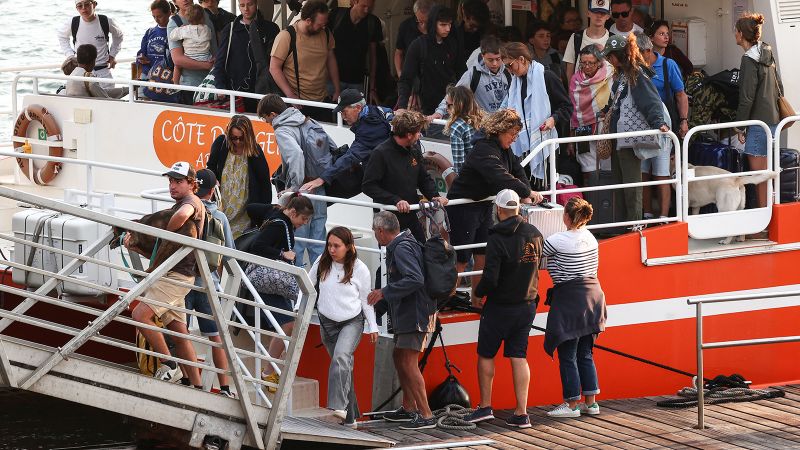
French authorities on Friday ordered a complete evacuation of the Cap Ferret peninsula and sent boats to rescue people from the popular tourist destination threatened by wildfires.
Evacuation boats are operating from three piers on the peninsula, about 70 kilometers (43 miles) west of Bordeaux in southwestern France, the state’s governor, Sophie Brocas, announced Friday morning.
Such operations demonstrate the severity of the wildfires currently burning in parts of southern France and elsewhere in Europe, sparked by record climate change heatwaves and turning the landscape into tinderboxes.
Similar wildfires have broken out in Spain, forcing the government to declare a national state of emergency.

French Interior Minister Laurent Nuñez said 40,000 people had been evacuated in Cap Ferret alone, but only a few hundred of them were evacuated by sea.
Only one road connects the Hamptons-like peninsula to the mainland, so evacuations are a priority if a fire cuts off access to that road.
Residents testified that they received text messages during the night asking them to evacuate. “There are firefighters everywhere, police everywhere, checking to see if people really left their homes,” one resident told CNN affiliate BFMTV. “Just 200, 300 meters from here you can see a wall of flames around Rege…the flames are right there.”
Video from the scene showed smoke in the sky, charred vegetation and firefighters battling an outbreak in a residential area.


Marc Vermeulen, head of Gironde’s fire and rescue department, said on Friday that the fire had grown by up to 1,000 hectares (4 square miles) every hour overnight.
“The fire was so strong that it caused a spot fire in the center of town, even though it was still on the outskirts. There were also embers, which spread the fire from house to house,” Vermeulen said.
The blaze has destroyed about 53 homes and a campsite, and 1,000 firefighters are working to extinguish it, Brocas said.
Another wildfire is burning in an area near Biscarrosse, about 40 kilometers south of Cap Ferret, where 23,000 people have already been forced to evacuate.
Other European Union countries are also sending firefighting planes to help fight the Paris wildfires, following a request for assistance from French President Emmanuel Macron.
“We can soon expect reinforcements from two Canadian Airlines from Croatia, two Air Tractors from Portugal, and two Black Hawk heavy helicopters from the Czech Republic and Slovakia,” Macron wrote on XFriday.
Wildfires occur in Europe every summer. But data from the European Forest Fire Information System (EFFIS) shows that much more land has been burned on the continent this year than the annual average for the same period.
The situation is particularly bad in France, where there have already been more than 300 wildfires this year (compared to the annual average of 93), according to EFFIS.

The climate crisis is making the weather hotter and drier, siphoning water from rivers, lakes and soils, drying out landscapes and causing more intense fire seasons.
The brutal record-breaking June heatwave that hit Europe earlier this summer would have been “virtually impossible” without the man-made climate crisis, according to an analysis by World Weather Attribution.
Thick smoke from wildfires darkened the skies over Spain on Friday, when the country’s government declared a national state of emergency.

Spanish authorities said as of Friday morning they had evacuated more than 10,000 people from a group of towns about 75 kilometers (47 miles) west of Madrid. They included residents of elderly care homes and holidaymakers visiting campsites.
“I’ve lived here for 36 years and I’ve never seen anything like this,” Javier Martín, a resident of Navallenga town, told Reuters. “I didn’t expect it either. Last night I thought they would get things under control, but it was already too late and everything was out of control.”
