

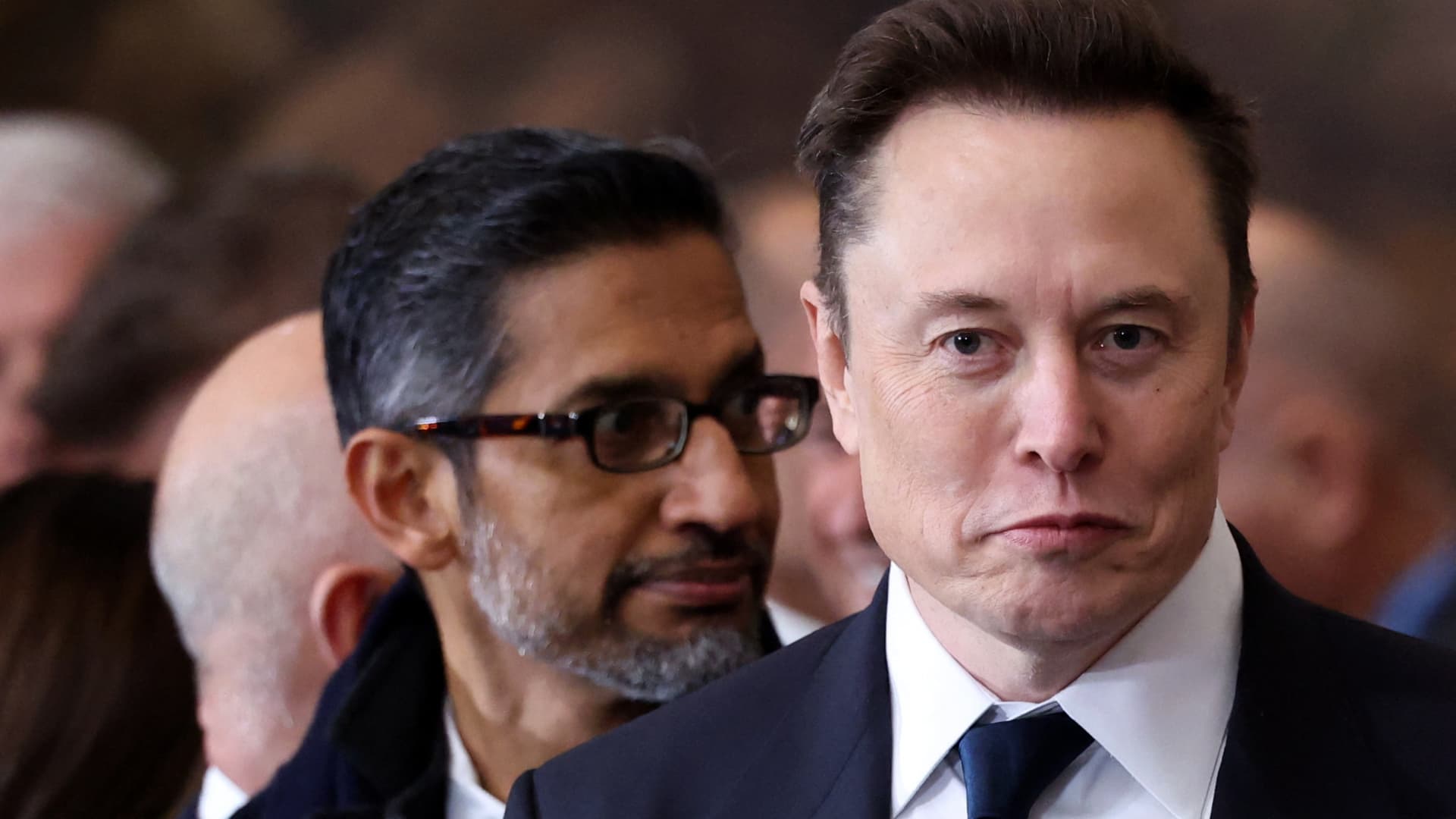
SpaceX, Tesla, and X CEO Elon Musk and Google CEO Sundar Pichai attend Donald Trump’s presidential inauguration in the U.S. Capitol Rotunda in Washington, D.C., January 20, 2025. Trump will serve his second non-consecutive term as the 47th President of the United States.
Kevin Lamarque | AFP | Getty Images
shares of alphabet and tesla Shares fell in premarket trading Thursday as both companies signaled an increase in AI spending, spooking investors worried about rising costs from the artificial intelligence boom.
Alphabet shares fell about 4%, and Tesla shares fell more than 5.7% in premarket trading. The move comes after Alphabet stock closed 1.46% lower on Wednesday and Tesla stock closed 1.3% lower.

Alphabet and Tesla stocks this year.
Both companies reported negative free cash flow in the second quarter on Wednesday. Alphabet raised its capital spending forecast for this year to between $195 billion and $205 billion, warning that it will spend even more in 2027. Google’s parent company had previously projected capital spending of $180 billion to $190 billion.
Meanwhile, Tesla announced that capital spending in the second quarter reached $5.79 billion, an increase of 142% from the same period last year. The company said it expects capital expenditures to exceed $25 billion this year.
Management at both companies sought to allay investor concerns about the spending.
“This is a year of massive capital investment. We’re confident that everything we’re investing in will deliver an incredible return. Really, probably the best capital investment return we’ve ever had,” Tesla CEO Elon Musk said on an earnings call Wednesday.

Musk spoke about the company’s future efforts with semiconductor production and Tesla’s humanoid robot Optimus, emphasizing where the spending will go. Tesla has “installed first-generation lines for Optimus” and will “begin production shortly,” the company said in its earnings call.
Alphabet’s CEO said the increase in spending was “primarily due to accelerated capacity supply to meet increased demand.” Tech giants claim they don’t have enough computing power to meet the demand for AI they see.
“While investors appear to be focused on rapidly increasing capital spending and the prospect of declining margins, the continued delays and lack of notable product releases for Gemini 3.5 Pro raise questions about whether Alphabet’s AI investments are still leading to a clear competitive advantage,” Ben Barringer, head of technology research at Quilter Cheviot, told CNBC.
The companies’ spending was offset by several bright spots.
There were signs that some of Google’s investments were starting to pay off. Google’s cloud revenue rose 82% to $24.8 billion, beating expectations.
“This was one of the strongest revenue growth quarters for Alphabet in the last five years, and Alphabet is a very good barometer for this whole AI wave,” Allison Porter, a portfolio manager at Janus Henderson, said Thursday on CNBC’s “Squawk Box Europe.”
Porter pointed to strong Google Cloud revenue growth and the unit’s operating margin to 35.6% in the second quarter, up from 20.7% a year earlier, as evidence that the company is performing well as a result of its investments.
“We think this outlook is very encouraging… both for overall AI capital spending and for the return that these platforms are seeing on their spend,” Porter said.
At Tesla, the company’s core automotive business brought in revenue of $20.52 billion, up 23% from a year ago.
—CNBC’s Lora Kolodny and MacKenzie Sigalos contributed to this report.
