

President Donald Trump has vowed that the United States will retaliate harshly after three American service members were killed in recent fighting with Iran.
“Every time Iran kills an American soldier, they will pay the price for that killing many times over!” President Trump wrote in Truth Social, adding that he had communicated the “directive” to “all military leaders.”
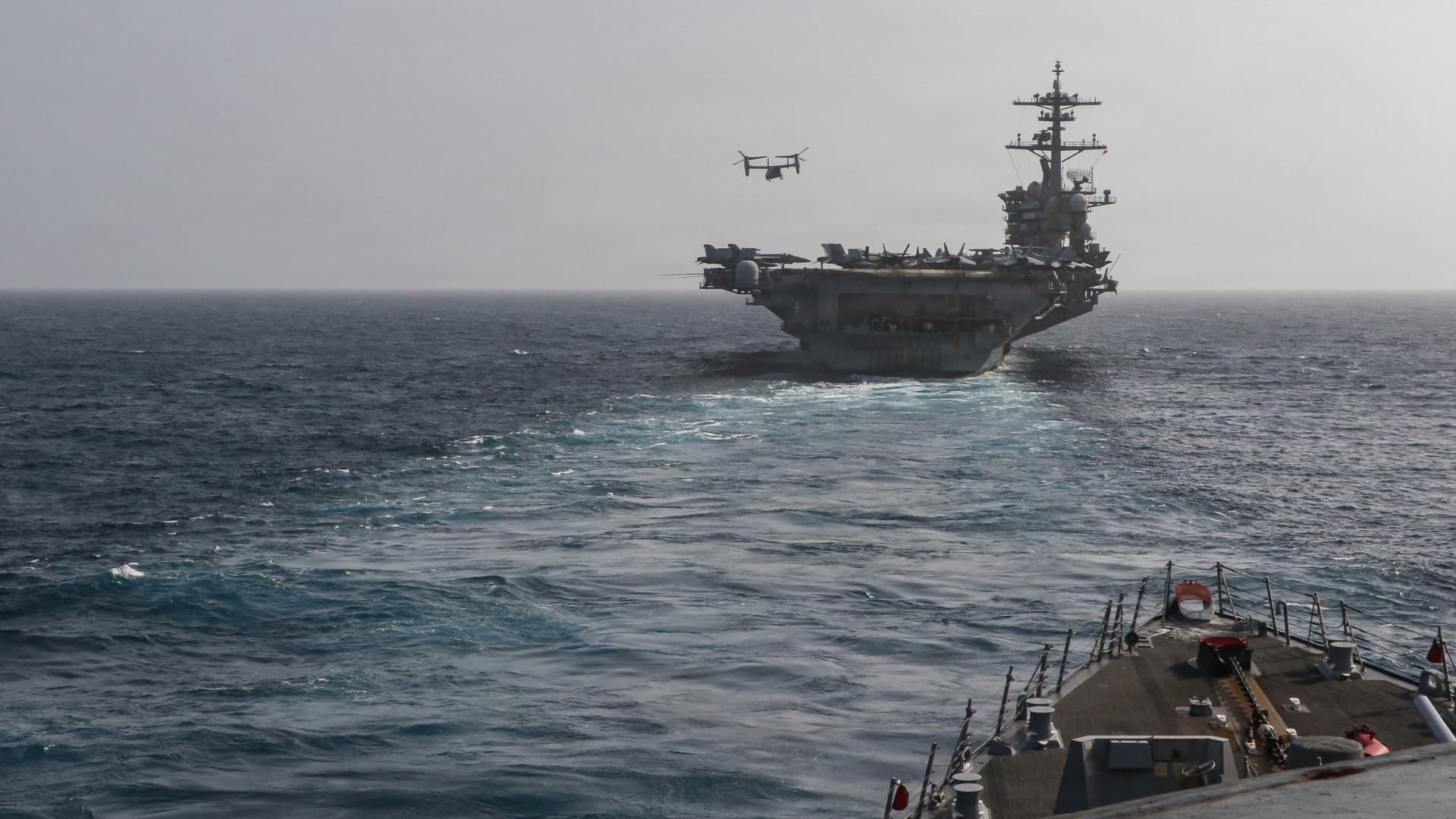
The angry post came after U.S. forces attacked a series of Iranian military sites and assets overnight as they worked to transit the Strait of Hormuz for oil tankers and other commercial vessels that were blocked during the war.
U.S. Central Command said in a post on X on Sunday night that it targeted “Iranian military command centers, air defense and coastal surveillance sites, maritime capabilities, missile and drone launch sites, and communications networks.”
Centcom said the three-hour barrage of attacks “further reduces Iran’s ability to attack commercial vessels and civilian seafarers transiting the Strait of Hormuz.”
But traffic in the strait, an economically important waterway through which 20% of the world’s oil passed before the war began in late February, remains far below pre-war averages. Tracking company Kpler announced Monday morning that there were just 30 “confirmed transits” in the strait between Friday and Sunday.
On Monday, Yemen’s Iran-backed Houthi militants declared a maritime embargo on Saudi Arabia, threatening to worsen the global oil supply squeeze caused by the strait disruption.
Nevertheless, oil prices fell on Monday morning after Iran’s Foreign Ministry spokesperson said messages were still being exchanged through intermediaries despite the escalating conflict. However, prices rebounded little by little following Trump’s post.
Brent crude oil futures, the international benchmark, were last trading 32 cents higher at $88.42 a barrel. U.S. West Texas Intermediate crude oil futures rose 1 cent to $82.50 a barrel.
Both the United States and Iran have repeatedly accused each other of violating a temporary ceasefire agreement reached in June. Frustrated by continued hostilities centered on the Strait of Hormuz, President Trump this month declared the ceasefire “over” and urged the United States to reinstate a retaliatory blockade of Iranian ports in the Gulf.
The US death toll from the Iran war has now risen to 17. Iranian authorities said Sunday that at least 50 people were killed and more than 500 injured in renewed U.S. attacks this month.
“The memorandum says little about how pending cases will be investigated or how violations in one area will impact obligations in other areas,” Michael Ferrer, chief strategist at Geopolitical Strategies, said of the June agreement. He noted that due to the memorandum’s ambiguity, the case quickly turned into a dispute over whether the agreement still existed.
US attacks have expanded in recent days to target civilian infrastructure, including the Bonzi desalination plant, which has cut off water supply to about 10,000 people.
The Iranian government is also retaliating across the Gulf with new attacks against targets in neighboring countries, including Bahrain, Saudi Arabia, and Jordan. Kuwait’s military announced on Monday that its air defense systems were intercepting “hostile” drone attacks from Iran.
The U.S. Embassy in Bahrain’s capital, Manama, said Monday that it has intelligence suggesting Iran may be targeting unspecified locations in the city. Sirens rang across Bahrain as authorities urged residents to evacuate.
Iran’s Islamic Revolutionary Guards Corps said on Monday that two oil tankers “exploded” while attempting to pass through the “unsafe and dangerous route south of the Strait of Hormuz.” Iranian authorities warned ships not to use the US- and Oman-backed Southern Corridor, insisting that only Iranian-designated routes would be allowed.
Despite reports of a slowdown in traffic passing through the strait, US officials insisted that flows were still being maintained. Energy Secretary Chris Wright said Sunday that about two-thirds of pre-conflict traffic – about 14 million barrels per day – was passing through the chokepoint. Before the conflict, approximately 20 million barrels of crude oil and refined products passed through the waterway.
In an interview with the ABC on Sunday, Wright said public reports that most shipping had stopped in recent days were untrue, estimating it to be about two-thirds of normal traffic.
