

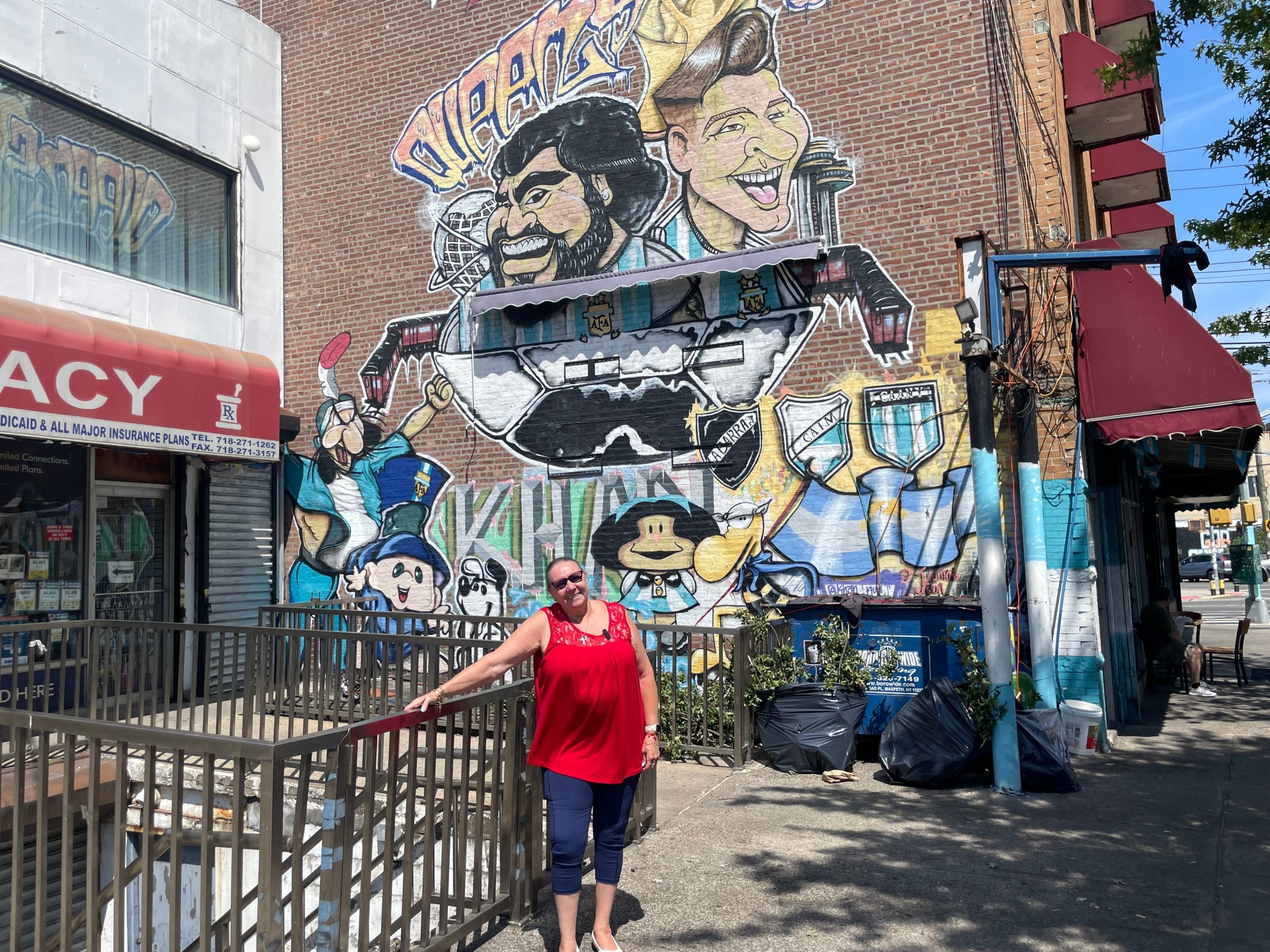
NEW YORK CITY – It’s called “Little Argentina,” but lifelong resident Cristian Jimenez says a lot has changed in the area where he grew up.
Once the center of the Argentine diaspora that settled in New York City, most of whom emigrated during the so-called “Dirty War” of the 1970s, only a handful of Argentine restaurants and bakeries in the Elmhurst neighborhood of Queens remain.
Recommended stories
list of 3 itemsend of list
But as the FIFA World Cup approaches, the city is filled with revelers dressed in white and sky blue. When Argentina plays the final against Spain just a few miles away in East Rutherford, New Jersey, on Sunday, everything on the block will be painted in the iconic color, from the asphalt to the benches, storefronts and even fire hydrants.
Jimenez, owner of Rio de la Plata Bakery and one of the people who spearheaded the decoration, told Al Jazeera that when he was a child, “everywhere I went, it was Argentina.” “So what I’m doing is keeping it alive.”

Indeed, it is clear that the 40-year-old’s commitment to the Argentina national team goes far beyond the month-long tournament. The World Cup only takes place once every four years, but the proud mural of Lionel Messi and Diego Maradona on the side of his bakery takes center stage.
For many, this is a reminder of the intergenerational importance of this country’s soccer tradition, one that has remained the glue for Argentines in New York City for decades, despite the community’s dispersion.
Beatriz Jaime, 74, watched Argentina’s loss to the Netherlands in 1978 live from Madison Square Garden, and when she returned to her neighborhood immediately afterward, she recalled that it was “filled with people” until the evening.
“The important thing is that the roots are here, in Argentina,” says Jaime, who grew up in Queens and now lives on Long Island.
“Never forget that. It gives you goosebumps.”

For Henry Pachaco, 45, also from Queens, the fans are a family affair. He stood there wearing a national team jersey while his mother wore a blue shirt with the words “Hand of God” written on it. It is named after Maradona’s infamous handball goal in the 1986 quarter-final against England.
Pachaco calls the block the city’s “center” for Argentine fans, and on game days it offers a stadium atmosphere without the price tag, complete with closed streets, music, outdoor television and street food.
For Argentina to reach the final, for Messi to potentially play his final game for the national team, and for it all to happen right before New York’s eyes, it means the world is coming together, he said.
“It’s like bringing Argentina to New York… No matter where you go, no matter where you are in the world, when Argentines come together, the same passion is that no matter what, we are equal.

“You will always be accepted here and have the time of your life,” he said.
Jiménez echoed that sentiment, citing several racist incidents by Argentine fans that marred La Albiceleste’s performance in this and the previous World Cup. He said it’s not representative of the fan base.
“Whatever your racial or ethnic background is, we don’t look into it,” he said.
“If you support us, we love you. Stay straight, stay the way you are.”
A new fandom is born in Brooklyn
The message is also likely to be well-received in neighborhoods outside of Brooklyn’s Kensington neighborhood, home to a burgeoning Bangladeshi community that calls the area “Little Bangladesh.”
New York City data shows the diaspora population has tripled in the past two decades, making it one of the fastest-growing groups in an ever-changing city. Last year, the community elected the first-ever Bangladeshi American to the New York City Council.
Shafiqur Alam, 66, who has lived in the area for 36 years, said the area has changed and brought in a passionate new base of support for the Argentina national team.
On game days, large televisions will be installed in the nearby pedestrian plaza. When the weather turns bad, he said, it’s not uncommon for people to flock inside to watch TV at home.
“Bangladeshis love Argentina, and Argentina loves Bangladesh,” he said.

A number of factors converged to increase support for Argentina, and especially Bangladesh, within South Asia, most notably newfound access to television in the 1980s, coinciding with Maradona’s national team’s defeat of England in 1986.
The match had powerful political implications for countries still grappling with the legacy of British colonialism. But for many young fans, their support comes down to one man: Messi.
“If everyone knew that this could be Messi’s last match, they would want to watch it,” said Sajid Bhuyan, 31, who lives nearby.
He could not imagine that less than 90 percent of Kensington’s local Bangladeshi community supported Argentina.

Although the origin stories of their fandoms may be different, Bhuyan felt the passion was the same from Little Bangladesh to Little Argentina.
He looked back at the tournament, where Argentina repeatedly came back from the brink of defeat, most recently with a spectacular comeback against England in the semi-finals.
“I almost died when Argentina scored two goals in just a few minutes,” Buyan said. “I couldn’t breathe, I couldn’t speak, and it took me five or six minutes to calm down.
“So if it happens again, let’s have fun!” he said.
