

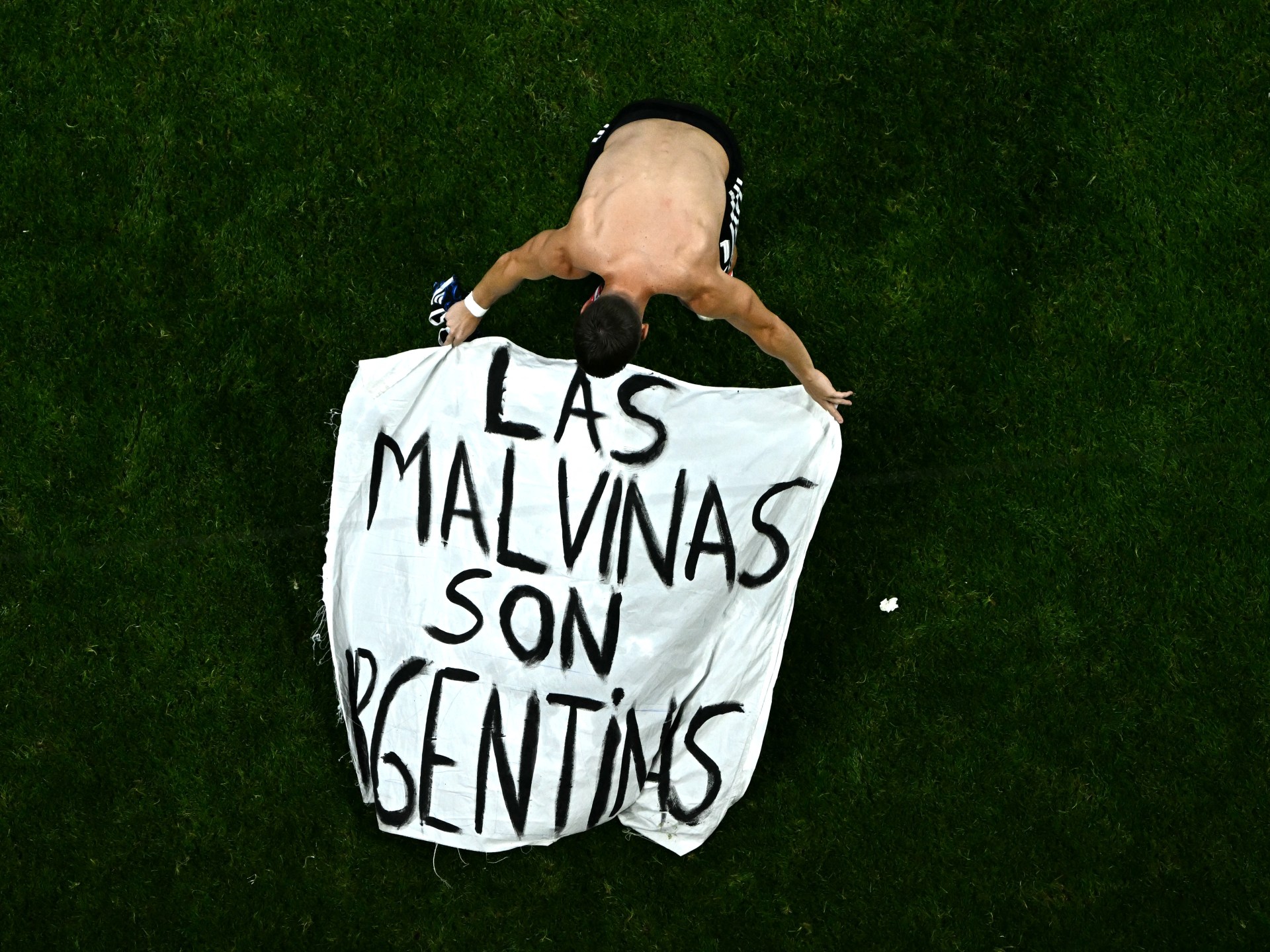
FIFA has launched an investigation into Argentine players’ display of political banners after their World Cup semi-final victory over England, which breached stadium codes of conduct and struck a nerve with Britain over political sovereignty.
After Wednesday’s dramatic come-from-behind victory, defender Lisandro Martinez and unused substitute Giovani Lo Celso celebrated on the pitch holding up a banner reading “Argentina, son of Las Malvinas” and waving to fans in the stands.
Recommended stories
list of 4 itemsend of list
The move caused an uproar in the UK, with senior government officials asking FIFA to investigate the matter, and the international governing body confirmed FIFA had launched an investigation as “standard procedure”.
“FIFA’s Independent Disciplinary Committee is currently assessing the match report and considering the relevant circumstances before deciding on further action under the FIFA Disciplinary Code,” a FIFA spokesperson told Al Jazeera on Thursday.
The origin of the banner in question is unclear, but FIFA could prosecute the Argentine players and the soccer federation for violating stadium disciplinary regulations that prohibit “messages unsuitable for a sporting event” that are “political, ideological, religious or offensive in nature.”
FIFA fines for political messages range from approximately $5,000 to $20,000.
Argentina will defend its World Cup title on Sunday against Spain in the World Cup final at New York/New Jersey Stadium.
Asked on Wednesday if the banner had touched deep emotions among war veterans, Martinez said: “We couldn’t let the Argentine people down.” Martinez has been playing soccer for Manchester United in England for the past four years.
UK asks FIFA to investigate ‘serious breaches’
Earlier on Thursday, British Economy Minister Peter Kyle had asked FIFA to investigate “serious breaches” of FIFA rules.
“The World Cup may not be ours, but the Falkland Islands most certainly is,” a Downing Street spokesperson said. “Self-determination rests with Islanders and our commitment to the Falkland Islands will never waver.”
Argentina invaded British Overseas Territories in the South Atlantic in 1982.
However, Britain regained the islands in a short war after then Prime Minister Margaret Thatcher sent in a naval force.
Kyle has called on soccer’s world governing body to “thoroughly” investigate the banner-banning incident after Wednesday’s match in Atlanta, Georgia.
“Politics needs to be separated from football. Indeed, one of the central tenets of the World Cup is that politics is separated from football,” he told BBC television.
“It is now a matter for FIFA. … We expect FIFA to launch an investigation into this matter,” he added.
Britain occupied the Falkland Islands in the 19th century, but Argentina claims the islands are part of its territory.

Argentina’s President Javier Millay said it was “completely legitimate” for the players to celebrate by holding up banners and said the message “reflects the sentiments shared by all Argentines.” But he said he expected FIFA to fine the team.
“I can understand the actions of the players. They are emotional and act impulsively. That will lead to discussions about fines,” Millay told a local radio station in Buenos Aires.
Argentina’s Vice President Victoria Villaruel heightened tensions before Wednesday’s kick-off, calling Britain “usurping pirates.”
The 1982 conflict ended with the deaths of 649 Argentinians and 255 British nationals.
After the World Cup semi-final victory, Argentina’s foreign minister said Buenos Aires had lodged a formal protest against British warships near the Falkland Islands.
In a post on X, Pablo Kirno expressed his “strongest rejection” of the “unconsulted and illegal” passage of the British battleship Medway through Argentine territorial waters, citing the lack of proper notification.
Kirno said Falkland Islands-based Medway was accused of breaching bilateral agreements in a diplomatic note of protest submitted to the British embassy in Buenos Aires dated Monday.
Past cases
Argentina’s players displayed the same slogan, “Argentina, sons of Las Malvinas”, during a June 2014 warm-up match in Buenos Aires in preparation for the World Cup, which starts in Brazil a few days later.
The decision of FIFA’s disciplinary committee in this case was made public after the tournament, and the Argentine federation was fined 30,000 Swiss francs (approximately 3.7 million yen).
FIFA’s disciplinary case under its previous leadership saw a South Korean player suspended from two 2014 World Cup qualifying matches for holding up a similar banner about territorial claims against Japan at the 2012 London Olympics. After South Korea defeated Japan in the men’s bronze medal match, Park held up a banner with the slogan “Dokdo is our territory.” FIFA’s ruling said the Korean players’ actions were “unacceptable.”
At the 2022 World Cup, FIFA has fined the Serbian federation 20,000 Swiss francs ($24,800) for displaying a political banner about neighboring independent Kosovo in the locker room before a game against Brazil. It showed a map of Serbia, including the territory of Kosovo, which has been an independent state since 2008, and the slogan “No Surrender”.
