

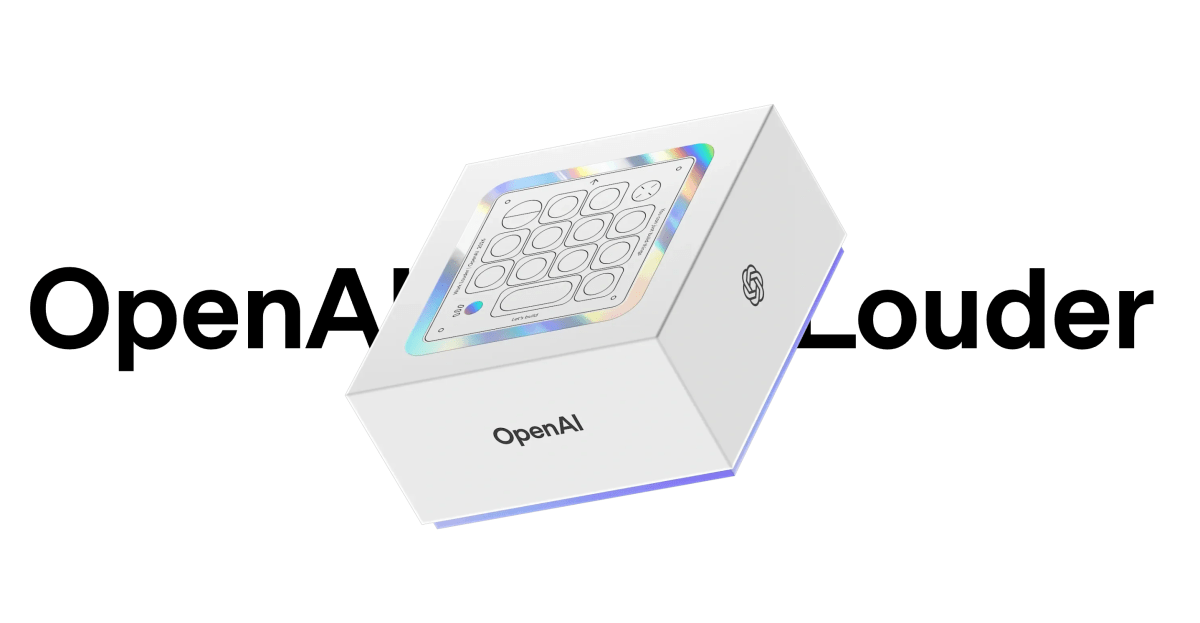
OpenAI officially enters the hardware market with the launch of a $230 light-up keyboard designed to pair with its AI coding assistant, Codex.
Codex Micro was co-designed with expert keyboard designer Work Louder and is being touted as a great new way for ChatGPT users to manage their AI coding agents – semi-autonomous bots that can write and run code with little to no human input.
The device features an illuminated “Agent Key” to indicate agent status, a customizable command key to serve as shortcuts for frequent Codex actions, and a joystick to launch common workflows. It also has a dial that adjusts the amount of “reasoning” (essentially time and computing power) that the agent uses for a given task (the agent’s reasoning level).
The idea is that instead of managing agents through your phone or desktop app, you’ll be able to use the Micro as what OpenAI calls a “command center for agent work.” It will look really cool on your desk. This device can be controlled and customized via the ChatGPT desktop app.

OpenAI told TechCrunch in an email that the Micro is a limited production collaboration, suggesting it’s more of a novelty item than a product designed for the masses. This seems like a flashy bauble designed to herald the company’s entry into the hardware market.
More important hardware news arrived on Tuesday. The yet-to-be-released OpenAI device revealed by Bloomberg appears to be designed for long-term use. It’s described as a portable, screenless smart speaker that integrates with ChatGPT and has “mechanical elements that can move on their own.”
At this point, it’s hard to imagine how all the different details – screenless, portable, moving parts, etc. – can be integrated into a coherent product (OpenAI doesn’t say so). But it leaves an interesting picture, to say the least. It seems like it’s not over yet. The Bloomberg report emphasizes that this item is still in development and subject to change.
The new device is also reportedly designed by a former Apple engineer who is currently suing OpenAI for trade theft.
This connection has not gone unnoticed, especially by Apple. Apple last week sued OpenAI, accusing its senior executives of a deliberate strategy to extract sensitive information. OpenAI claims to have used that information to develop its own hardware devices. OpenAI denies wrongdoing.
If you buy through links in our articles, we may earn a small commission. This does not affect editorial independence.
