

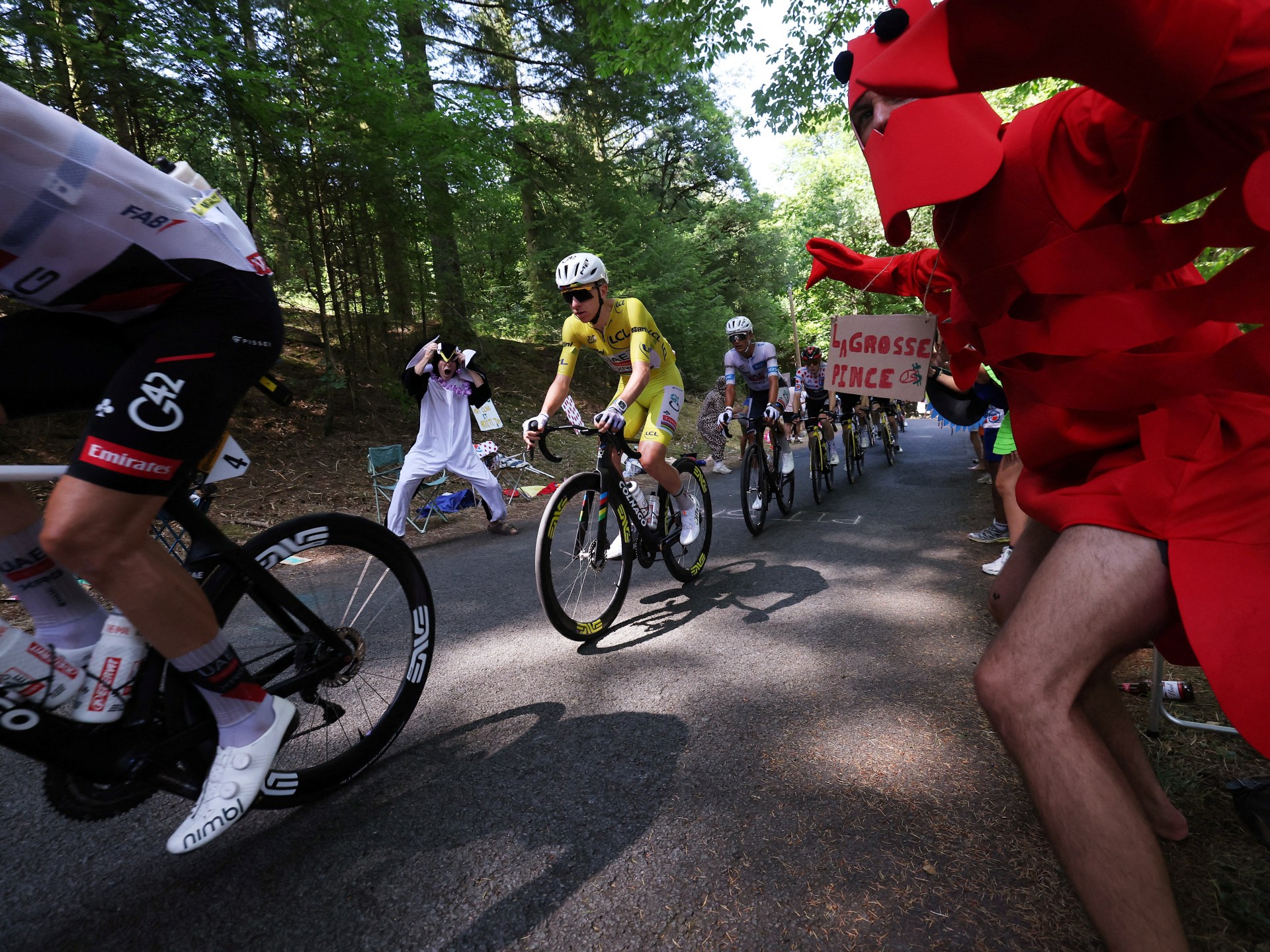
Published July 14, 2026
Like every year, the opening week of the Tour de France is punctuated by crashes, several of which highlight how difficult it is to deal with concussions in a sport where the clock is always ticking.
Of the eight riders who have withdrawn from the race since the race began on July 4 in Barcelona, Spain, three have withdrew due to concussion. French rider Clement Berthe of Groupama-FDJ United, Dutch rider Alex Molenaar of Caja Rural-Seguros RGA and Norwegian Torstein Trien of Uno-X Mobility, who temporarily wore the yellow jersey.
Recommended stories
list of 4 itemsend of list
All three had one thing in common. He crashed, completed the stage, was diagnosed and retired later that night.
Berthe crashed heavily in the opening round of the team time trial, Molenaar crashed 5 km (3 miles) from the finish of the fifth stage, and the next day Triene, wearing the race leader’s yellow jersey, crashed to the ground on the descent of the Col du Tourmalet.
“It is never satisfying to see athletes who have resumed racing diagnosed with concussion,” Xavier Bigard, medical director of the International Cycling Union (UCI), told Reuters.
The UCI introduced a concussion protocol at the beginning of the 2021 season. A year ago, French rider Romain Bardet covered almost 90 kilometers (56 miles) despite sustaining a concussion in a crash at more than 60 kilometers per hour (37 miles per hour).
“We have come a long way,” said Bigard, who started working on the protocol after joining the UCI in 2018.
Under current procedures, a rider who crashes must be evaluated by the first person to arrive, often the team’s mechanic.
If the rider detects at least two signs of concussion, such as nausea, head or neck pain, limb weakness, disorientation, or loss of balance, the rider must be removed from the race.
If not, the rider may continue before receiving further evaluation from the medical car or team vehicle during the race. This inspection requires answering some relatively simple questions about the race situation and can still result in a rider being disqualified.
If a concussion is suspected, a more complete examination should be performed after the stage, lasting approximately 10 minutes.
“The roadside protocol is much shorter,” said Mathieu Le Strat, medical director of Groupama FDJ United. “It’s very difficult to assess because it happens instantaneously.
“There are riders who get caught up in a race and want to get back on the bike right away, but it’s not easy.
“Proper concussion protocols take 10 to 15 minutes and require several tests. You can’t do it on the side of the road.”
Florence Pommery, who has been the Tour de France’s attending physician since 2010, also emphasized how difficult it is to diagnose concussions.
“You don’t see it,” she said. “There is no single defining sign, just a combination of indicators.”
Pommery added that he had not seen each of the three riders in question return to the medical car after the crash.
“Some signs appear right away and disappear after a few hours, while others appear only later,” Bigard said, explaining why roadside assessments can differ from post-stage diagnoses.
All interviewed agreed that the cycling industry has taken the issue much more seriously in recent years.
“This is now fully recognized,” said Pascal Chantour, vice president of the CPA International Riders Union.
But the central issue remains the understandable urgency of getting back on the bike in a sport where every second counts, especially for riders competing for overall position over three weeks of racing.
“We are far from perfect and we are trying to minimize imperfections as much as possible,” Bigard said.
He added that education remains a “real challenge” in elite cycling, which is necessarily a performance-based sport.
“This is a long-term process and will take time, but it is essential.”
