

london —
The political gamble appears to have backfired spectacularly.
When Britain’s right-wing populist leader Nigel Farage announced he would resign from parliament and hold a special election in the wake of a swirl of allegations over his personal finances, he aimed high and declared that his constituents should be the “judges of my actions.”
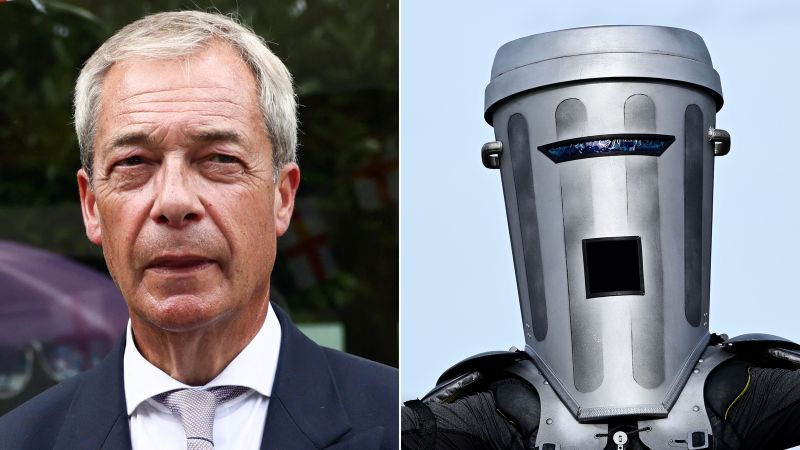
Instead, rival parties dismissed his actions as a stunt and announced they would abstain from the election, leaving his main opponent as a trash-can-wearing comedian with policies such as forcing rule-breaking cyclists to ride unicycles.
Farage, leader of the Reform Britain party which leads in most British opinion polls, is facing allegations of failing to declare gifts worth millions of pounds from wealthy donors and is being investigated by Parliament’s standards watchdog. He denies any wrongdoing.
He resigned as MP for Clacton-on-Sea, a constituency in southeast England, on Tuesday amid mounting controversy over undeclared donations.
He framed the move as a way to let the people of Clacton decide their own political future, rather than the “establishment” he was trying to discredit.
“I decided that the people of Clacton should judge my actions,” Mr Farage said. “I will fight to win. I will fight to continue the political revolution that the reforms started.”

But the decision was quickly branded a stunt by his usual sparring partners, with all of Britain’s major political parties – the ruling Labor Party, the right-wing Conservatives and the centrist Liberal Democrats – announcing they would boycott the Clacton vote.
British Prime Minister Keir Starmer, who resigned as Labor leader last month, called the move a “desperate stunt”, while a spokesman for Andy Burnham, widely seen as the country’s next prime minister, said it was “a gimmick to distract from serious allegations about Mr Farage’s financiers”.
With all of his usual political opponents absent, only a few have so far come forward to challenge Mr Farage. The best known is the man known in the UK as ‘Count Binface’, a satirical comedian who describes himself online as ‘The Space Politician’.
Created by playwright and comedian John Harvey, Binface has been featured in British elections for years. He is part of a long tradition in Britain of satirical candidates confronting prominent politicians as a way to draw attention to their absurdities, or simply as a publicity stunt. Binface became the best known of the genre, with characters and costumes becoming more elaborate over time.
After Mr Farage resigned, Mr Binface posted on Platform
The decision by the major parties to avoid a special election, known in the UK as a by-election, is aimed at underscoring that this is a stunt to distract from scrutiny of Mr Farage’s personal finances.

British Chancellor of the Exchequer Rachel Reeves, who effectively had to accept Mr Farage’s resignation from parliament, told X: “This is a travesty, a hopeless distraction and the people of Clacton deserve better. But if he wants to spend the summer arguing with the bins, I won’t stop him.”
But Mr Farage’s supporters say the main political parties fear him as the Brexit mastermind, and that his party has made significant gains in recent local government elections.
Reform UK home affairs spokeswoman Zia Yusuf criticized boycotting party leaders for denying him the chance to run against Mr Farage, despite years of attacking him.
“Sneaky but transparent. The establishment is in crisis,” he posted on X.
Meanwhile, Mr. Binface has been the focus of British media attention, with some commentators even speculating that although he is unlikely to beat Mr. Farage, he could attract a significant protest vote, far exceeding the usual small number of tallies.
In a BBC radio appearance on Wednesday, which the presenter sarcastically described as a “morning interview”, the comedian joked that the politicians who refused to take part in the contest might be afraid of him rather than Farage.
“Are they running away scared of old Vinny, or do they think Nigel is pulling a cunning stunt?” he told BBC Radio 4’s Today programme.
Asked what his appeal would be to the people of Clacton, the comedian replied: “I’m not Nigel Farage.”
