

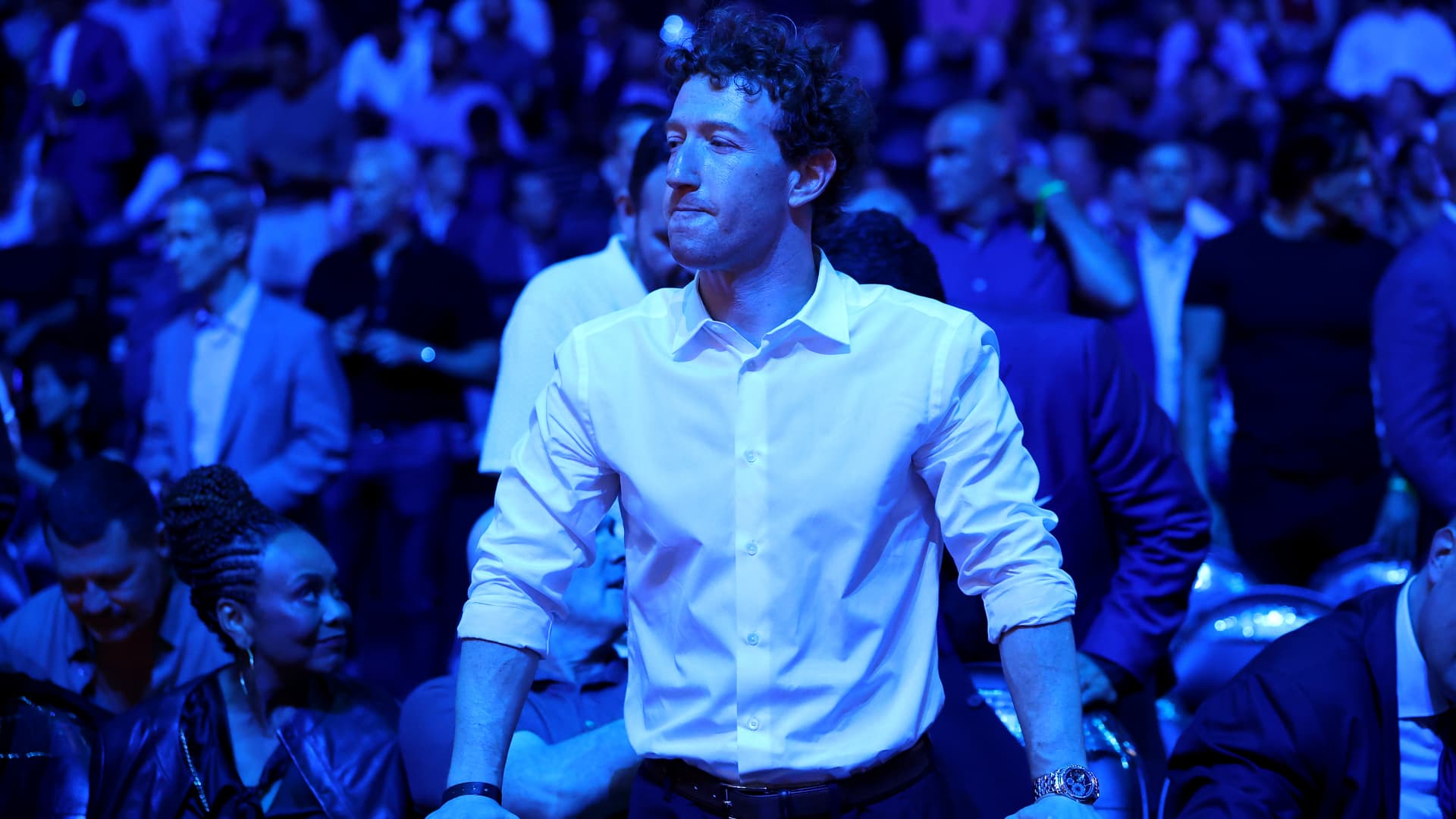
Mark Zuckerberg watches UFC Freedom 250 at the White House in Washington, DC on June 14, 2026.
Chris Gracen | Getty Images Sports | Getty Images
meta The company on Tuesday released Muse Image, a new artificial intelligence model for image creation, aiming to attract creators and advertisers to its service.
The AI technology, originally codenamed Mango, is the second major release from Meta Superintelligence Labs, led by Alexandr Wang, who oversaw the April launch of the Muse Spark large-scale language model, which followed the company’s previous Llama family of models.
Muse Image will be accessible to consumers for free through the Meta AI app and site, WhatsApp Direct Messages, and Instagram Stories. Power users and creators will need to sign up for one of Meta’s new monthly subscription plans, which debuted in May, to create a large number of AI-generated images and access certain features. If users reach the free limit, they can purchase a Meta One subscription or wait until the limit is reset, the company said.
Muse Image also powers advertiser-specific image generation tools as part of Meta’s AI-powered Advantage Plus service. This allows brands to more easily develop ad creative for marketing campaigns and automate certain tasks. Meta said it is working with businesses and advertisers as part of Muse Image’s debut.
“Muse Image brings native inference to the creative process to adjust elements, swap styles, and create variations based on an advertiser’s creative, resulting in high-quality, on-brand ad variations with fewer iterations,” the company said in a blog post for businesses. “In the coming weeks, advertisers and agencies will start seeing image variations powered by Muse Image.”
The new image generation model and efforts to monetize it illustrate how Meta is expanding beyond its core business of online advertising and creating new revenue streams tied to significant spending on AI-related infrastructure.
OpenAI and alphabet Google’s Nano Banana was a hit with consumers when it was released last fall, giving it a head start on Meta in offering a similar image generation model.
Meta also revealed internal benchmark tests showing that Muse Image lags behind OpenAI’s latest GPT Image 2 model, but outperforms the Nano Banana 2 model on tasks such as both single and multi-image editing.
The social media giant has previously used third-party AI models, such as Midjourney and Black Forest Labs, to power its Meta AI app and various image and video generation capabilities within the site. The company said it plans to use new AI models to reduce its reliance on similar third-party technologies.
Meta also plans to release an AI video generation model called Muse Video at a later date, adding in its tech blog that it “offers competitive performance in instant compliance, visual fidelity, and temporal consistency.”
Muse Image will be available on Facebook and Messenger, as well as Instagram and other areas within the WhatsApp service later this year.
Spotlight: AI’s 3 Big Narrative Violations.

