

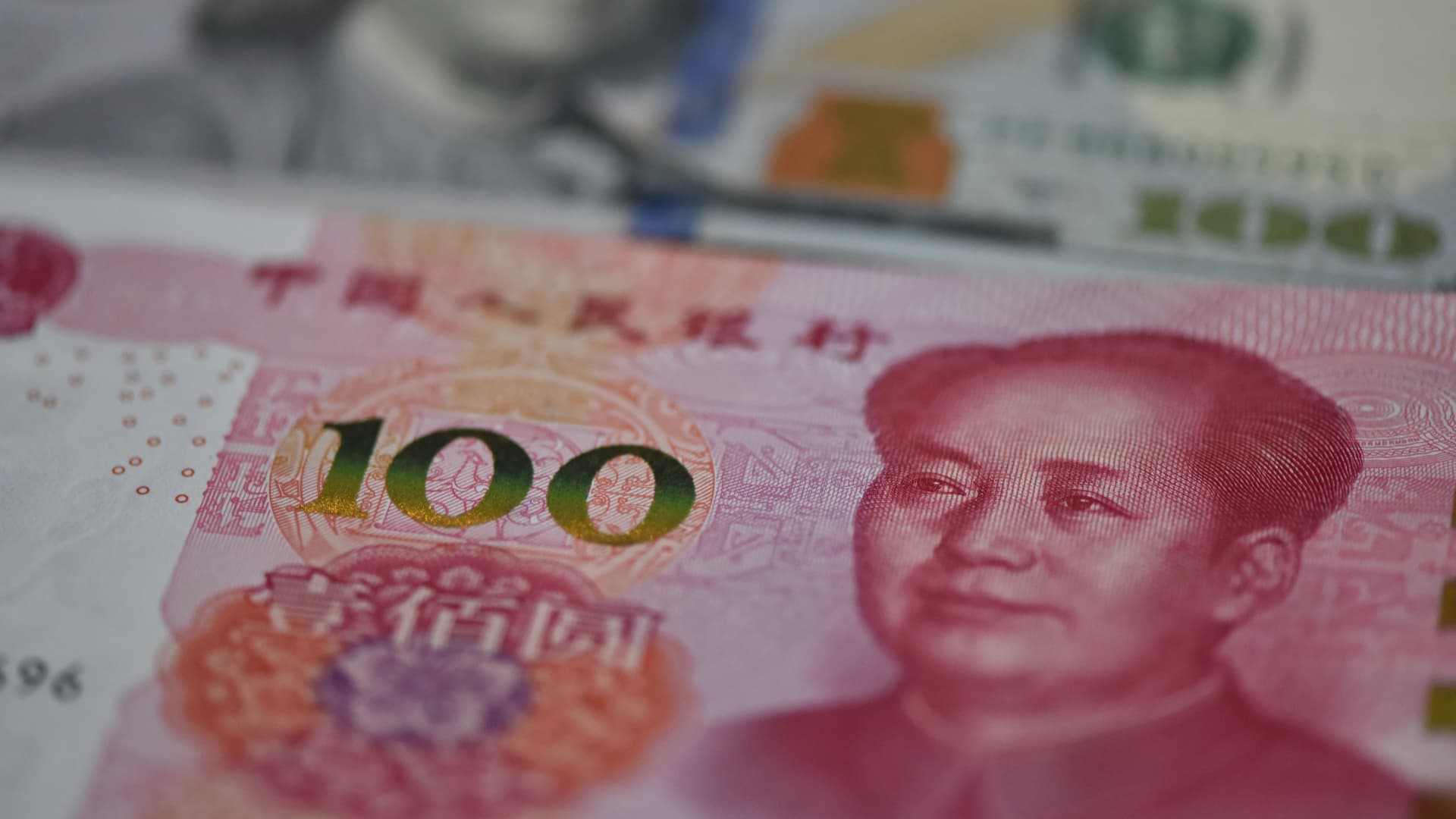
Renminbi and US dollar banknotes photographed in Fuyang, Anhui Province, China, March 1, 2026 (Photo: Costfoto/NurPhoto, Getty Images)
Null Photo | Null Photo | Getty Images
Every June, policymakers, regulators, bankers, investors and financial executives gather in Shanghai for China’s main monetary policy conference, the Lujiazui Forum. If Davos is where the world’s elites discuss the future of the global economy, Lujiazui is becoming a place where Beijing shows how it intends to shape that future to its own benefit. As an American, I believe this year’s forum is worth watching, despite the current divergent focus.
At this year’s Lujiazui Forum, Chinese authorities announced a series of measures aimed at expanding offshore renminbi (RMB) financing, deepening Shanghai’s role as an international financial center, creating new liquidity facilities for foreign central banks and sovereign investors, expanding cross-border renminbi trading, and further opening parts of China’s financial sector to international participation.
It’s true that we’ve heard a lot about this before, and it’s natural for skeptics and many observers to question its sincerity and feasibility. Is China finally ready and serious to challenge the US dollar? The answer is that there is no doubt that China is serious about the challenge of dollar dominance, but it is also the wrong question to ask.
I would argue that the world’s focus should not be on whether China achieves its true goal of replacing the renminbi with the dollar. The world should pay more attention to the fact that the Chinese government continues to systematically build the financial infrastructure necessary to reduce dependence on the dollar-centered global system and create alternatives to U.S. financial power for other countries. In other words, China is serious, but it may not achieve its goals, at least not right away. But what China is doing is positioning itself as a serious competitor and disruptor of dollar dominance.
This is not primarily a financial story. It’s geopolitical.
For nearly 80 years, the United States has enjoyed extraordinary benefits from the dollar’s central role in the global financial system. The dollar’s dominance provided Washington with tools of statecraft that previous great powers could hardly imagine. The United States can impose sanctions, restrict access to dollar payments, shape international compliance standards, influence capital flows, and leverage its position within the global financial structure to advance its national security goals. China understands this reality better than anyone and, like many countries, has resisted this massive concentration of power for decades.
Today, we’re in a better position than ever to do something about it.
20-year renminbi internationalization plan enters new phase
Chinese leaders have been working to internationalize the renminbi for nearly two decades. In the aftermath of the 2008 global financial crisis, the Chinese government launched a renminbi trade settlement program, established offshore clearing centers, expanded currency swap agreements, developed alternative payment infrastructure, and gradually opened parts of its capital markets.
It has not become a silver bullet that can reverse or weaken the dollar’s dominance. But China’s story is rarely told in terms of immediacy or swiftness. It’s a methodical decision and gradual progress. The latest measures announced in Lujiazui are just the latest chapter in that long story. What makes this year’s announcement particularly noteworthy is that it coincides with the first year of implementation of China’s 15th Five-Year Plan. It is important that China wastes no time in getting this program off to a solid start.
Western observers sometimes view China’s planning documents as ambitious wish lists, propaganda documents, or collections of ambitious ideas developed on whiteboards. The Chinese government has a different view. A five-year plan is not a marketing brochure. These are resource allocation documents that shape regulatory priorities, guide state-owned enterprises, influence lending decisions, direct local governments, and signal strategic priorities throughout China’s system.
It is therefore important to remind policymakers, investors and businesses that the new 15th Five Year Plan will bring public finances to the level of national strategic objectives. Chinese leaders have repeatedly stated their goals of building China into a “financial superpower,” strengthening Shanghai and Hong Kong as international financial centers, expanding the offshore renminbi market, improving cross-border payment infrastructure, and steadily advancing the internationalization of the renminbi.
Importantly, these goals are no longer just topics of discussion among Chinese economists. These are now incorporated into China’s key national planning documents, meaning regulators, state-owned banks, local governments and financial institutions can all be expected to align their resources and policy decisions to support these goals. The ultimate success of these efforts is an important question. But the question is whether Beijing intends to pursue them persistently and aggressively.
Wall Street ignores threats at its own peril
The world has seen this movie. Many Western analysts initially dismissed any ambitions related to Made in China 2025. Critics pointed to technical flaws, market distortions, misallocation of capital, inefficient state intervention, corruption, and questions about implementation. All these concerns were natural at the time. Yet the Chinese government continued to move slowly but deliberately forward, implementing industrial policy, increasing subsidies, directing banks to introduce state financing, establishing aggressive procurement incentives, forcing universities to focus on developing engineering and technology talent, and providing preferential regulatory support to pursue their goals.
The results weren’t perfect. However, this was enough for China to establish a position of global importance across a number of strategic areas. In fact, many will recall that it was the growing success of Made in China 2025 that led to the first Trump administration’s trade war in 2018. The lesson is not that the Chinese government will always succeed or that it will succeed immediately. The lesson is that the Chinese government rarely abandons strategically important goals once they are incorporated into national planning documents and long-term competitive strategies.
This reality deserves more attention in Washington, Silicon Valley, and especially Wall Street. It’s no surprise that many investors see Lujiazui’s announcement as a positive development. Expanding offshore renminbi trading, new liquidity facilities, deepening debt markets, and expanding access to Chinese financial products are creating opportunities for global capital. But investors should be careful not to confuse these moves with China, which is moving to fully open its capital account and allow capital flows to move solely according to market fundamentals.
China is not pursuing these reforms simply to please Wall Street or to prove that it has become a financially liberal economy. Rather, these measures are aimed at reducing China’s exposure to U.S. financial influence and increasing its freedom of strategic action in pursuing China’s interests in the international arena. As a result, geopolitical risks surrounding China-related financial exposures are likely to increase, rather than decrease.

One-year performance in currency trading between the US dollar and the Chinese yuan.
Right now, China hawks in Congress are silent, or silenced by Trump. In private, they will say they don’t like his China policy, but they won’t say it publicly. But Congress is unlikely to remain on the sidelines forever. During the Biden administration, Congress has shown increased interest in the role of U.S. capital in foreign investment reviews, pension fund exposures, index provider decisions, and supporting Chinese companies related to strategic industries. There remains an unfinished business in Washington’s foreign investment review, and future efforts to expand review authority could lead to even tighter scrutiny of U.S. financial participation in the Chinese market.
If Democrats regain the House majority, or if Republican China hawks regain political momentum, lawmakers could revive aggressive legislation focused on strategic competition with China. Monitoring Wall Street’s China exposure will almost certainly be part of that conversation.
Sen. Elizabeth Warren has repeatedly expressed concerns about financial engagement with China. At the same time, Republican China hawks continue to advocate, often quietly, for tighter restrictions on capital flows into areas seen as supporting China’s military modernization and strategic competition. The result was an unusual bipartisan confluence. Progressive skeptics and national security hawks about the U.S. national security establishment often disagree on almost everything. Skepticism about certain forms of financial engagement with China has become one of the few areas where the two countries’ interests overlap.
However, many countries outside the United States are likely to welcome news emanating from Shanghai. Recent geopolitical events could accelerate China’s efforts and increase its attractiveness in the Global South, across the Middle East, and even among some allies and partners such as Canada and some ASEAN countries. The Iran conflict, concerns about sanctions enforcement, disputes over U.S. trade policy, and broader questions about the future of globalization and the weaponization of the dollar are leading many governments to seek greater strategic flexibility. The Trump administration’s erratic and often aggressive actions have raised concerns about over-reliance on a single financial system.
That doesn’t mean countries want to abandon the dollar completely. Nor do we want to depend on China. Many remain deeply skeptical of the Chinese government and its intentions. What that means is that many people see the alternative, hedging, as more attractive now than at any point in the past 80 years. China understands this, which is why its government is seizing broader opportunities. China does not need the renminbi to replace the dollar to achieve strategic victory. In fact, the Chinese government’s goals may be quite modest and therefore more achievable. The idea is to create enough alternatives that countries no longer feel the need to rely solely on dollar-based systems. We just need enough countries, institutions, and investors to maintain a viable alternative.
A world in which significant parts of trade, energy trading, national reserves, development finance, and cross-border payments can function outside of traditional dollar channels is strategically different from the one that existed just a decade ago. That possibility is the true meaning of the announcement at the Lujiazui Forum in Shanghai. So the question facing Washington is not whether the renminbi will become the next dollar. The question is whether the United States is paying enough attention to a competitor that has formally declared its intention to become a financial superpower and appears prepared to spend the next five years realizing that ambition.
—Dewardrick McNeil, Managing Director and Senior Policy Analyst, Longview Global, CNBC Contributor

