

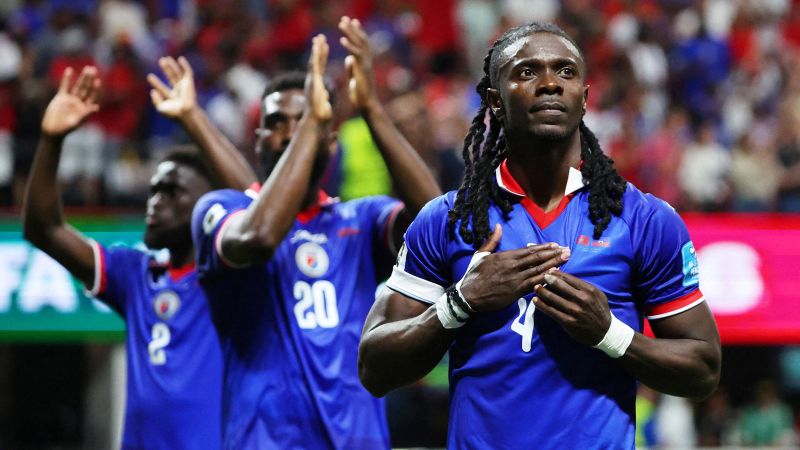
atlanta —
Haitian fans wearing red and blue jerseys showed up en masse in downtown Atlanta on Wednesday to watch the Caribbean nation’s final World Cup game of the year.
Although Haiti did not win against Morocco, fans were overjoyed to be able to support their team despite the possibility of their first World Cup appearance since the 1970s.
But that joy didn’t last long. The next day, the U.S. Supreme Court gave President Donald Trump permission to strip the legal status of millions of foreign nationals from war-torn countries such as Haiti and Syria.
The decision on so-called Temporary Protected Status (TPS) means more than 350,000 Haitians could lose their work permits and the ability to remain in the country unless they become eligible for other forms of protection.
Human rights groups and experts have warned that it is not safe for Haitians to return to a country where more than 2,300 people have been killed in gang attacks this year and another 1.5 million have been displaced.

Anxiety over the impending judgment against TPS was palpable among Haitian fans on Wednesday. Outside Atlanta Stadium, Jude Exama, a Haitian national, held a sign calling attention to what’s happening in his home country.
“I’m not going back,” said the Exama. “Tomorrow, if my country is safe, I will return,” he told CNN while holding a placard calling for a national dialogue to restore peace in Haiti.
Mr. Exama, a former medical student in Port-au-Prince, came to the United States two years ago on humanitarian parole after his medical school and affiliated hospital were closed following an armed attack. He filed for TPS and asylum after entering the United States, works as a food delivery driver in Georgia, and is awaiting decisions while sending money back to his family in Haiti.

Exama, who woke up Thursday to news of the Supreme Court decision, told CNN that leaving the United States after her work permit expires is not an option.
“For myself, I have no choice but to remain in this country,” he told CNN by phone. “How do you think I can go and live in a country like that?…I would rather starve and hide from immigrants than live in the hell of Haiti.”
In New Jersey, Frandy L’Esperance and her 10-year-old son celebrated Haiti’s World Cup trip from home.
“It’s great to be back after 52 years,” he told CNN, noting how long it had been since Haiti last qualified for the World Cup. But throughout the festivities, the fate of the pending TPS case weighed heavily on him.
He came to the United States on humanitarian parole with his son in 2023.
To apply for TPS, applicants must reside in the United States. Although her son was granted temporary deportation protection, Lesperance has a work permit that expires next year. L’Esperance had also applied for TPS, but Thursday’s ruling ended that path.

“I knew in my heart that this administration wouldn’t approve[TPS]because they don’t want foreigners in the country,” L’Esperance told CNN Thursday morning after learning of the Supreme Court’s decision. Even though he was preparing for this moment, he worries about what it will mean for immigrants like him and his son.
“I don’t know what’s going to happen,” he said, adding that he is consulting with a lawyer.
L’Esperance was a journalist and human rights activist who lived in Port-au-Prince, the capital of Haiti, where he faced threats and fled a kidnapping attempt.
He now works as a manufacturing plant operator and sends money back to Haiti, where his ex-wife and 6-year-old daughter remain in a provincial city. Their application for humanitarian parole was rejected in 2023, and around the same time they had to flee the largely gang-controlled capital.
He and his son are terrified of having to return and potentially losing their entire family’s source of income. “Going back to Haiti would be fatal for us,” L’Esperance said.
During a visit to the country this month, UN Secretary-General António Guterres said the “extraordinary scale of the crisis” he was seeing on the ground was rooted in insecurity caused by gang terrorism.
Haiti fans echoed Guterres’ sentiments at a party to watch the Haitian cultural festival Lacou Fet in Atlanta on Wednesday, eating plates of plantains and the Haitian rice dish jonjon.
“The situation in Haiti is unbearable right now,” Jocelyn Alberich, who is of Haitian descent, said while sipping a red and blue cocktail to match her team’s colors. “It’s kind of hard to live a normal life unless you live in the suburbs,” he told CNN as fans danced to Caribbean music.
“They should be able to come here. They work hard,” said Natasha, a Haitian-American who declined to give her full name.
Although most of her immediate family are U.S. citizens, she still worries about the community at large. “If they lose TPS, a lot of people will be forced to flee and go back to countries they haven’t been to in years. Where will they go?” she told CNN.
In Los Angeles, Reginald Joseph has also lived in the shadow of TPS rulings against Haitians like him. He holds two jobs as a security guard and an Uber driver to support his family back in the Caribbean country, one of the most remittance-dependent countries in the world.
His hometown of Petit Rivière in the Artibonite, Haiti’s main agricultural region, was destroyed in an armed attack. His home was then destroyed and his family evacuated from the area.
“I’m very worried because my whole family is counting on me,” he told CNN. “I’m the one who takes care of my family.”
He has been in the United States since September 2023, sending money to his mother, three sisters, and two young daughters, but he has not seen his mother since then. They are completely dependent on his income, and their employment prospects are bleak, especially after gang attacks destroyed the farmland where they used to work.
His children often ask him when he will be coming home, but all he can say is that he is in America for the sake of his children. His decision to come to the United States and obtain TPS was not easy, but it was a lifeline for his family.
Without TPS status, he says, there are few options. “If I get deported, things will get worse,” Joseph said.
