

Hello, this is Priyanka Salve writing from Singapore.
Welcome to the latest edition of Inside India. A one-stop destination for stories and developments in the world’s fastest growing large economy.
India is seen as a laggard in the global AI race, but it has the world’s second-largest workforce and relatively low labor costs, leading to a boom in companies collecting data to train robots. I spoke to workers and companies in India who are facilitating this trend of humans indirectly training robots.
Do you have any thoughts about today’s newsletter? Share them with the team.
big story
China and the US are far ahead of India when it comes to manufacturing AI-enabled robots. New Delhi is considered a latecomer in the global AI race and, by extension, the physical AI space.
But India, with the world’s second-largest workforce and relatively low labor costs, offers a unique advantage in providing humans to train robots.
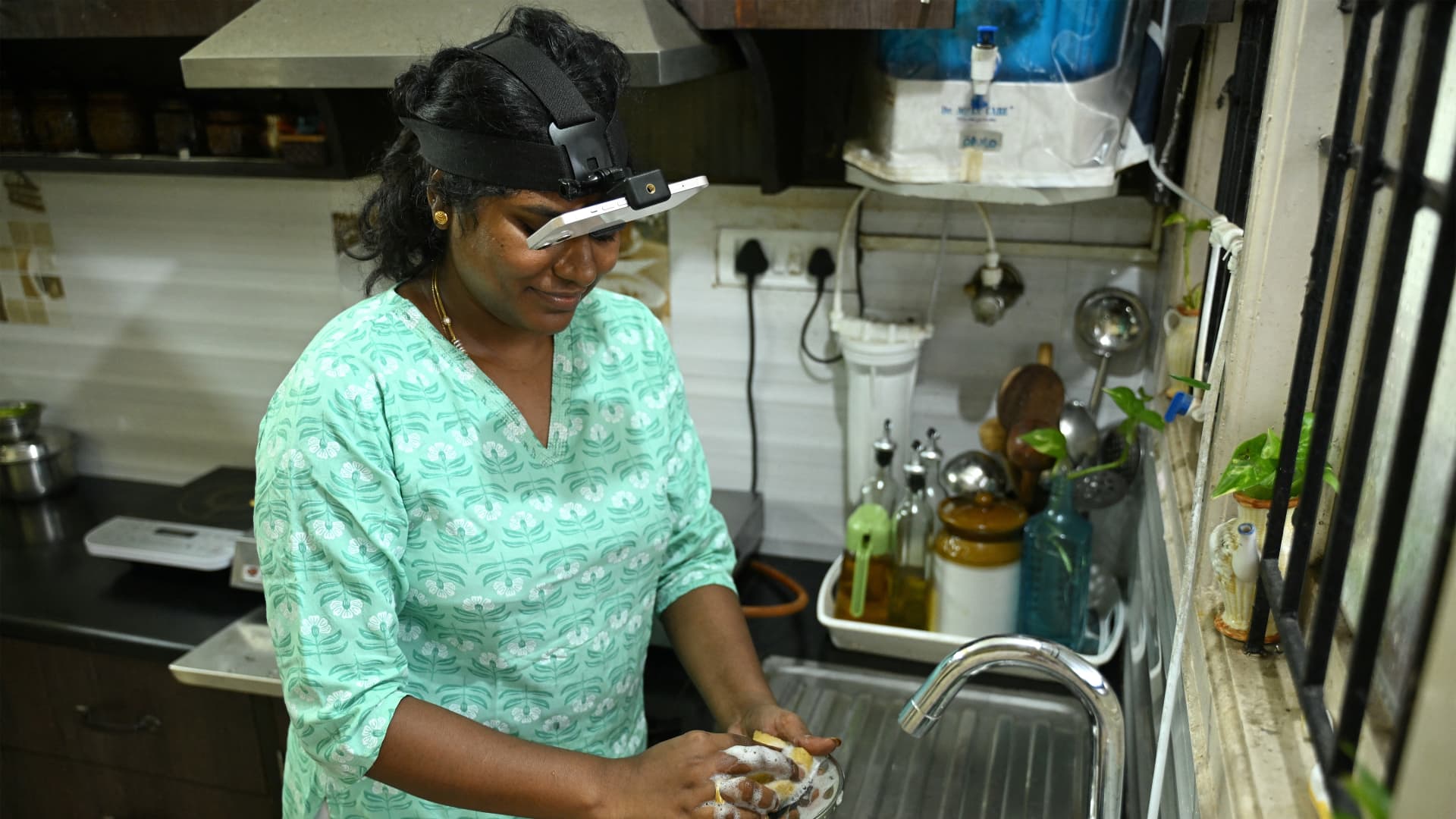
Tanisha Reddy, a teacher at a private school in southern India, works as a robot trainer. She told CNBC over the phone that her day begins by recording a first-person video of herself doing everyday tasks like cooking, washing dishes, and preparing lunch. Repeat this process in the evening, producing 3-4 hours worth of video each day. She receives less than $4 per hour of recording.
“I’m very happy,” Reddy said, explaining that the job is simple, requires no extra effort and doesn’t take up much of her time raising her two children.
It has been more than four months since she started working for Qanat Consulting Services, a company in Andhra Pradesh.
In less than a year, several companies have sprung up in India recruiting people to shoot first-person and self-centered videos. Many of them record data, check quality parameters, and perform data annotation on behalf of clients in the US and China. These could be either robot companies or possibly other intermediaries.
In this photo taken on May 15, 2026, Nagireddy Sriramyachandra, an Indian housewife with a smartphone on her head, is seen using motion capture to record her movements as she washes dishes at her home in Chennai.
R. Satish Babu | AFP | Getty Images
“We primarily get contracts from companies in the US and China,” Taslim Pattan, founder of Qanat Consulting Services, told CNBC, adding that he recently won a contract to source videos from workers at a clothing manufacturing company.
Although robots are developed in the lab, they need to be trained in real-world environments, she says. The robot market is expected to grow rapidly over the years, and the demand for data collection is also rapidly increasing.
Global brokerages are bullish on the growth in demand for robots, with Barclays predicting the humanoid robot market will grow to $200 billion within 10 years. At the same time, Morgan Stanley predicted that by 2050, it will exceed $5 trillion and the number of robots will reach 1 billion.
But even as the volume of work increases, contract prices for data aggregators are falling because of the growing number of competitors, Pattan said. Within a few months, prices have already halved, she added.
Data collection is becoming increasingly commoditized and Indian companies entering the space need to move up the value chain to remain relevant, experts say.
maintain the advantage
Neocambrian AI, a startup based in northern India, launched a robot data factory in Noida last month where it collects robot data in a simulated environment, Abhinav Kukreja, the company’s founder, told CNBC.
He also established a network of more than 100 factories where workers recorded their own work.
The company is focused on creating datasets that “help address dexterity” and teaching robots “how to manipulate objects,” he said, adding that 100 million hours of video would be needed to reach human-like dexterity levels.
For example, a robot needs to understand the different levels of pressure required when holding an egg and when holding a water bottle. Each additional dataset improves the robot’s ability to manipulate objects like a human hand.
His company’s core business is processing data, and unlike many of its peers, it maintains ownership of it. “We don’t go to our customers and ask them what they want,” the founders explained, adding that instead, we provide them with datasets that Neocambrian AI preemptively builds.
“In the entire AI stack, this is the only layer that India can not only participate in, but win,” Kukreja said. Ever since AI has existed, human data has been valued and India has the potential to become the ‘human labor market of the world’, similar to its experience in the information technology sector.
Experts say robots have a hardware side and an operating system side, just like a smartphone. Although India has a long way to go in terms of robot manufacturing, the country could play a role in developing operating systems, they said.
Another Indian startup in this space, Humyn Labs, focuses on data transformation and building diverse datasets from different environments. The company claims to offer “(verified) human intelligence at scale,” and collects 50% of its data from Latin America, 35% from India, and 15% from the rest of Asia.
Manish Agarwal, co-founder of Humyn Labs, told CNBC that its focus is on transforming and owning datasets.
Training robots using video is in its infancy, and the market for data collection tasks will eventually become saturated. He added that India needs to “evolve from a collector to a converter” to maintain its advantage.
need to know
$4 billion Indian startup gets Meta backing but loses founder to WhatsApp
Indian fintech startup Cred is set to raise $900 million in a funding round led by Mark Zuckerberg’s Meta, but has lost founder and CEO Kunal Shah to WhatsApp. The startup, in which Mehta will soon be a minority investor, was valued at more than $4 billion in its latest funding round.
Jio Platforms, India’s largest telecom and digital service, files for IPO
Jio Platforms, India’s largest wireless carrier and digital services provider, led by billionaire Mukesh Ambani, filed a draft proposal for an initial public offering on Friday. The proceeds will be used to reduce the debt of the company’s subsidiary Reliance Jio Infocomm, India’s largest wireless operator.
A 66-year-old water deal is becoming the latest flashpoint between India and Pakistan
A year after the last military clash, tensions between India and Pakistan are rising again, this time over access to water from the Indus River Basin. Pakistan’s defense minister warned on Friday that water security could become a cause for war if Islamabad deems its national interests threatened.
very soon
June 29: Industrial production statistics for May.
July 1: HSBC Manufacturing PMI for June.
