

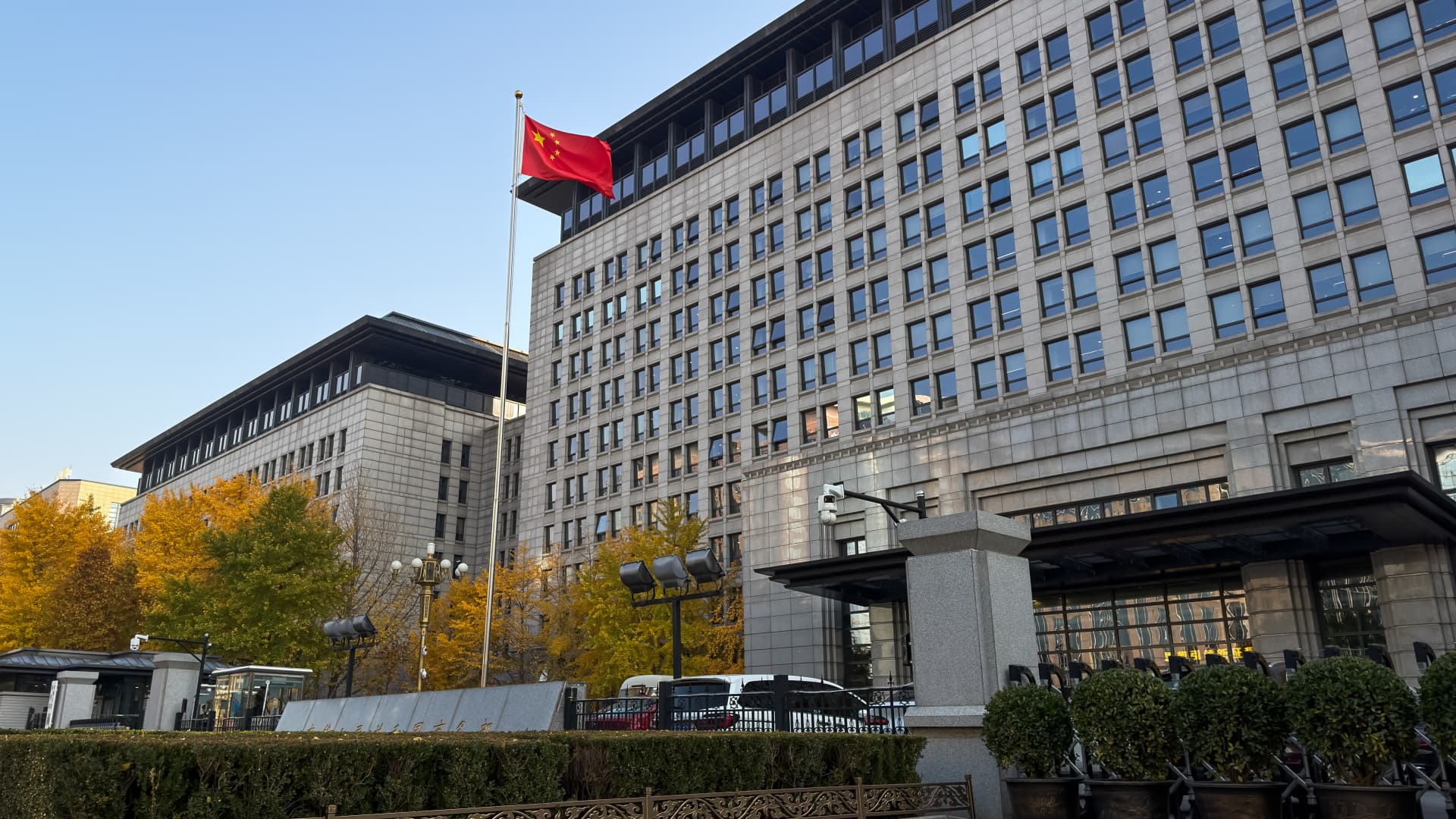
BEIJING, CHINA – NOVEMBER 11: The Chinese national flag flies in front of the Ministry of Commerce headquarters in Beijing, China, on November 11, 2025.
Chen Xin | Getty Images News | Getty Images
China imposed new trade restrictions on dozens of U.S. companies on Monday, retaliating against a U.S. move to add more Chinese companies to the Pentagon’s list of companies it accuses of supporting the Chinese military.
China’s Ministry of Commerce on Monday placed 10 U.S. industrial suppliers on an export control list, including rare earth mining companies. MP Materials Co., Ltd. and usa rare earthsdrone manufacturers Teal Drones and Jaia Robotics will be prohibited from exporting Chinese-origin civilian products to these companies.
Other companies on the list include California-based electronics manufacturer Aveox, Ball Aerospace & Technologies, and military equipment provider Oshkosh Defense.
In a separate statement on Monday, China’s Ministry of Finance excluded 46 American companies, mostly defense contractors, from participating in government procurement projects. Foreign locally registered entities associated with excluded companies are exempt.
The move comes after the Pentagon earlier this month updated its so-called “1260H” list by adding a number of Chinese technology companies to the list of companies believed to have supported the Chinese military. alibaba group, Baidu and car manufacturers BYD It was included among the latest additions.
Han Sheng Lin, China director at consulting firm Asia Group, said Beijing’s countermeasures appear to be largely symbolic rather than a substantive escalation in U.S.-China relations, as most of the targeted companies have “little or no meaningful business exposure in China.”
The 1260H designation does not impose immediate sanctions, but starting June 30, the U.S. Department of Defense will be prohibited from entering into direct contracts with affected companies, and indirect procurement will be restricted starting in 2027. The designation would likely prevent other federal agencies and commercial partners from doing business with the publicly traded company.
Earlier this month, Chinese authorities criticized the United States for “creating a discriminatory list under the pretext of national security” and vowed to take all necessary measures to protect the “legitimate and lawful rights and interests” of Chinese companies.
Dan Wang, China director at Eurasia Group, said the countermeasures provide an “exemplary example” of how China is likely to respond to a mild escalation from the United States while stabilizing broader relations, adding that last month’s Trump-Xi summit reset relations on a more positive footing.
Analysts said the Pentagon’s move was largely symbolic but showed how far the US government is drawing the line on sensitive Chinese technology, from artificial intelligence to consumer electronics and biotechnology.
Several designated Chinese companies have objected to the designation and have pledged legal action to have it removed. Chinese smartphone maker Xiaomi won a court challenge and had its designation lifted in May 2021.
