

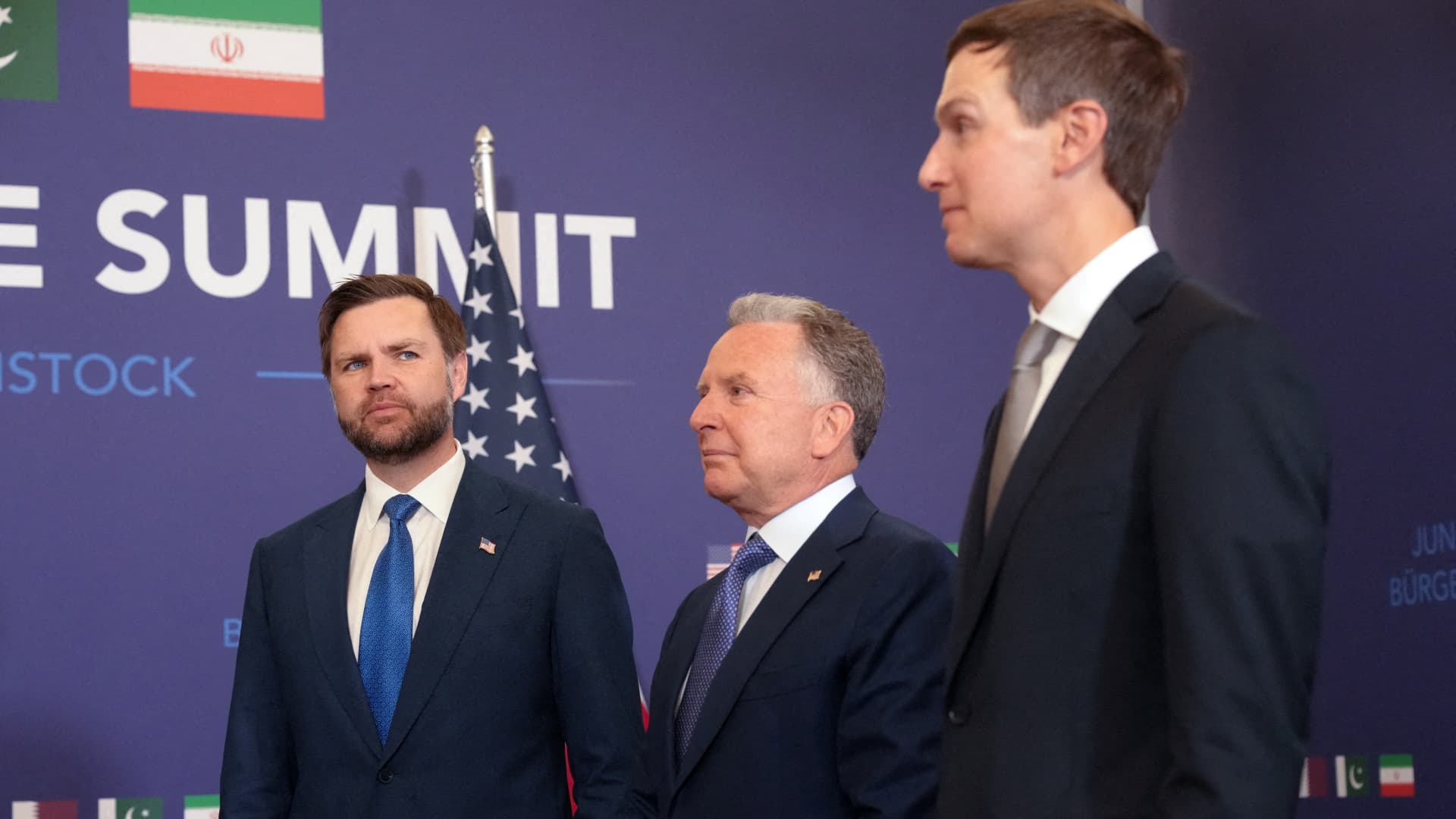
The United States and Iran made progress in talks in Switzerland on Monday towards a final agreement within 60 days, including the creation of a commission and mechanism to end hostilities in Lebanon.
A joint statement from mediating parties Qatar and Pakistan said: “The Lake Lucerne Summit took place in a positive and constructive atmosphere. Encouraging progress was made, including the creation of a mechanism for further technical consultations.”
Under a memorandum of understanding signed last week, the parties agreed to set up a “high-level committee” to provide political oversight of the mediation. According to the joint statement, the chief negotiator will report regularly to the committee and lead working groups on nuclear, sanctions and conflict resolution.
The parties also agreed to establish a “deconfliction” cell between the United States, Iran and Lebanon, with the support of mediating countries, to ensure a complete cessation of military hostilities in Lebanon.
Iranian Foreign Minister Abbas Araghchi said the talks brought “significant progress”, with Iran securing export exemptions for oil and petrochemical products, the lifting of port blockades, the release of some frozen assets and the start of a reconstruction and development plan.
In a post on X, Araghchi said Lebanon’s newly established dispute resolution mechanism would be the “first real test” of a deal, underscoring concerns that continued violence in Lebanon could threaten broader diplomatic efforts.
Vice President J.D. Vance postponed his planned departure on Friday due to logistics issues and arrived in Switzerland on Sunday to lead a U.S. delegation to the talks.
A senior U.S. diplomat who was involved in the talks told reporters on the same day that he denied reports that Iran had withdrawn from the talks, saying both delegations remained engaged and that he expected talks to last into the evening.
“We have had robust discussions on all elements of the nuclear deal. We will continue to address each of these issues and use today’s work as a springboard for continuing technical discussions,” the U.S. official said.
“The topics of discussion include clarifying some of the confusing messages from Iran regarding the strait and establishing deconfliction mechanisms to ensure that the straits remain fully open. We have also been working on deconfliction mechanisms and enforcing a ceasefire in southern Lebanon,” the official said.
Under the memorandum, the two sides agreed to keep the Strait of Hormuz free for at least 60 days and cease all hostilities, including in Lebanon, where fighting continues between Israel and Iran-backed Hezbollah.
Negotiations proceeded under a cloud of heightened tension. Iran’s Islamic Revolutionary Guard Corps announced on Saturday that it would re-close the Strait of Hormuz in response to Israel’s attack on Lebanon.
The US military has denied these claims, saying the waterway remains open and “Iran does not control the Strait of Hormuz.” Iran’s Tasnim news agency reported that Iranian authorities will continue to block the strait until a ceasefire is achieved in Lebanon and sanctions on Iranian oil sales are lifted.
Trump later wrote on Truth Social that “Iran must immediately stop its highly paid proxies from stirring up trouble in Lebanon,” referring to the Iranian-backed Lebanese militant group Hezbollah.
“If not, we will be hitting Iran very hard again, just like last week, but even tougher!!!” Trump wrote.
Earlier Sunday, Vance expressed optimism about negotiations despite Iran’s recent threat to block the Strait.
He also downplayed the impact of the violence in Lebanon, saying progress had been made towards ending hostilities in Lebanon. “Things like this always get a little messy,” he says.
Despite President Trump’s hints of possible military action, Vance said the president “asked us to change our minds to change our relationship with the Iranian people.”
Vance also said negotiators are focused on securing Iran’s enriched uranium stockpile, making it “virtually impossible” to rebuild Iran’s nuclear program. He added that the United States would maintain significant economic influence even if Iran did not abide by the deal.
Technical discussions are expected to continue at the Bürgenstock Resort throughout this week as the parties work towards a final agreement within 60 days.
—Emily Huang and Yun Li contributed to this report.
