

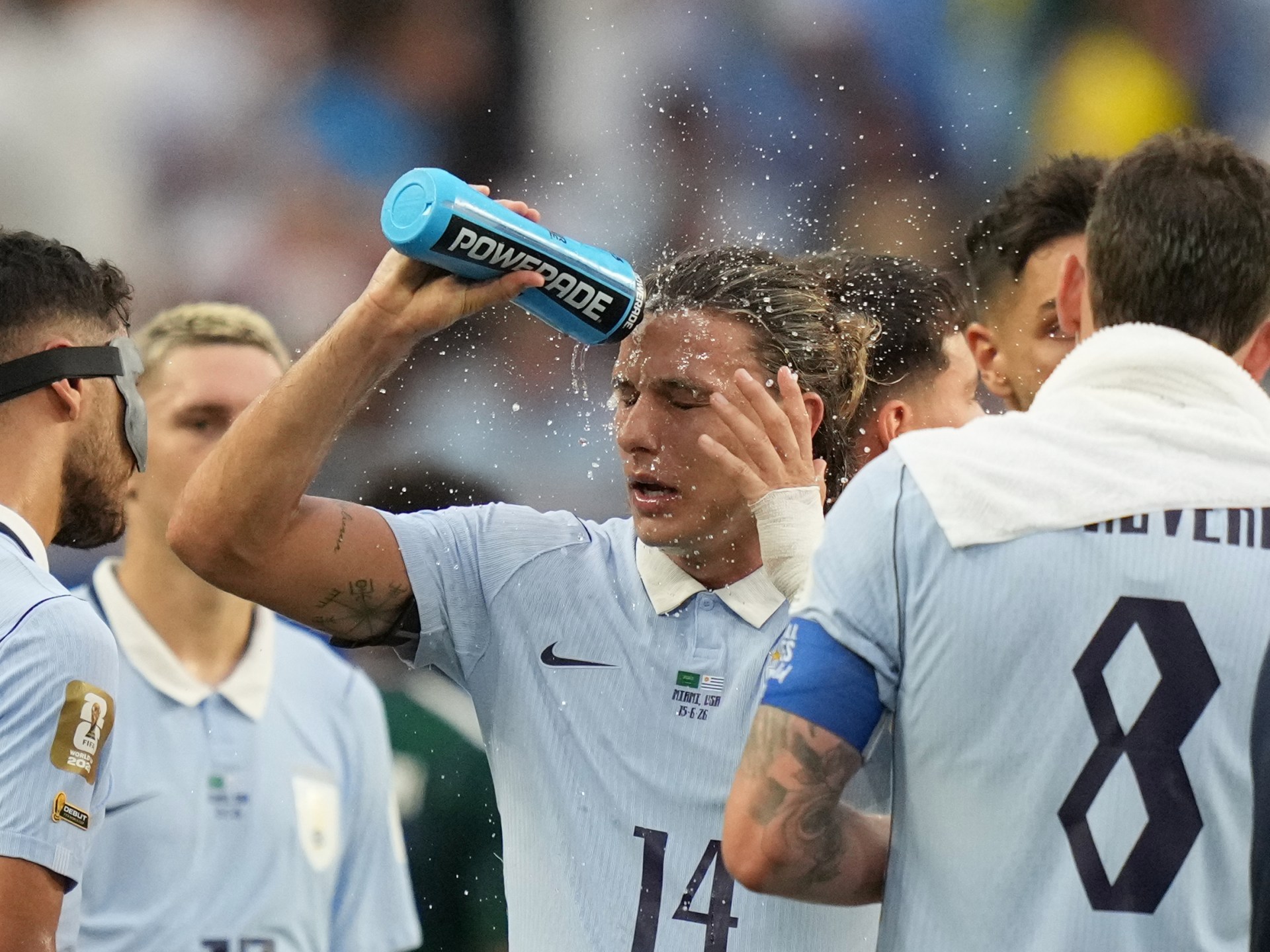
FIFA’s ability to use football as a unifying factor is perhaps nowhere more rationalized than its collective disgust at the decision to introduce hydration breaks in all World Cup matches.
Fans, players, coaches and everyone in between have criticized, debated and challenged the decision, which, along with a myriad of other socio-economic, political and financial issues, became the main talking point of the six-week tournament.
Recommended stories
list of 4 itemsend of list
When FIFA announced this rule in December, it did so with the sense that it was final. The international football governing body said: “FIFA prioritizes player welfare and therefore players will benefit from a three-minute hydration break during each half of a match.”

Do athletes prefer hydration breaks?
A week into the tournament, it’s clear the players aren’t keen on the first forced, non-negotiable amendment.
Dutch defender Virgil van Dijk led the attack against an “interesting” hydration break.
“If it’s really hot, obviously it’s better to put them in. But in my opinion, I think you have to look at it individually for every game.”
Belgium’s Youri Tielemans seemed to agree, saying that breaks go both ways.
“Maybe you shouldn’t do it because it’s not that hot in some cities. But at the end of the day, if you’re going to do it in some cities, you should do it for everyone.”
Tielemans’ comments are consistent with FIFA’s reasoning.
FIFA said last year: “In order to ensure equal conditions for all teams during all matches, there will be no weather or temperature conditions and breaks will be ordered by the referee in all matches.”
Weather expert Everton Fox said that from a weather perspective, very few matches so far have actually met the required level of hydration breaks.
“The stadiums in New York, California, Miami, and Mexico were hot enough, but there is no good reason to rest in air-conditioned arenas like Dallas, Houston, Atlanta, and Vancouver,” a senior meteorologist told Al Jazeera.
“I know FIFA claims they did this for every match to ensure consistency, but it’s hard to see this as anything other than a commercial venture worth millions, if not billions, of dollars in advertising on U.S. television channels around the world.”

Hydration or commercial break?
Much of the criticism surrounding the break is aimed at the commercial benefits of a three-minute break in play.
A 30-second World Cup spot on Fox Sports costs between $200,000 and $300,000, and could reach up to $750,000 during the U.S. games and later stages of the tournament, BBC Sports reported last week.
In the US alone, ads during hydration breaks can generate more than $250 million, the report added.
“It’s probably a little more lucrative for FIFA,” Canadian right-back Alistair Johnston said of the repercussions around the world.
“A hydration break turned into a commercial break,” the 28-year-old said this week ahead of Thursday’s indoor game between Canada and Qatar. The match ended with a 6-0 victory for the hosts and two red cards for Qatar.
Some broadcasters stuck to live feeds featuring the players, while others cut into commercials, disrupting the game-watching experience for fans watching on TV.
U.S. viewers were left frustrated after the Fox broadcast cut out full-screen commercials, causing them to miss part of the live action of the second half of the opening game between Mexico and South Africa.
momentum killer
From a purely sporting perspective, some argued that the break would kill the momentum of the match.
Curaçao, making their first appearance at the World Cup, were in dreamland when Libano Comenencia scored the equalizer 21 minutes into their first group game against Germany, but moments later the referee signaled for a hydration break and Germany coach Julian Nagelsmann rallied his team to a 7-1 victory.
Another example is Bosnia and Herzegovina, which lost momentum during the hydration pause.
Since matches in the tournament’s group stage began on June 11, fans in packed stadiums and around the world have booed the hydration break in unison.
Social media users even went so far as to create an AI video of the team being stereotyped nationally during the break. England’s players enjoyed tea in flower-patterned cup saucers, the U.S. team dined on hot dogs and beer, and the Japanese players stuffed themselves with sushi.
Still, not everyone is disappointed with the hydration break.
“For me, this is more of a coaching vacation than a cooling break, so it’s very important for me,” said Belgium national team coach Rudi Garcia.
“Maybe if we’re in a good moment, a good flow, it could be interrupted, so we’ll see again. But during the two friendlies we played… it was interesting to provide tactical information to the team.”
France coach Didier Deschamps also spoke to his players before the restart, saying it was an opportunity to “adjust some things”, adding: “Basically we have four quarters. Coaches are adapting to this new reality.”
