

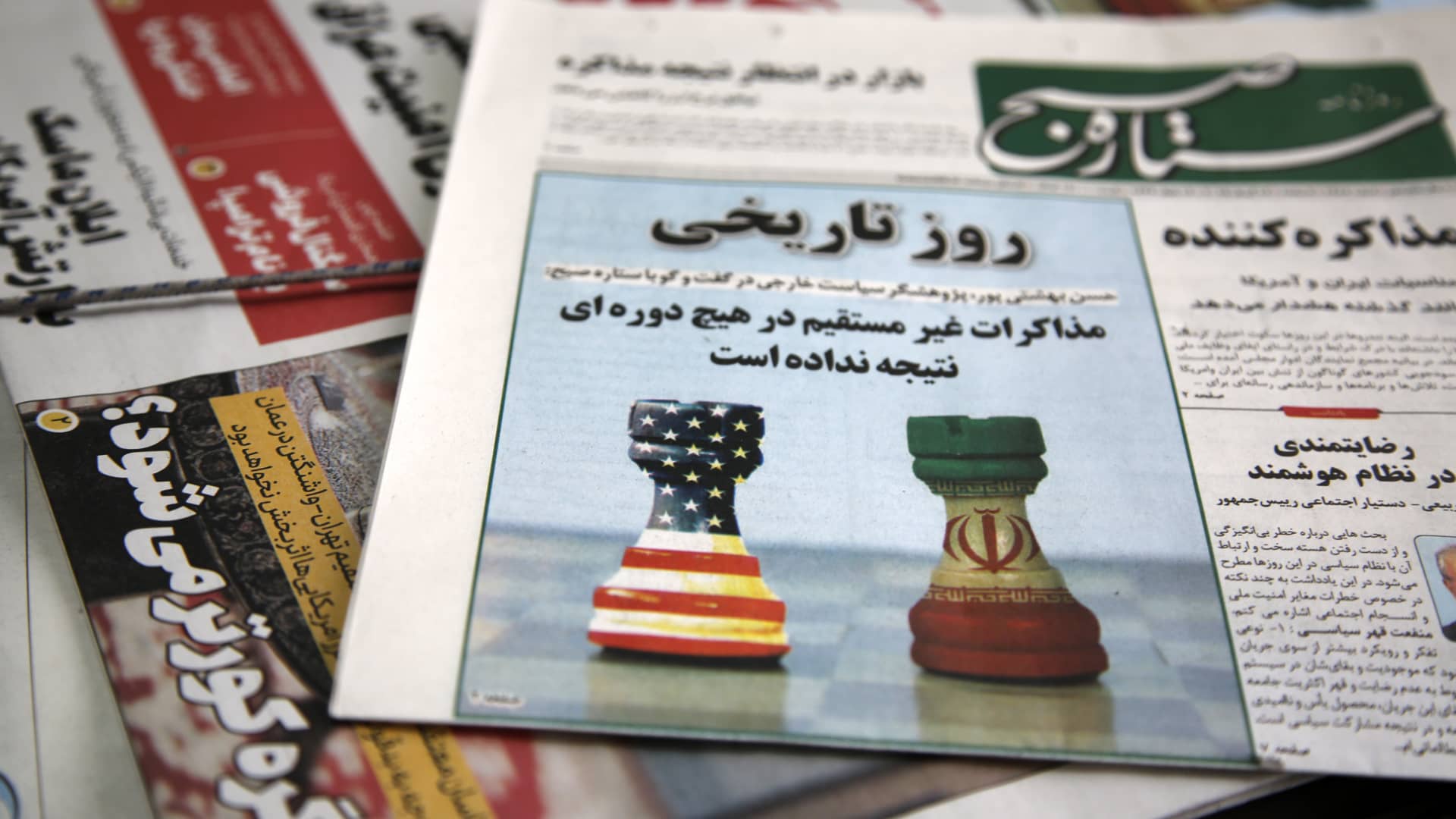
On April 12, 2025, a newspaper with a headline article about indirect negotiations between Iran and the United States in Muscat, Oman is displayed at a newsstand in Tehran, Iran.
Fatemeh Bahrami | Anadolu | Getty Images
News that the United States and Iran have reached an interim agreement may have initially brought a sense of relief to markets, but new uncertainties have emerged after follow-up talks scheduled in Switzerland were canceled on Friday, highlighting the challenge of turning the deal into a permanent peace deal.
The Swiss Foreign Ministry announced that talks between the United States and Iran scheduled for Friday in Burgenstock will not proceed as planned.
The White House also announced that Vice President J.D. Vance will no longer visit Switzerland, citing unresolved logistical issues surrounding the negotiations.
“Although plans for further technical consultations have not yet been finalized, the U.S. delegation stands ready to depart at the first available opportunity,” a White House spokesperson said.
“But the logistics of these negotiations were never simple or predictable.”
After the United States and Iran signed an agreement to end wars in the Middle East, Israeli forces said they would continue operations in southern Lebanon to “eliminate threats” beyond the so-called security zone.
Mahmoud Zaiyat | AFP | Getty Images
The development came a day after President Donald Trump and Iranian President Masoud Pezeshkian signed a memorandum of understanding aimed at developing a permanent peace deal to end the months-long conflict.
Under the 14-point memorandum, the two sides agreed to extend the ceasefire, including in Lebanon, and reopen the strategically important Strait of Hormuz.
But Friday’s talks were abruptly called off after Israel launched a series of deadly airstrikes against Lebanon, the Financial Times reported, citing three people familiar with the matter.
Lebanon’s Health Ministry said a series of attacks by Israeli forces overnight left 18 people dead in the country’s south. Israel announced that four soldiers were also killed.
Israeli Prime Minister Benjamin Netanyahu said in a social media post Friday morning that he had instructed the Israel Defense Forces to attack Hezbollah with “full force” in response to a “heinous attack” by the Iranian-backed group.
Hours later, a U.S. official told CNBC that the two groups had agreed to a ceasefire starting at 4 p.m. local time (9 a.m. ET).
Oil prices fell after the ceasefire was reported.
Future challenges
Analysts have warned that the U.S.-Iran deal is only an early step toward a broader rapprochement.
“While an important step forward, this agreement marks the very beginning, not the end, of a process that seeks to end the war and address Iran’s nuclear capabilities,” UBS said in a report.
Although uncertainty remains, the agreement helps ease disruption in the Strait of Hormuz, where shipping has been affected by both Iranian attacks and the U.S. Navy’s blockade of Iranian ports and coastal areas at the direction of President Trump.

David Roche, a strategist at Quantum Strategies, told CNBC’s “Squawk Box Asia” that lower oil prices could help curb inflation and reduce pressure on central banks to raise interest rates, so easing transportation disruptions could benefit economies that rely heavily on imported oil.
“More than that, this is a really bad deal,” Roche said, noting it would put Iran in a stronger position in the Gulf and limit outside interference in its internal affairs.
“Iran is going to make the Middle East very unstable, and that’s a bad thing in the long run,” Roche said. He added that Israel was unlikely to accept the deal. “Iranians, I confidently predict that you will never, ever abandon your nuclear ambitions,” Roche said.
The interim deal has also drawn criticism from some who say the United States has made “too many” concessions to Iran, and Mr. Trump and Mr. Vance have urged them to stick to the deal.
Mr. Vance defended the deal, saying, “The United States is not giving Iran a penny.”
Trump also hit back at his critics Thursday on Truth Social.
“Any idiot who thinks I’m not being tough enough on Iran at a time when the stock market is at record highs and oil prices are ‘crashing’ is either jealous, evil, or stupid,” Trump wrote.
