

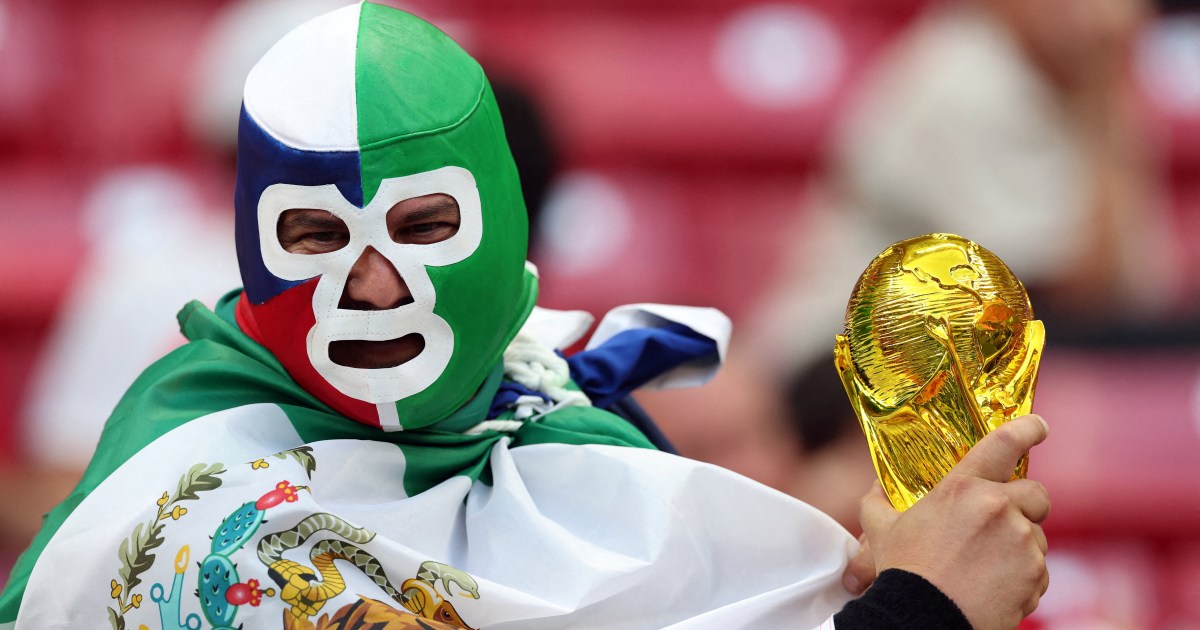
Thursday’s World Cup will feature four more games in the group stage, including a match between Mexico and South Korea after both teams opened with wins.
The race for the Golden Boot is already starting to take shape, with Cape Verde and the Democratic Republic of the Congo (DRC) celebrating historic results, and discussions around hydration breaks, diversity in football and increasing Africa’s presence in the competition continuing to generate controversy.
Recommended stories
list of 4 itemsend of list
Here’s what you need to know:
What’s the schedule for Thursday?
Czech Republic vs. South Africa, noon (16:00 GMT) at Atlanta Stadium, Atlanta, Georgia, USA Switzerland vs. Bosnia and Herzegovina, noon (19:00 GMT) at Los Angeles Stadium, Los Angeles, California, USA Canada vs. Qatar, 3:00 pm (22:00 GMT) at Vancouver Stadium, Vancouver, British Columbia, Canada Mexico vs. South Korea, Guadalajara, Mexico, at Guadalajara Stadium, 7:00 pm (1:00 am GMT Friday)
What are your predictions for Mexico vs. Korea?
Mexico has a good record against South Korea, having won each of their previous World Cup matches, including a 2-1 win in Russia in 2018.
Both teams had their hopes of advancing to the knockout stages with wins in their first matches, but Opta’s supercomputer gave Mexico an advantage in this Group A match. Across 25,000 simulations, El Tri won 49.1 percent of the time, South Korea 24.3 percent and 26.6 percent ended in a draw.

What are your predictions for Czech Republic vs. South Africa?
The Czech Republic and South Africa have only faced off once before. South Africa have a solid record against European opponents at the World Cup, including a famous 2-1 win over France in 2010, losing just one of their last four such matches.
Meanwhile, the Czech Republic lost 2-0 to Ghana in their only match against an African opponent at the World Cup. Opta’s supercomputer has calculated the Czech Republic as favorites, with a 54.9% chance of winning, compared to South Africa’s 21.8%.

What are your predictions for Switzerland vs. Bosnia?
This will be the first time Switzerland and Bosnia and Herzegovina will face each other in a World Cup. The only previous meeting between the two countries was a friendly in Zurich in 2016, with Bosnia winning 2-0 with goals from Edin Dzeko and Miralem Pjanic.
Despite this result, Switzerland will go into this match as clear favorites to win. According to Opta’s supercomputer, Switzerland won 61.6% of 25,000 pre-match simulations, while Bosnia came first with 17%. A draw was predicted in 21.4% of the scenarios.

What are your predictions for Canada vs. Qatar?
History has shown that the host side has the advantage in this matchup. The host nation of the World Cup has played against the Asian Confederation team in the past three times, with the host nation winning each time. Mexico defeated Iraq in 1986, France defeated Saudi Arabia in 1998, and Russia also defeated Saudi Arabia in 2018.
Opta’s supercomputer predicts this trend will continue. Canada won in 72.9% of the 25,000 pre-game simulations and tied in 16.5%. Qatar has just a 10.6 percent chance of pulling off an upset.

What else is shaping the World Cup?
The first round matches have already produced memorable moments, surprising results and stories that go beyond the scoreline. Here are some of the biggest talking points surrounding the World Cup.
The Golden Boot race is already fierce
Lionel Messi scored a hat-trick in Argentina’s opening game against Algeria and leads the race for the World Cup Golden Boot with three goals.
A group of seven players sits with a one-goal difference:
France’s Kylian Mbappé Norway’s Erling Haaland American forward Folarin Balogun Germany’s Kai Havertz Sweden’s Yassin Ayari New Zealand’s Ilya Just England captain Harry Kane
Democratic Republic of Congo makes World Cup history
Yoan Ouisza scored DRC’s first ever World Cup goal during an unexpected 1-1 draw with Portugal, ranked fifth in the FIFA world rankings.
The Newcastle United forward returned just after half-time in Houston, Texas, canceling out Portugal’s Joao Neves’ early goal and securing a historic point for Leopards in their first World Cup appearance in 52 years. This milestone sparked celebrations in the stadium and among Congolese supporters around the world.
Colombia starts with a win
Colombia got off to a good start to the World Cup by defeating tournament debutant Uzbekistan 3-1 at Mexico City Stadium.
Luis Diaz was outstanding, setting up Daniel Muñoz’s opening goal and scoring Colombia’s second after the break. Uzbekistan briefly tied the score with Avosbek Faizulaev’s goal, but the South American team regained control and secured all three points.
Colombia, who missed out on participating in the 2022 World Cup in Qatar, gained momentum to advance to Group K with this victory.
The biggest surprise of the first round?
The 0-0 draw between Cape Verde and Spain was perhaps the biggest surprise of the first group match. The newcomers to the World Cup held one of the tournament favorites to a draw, earning a historic point in their first World Cup match.
Democratic Republic of the Congo’s 1-1 draw with Portugal was also one of the tournament’s biggest shocks, while Iran’s 2-2 draw with New Zealand raised eyebrows as Iran was widely expected to win their opening Group G game.
A World Cup team united across faiths and backgrounds
Some World Cup teams include players from different ethnic, cultural, and religious backgrounds, reflecting the diversity of the countries they represent.
England, France, Spain and Sweden are countries that have both Christian and Muslim players on their teams. Spanish teenage star Lamine Yamal and Swedish midfielder Yassin Ayari are among a growing number of Muslim footballers competing on the sport’s biggest stage.
Some analysts see these teams as an example of how people from different backgrounds can work together despite widespread debates over immigration, identity and integration in some parts of Europe. Ebu Patel, Chairman of Interface America, said the cooperation seen on the pitch sends a powerful message.
“They score, each say their own prayers, and then they hug each other,” Patel said. “We’re working together to build a community and a team. That’s how you build a great soccer team.”
Cristiano Ronaldo’s record sixth World Cup appearance ends in disappointment
The 41-year-old became one of only two players, along with Lionel Messi, to have appeared in six World Cups, but despite having several chances in the second half he failed to find the back of the net. His missed chances were particularly noticeable after stars such as Messi, Kylian Mbappe, Erling Haaland and Harry Kane scored in the opening game.
Portugal dropped points in their opening Group K game, so Ronaldo and his teammates will be hoping for a comeback in the next group game.
Hydration breaks spark debate
FIFA’s new hydration breaks, introduced in the United States, Canada and Mexico to help players cope with the summer heat, have drawn criticism from experts and fans who say they could disrupt the flow of matches and change momentum.
The debate intensified after Curacao scored against Germany before a rehydration break in Houston, but conceded two goals before halftime and ultimately lost 7–1. Former England striker Alan Shearer said the break had “lost momentum”, while former Ireland captain Roy Keane likened the break to a time-out, claiming it hampered the pace that makes football unique.
FIFA insists the breaks are aimed at protecting player welfare, but critics argue they also create opportunities for tactical adjustments and additional broadcast advertising.
In a special report, Al Jazeera’s Marte van der Wolf examines the record number of sub-Saharan African teams competing in the World Cup, and the challenges and opportunities they face.
A record six countries will participate in the 2026 World Cup, with more sub-Saharan African countries participating than ever before. South Africa’s Bafana Bafana were the first to play, losing 2-0 to Mexico in the tournament’s opening match. But some of the continent’s traditional powerhouses are also returning to the biggest stage.
Ghana’s Black Stars reached the quarter-finals in 2010, matching Cameroon in 1990 and Senegal in 2002. Senegal returned to the competition this year, while Ivory Coast, two-time African Cup of Nations winners, are playing in their first World Cup since 2014.
Among the continent’s most interesting stories are those of the Democratic Republic of Congo and Cape Verde. The Leopards are returning to the World Cup for the first time since 1974, when the country was known as Zaire. Many members of the team were of European origin, a trend that was also seen in the Cape Verdean team. The Blue Sharks have already made history in their World Cup debut with a surprise draw against Spain.
The road to the tournament was not without its challenges. Some teams, officials and supporters are facing travel and visa-related issues. Many fans with African passports were initially required to post $15,000 bail to enter the United States, a policy that was later rescinded but critics said it was too late for some supporters to make travel plans.
The tournament is also missing one of the most famous symbols of the 2010 World Cup in South Africa, the vuvuzela. The constant blaring plastic horns that have become synonymous with the tournament have been banned from this year’s tournament.
But with an African-born diaspora of more than three million people in the United States and Canada, the continent’s six representatives are expected to receive strong support as they seek to make their mark on soccer’s biggest stage and carry the hopes of the entire continent on their shoulders.
