

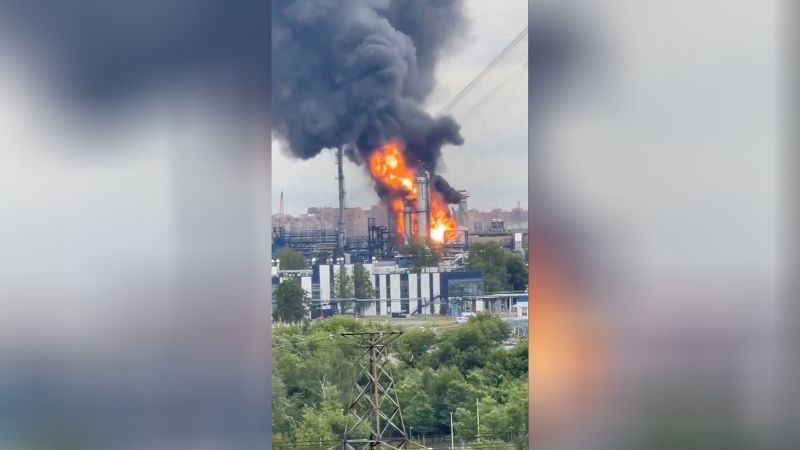
Ukraine attacked a major Moscow refinery for the second time this week, Russian officials announced early Thursday, as Kiev increasingly targets long-range attacks on Russia’s energy infrastructure.
According to Reuters, the mayor of the Russian capital, Kapotnya, Sergei Sobyanin, said on Telegram that several drones attacked the Moscow refinery in the southeastern district of Kapotnya. He said more than 40 drones heading for Moscow were shot down.
“Air defense forces continue to repel major attacks,” he added.
Video geolocated by CNN showed the moment of the explosion at the refinery. Video showed thick black smoke billowing from part of the facility, before a massive explosion rocked another part of the facility, blowing the roof of a large fuel tank container into the air.
An apartment building in the Moscow suburb of Zhukovsky was also attacked by a drone, Russia’s state-run Mediatas news agency reported, citing Moscow region governor Andrei Vorobyov.
The attack damaged the building and some balconies, but there were no casualties. He said debris from the drone also fell in several other locations on the outskirts of the capital, damaging a fitness centre, an industrial facility, a shopping center (where the fire started) and homes.
Further south, in Russia’s Rostov region, another drone attack on Thursday killed one civilian, injured two others, damaged a locomotive and set fire to two commercial buildings, the region’s governor, Yuri Slyusar, said, according to TASS news agency.
Sobyanin said at the time that Thursday’s Moscow airstrike came after a drone attack on Tuesday “damaged facilities on the premises” of the same refinery.
After Tuesday’s attack, Ukrainian President Volodymyr Zelenskiy said his army used long-range weapons to attack facilities “500 kilometers away” and characterized Kiev’s intensified offensive deep into Russian territory as a key strategy for Russia to end the war.
In recent months, Ukraine has launched large-scale drone attacks against Russian oil refineries and military facilities, including naval facilities, oil depots and terminals. Some attacks occurred in the Leningrad region, while St. Petersburg recently hosted the World Economic Forum, also known as Russian President Vladimir Putin’s version of Davos.
Russia’s state budget relies on oil revenues for at least a third of its revenue, analysts say. Since the Ukraine war began, there have been fewer buyers for Russian oil thanks to tougher sanctions imposed by the European Union and the US government, but the Iran war has turned out to be a windfall, with Russia benefiting from higher global fuel prices and sanctions relief.
Still, Ukraine’s near-daily attacks on oil infrastructure are taking a toll. Crimea, which Russia illegally annexed in 2014, faced oil shortages and gasoline rationing earlier this month after Ukrainian attacks restricted road supplies across the region, Reuters reported.
Thursday’s attack took place as world leaders gathered for the G7 summit in France, where President Zelenskiy met with President Trump on Tuesday. After the first meeting, President Zelenskiy said that “everyone” agreed to help Ukraine acquire more air defense capabilities, and that President Trump also took his proposal positively.
Earlier Tuesday, President Trump urged Russia to agree to a deal to end the war, which is now in its fifth year. “Russia has lost a huge number of people, and so has Ukraine,” he said.
And French President Emmanuel Macron, in his closing remarks at the summit, said Trump and other leaders in attendance recognized that Russia was not seeking peace, and described a “substantial change in the approach” of the United States on the war.
