

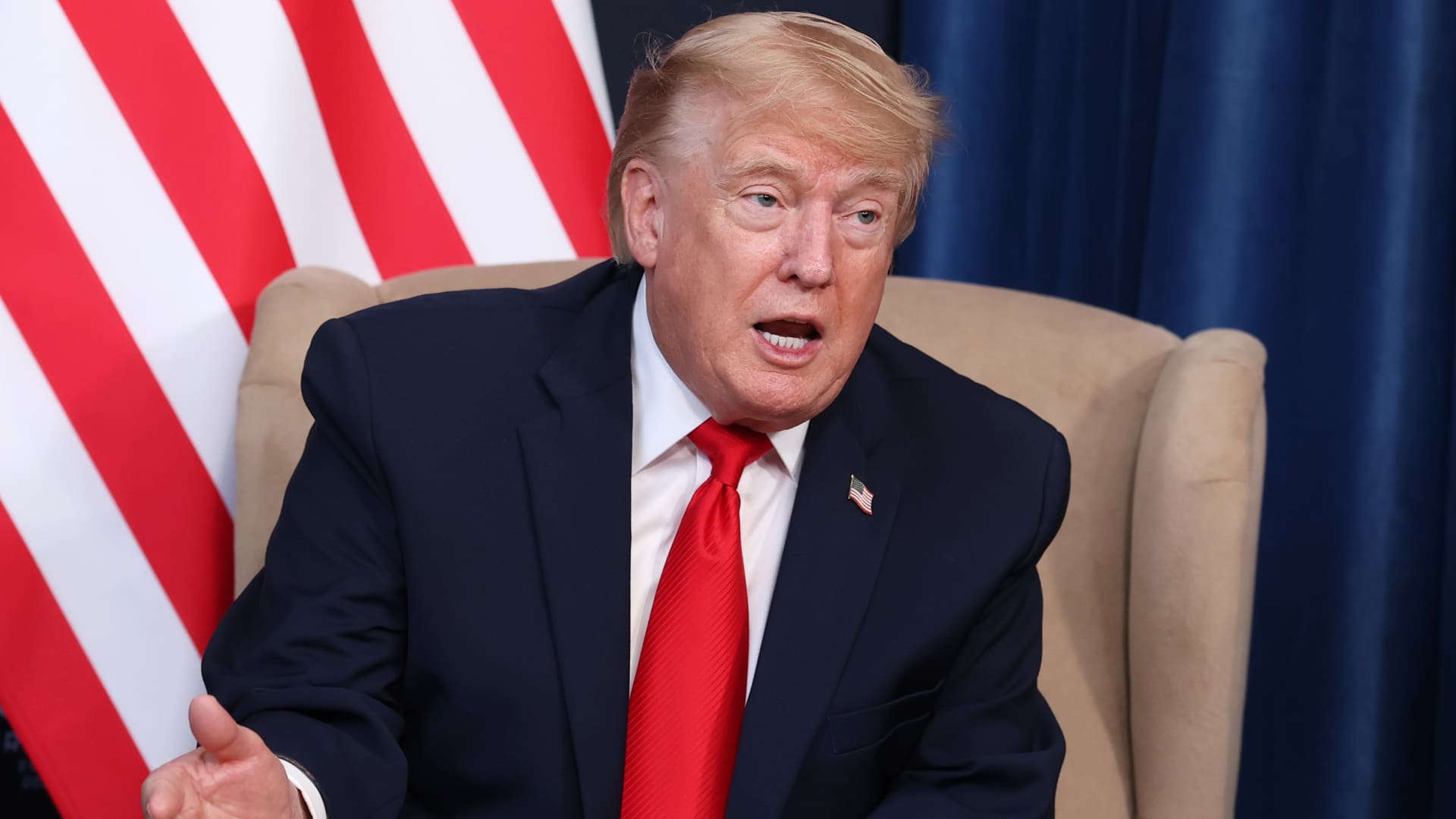
President Donald Trump signaled Tuesday that he is prepared to send details of the deal with Iran to members of Congress as they raise questions, ask to see the deal and say they need to vote on the final deal.
Trump, who arrived in France for bilateral talks with United Arab Emirates President Mohammed bin Zayed Al Nahyan, said he was willing to send the memorandum to Congress for review. He did not say when Congress would receive details. The framework, announced and digitally signed on Sunday, could end hostilities between the United States and Iran that began in February.
“What I’d like to do is send it to Congress and say, ‘You shouldn’t approve it,’ and they’ll approve it,” Trump said, clearly joking. He is in Evian-les-Bains, France, to attend the 2026 G7 summit.
Senate Minority Leader John Thune, a Republican, said at a news conference Tuesday that he had not been briefed on the agreement. “We’re asking for it, but we certainly haven’t heard it yet. We’ll probably hear from the government more specifically about what’s in that memorandum at some point,” Thune said.
And Senate Minority Leader Chuck Schumer (New York) called on the Senate floor on Tuesday for a briefing and for more information to be shared with the public.
“Americans need to know what President Trump has promised Iran and what the United States will get from it,” Schumer said.
The preliminary agreement would extend the ceasefire between the United States and Iran for 60 days and create a framework for future negotiations over Iran’s nuclear program and other issues. The text of the agreement has not yet been made public, but President Trump said he would reveal details on Friday.
News of the deal was met with a lukewarm reaction on Capitol Hill this week from some key Trump allies.
Sen. Lindsey Graham (RS.C.) said he was “pleased” with a deal that could open the Strait of Hormuz. The Strait of Hormuz was effectively shut down this spring amid the conflict, disrupting international supply chains and sending gas prices soaring. But he said Congress should be given a chance to consider it.
“I am somewhat concerned that Iran’s view of the deal appears to be different from what the American negotiating team has advocated,” Graham wrote in a post to X on Sunday. “Under our nation’s laws, the nuclear deal with Iran must be sent to Congress for review and vote. I look forward to reviewing the final product and believe it is essential that the agreement’s architect, Vice President Vance, and his negotiating partners participate in the process that brings the final agreement to Congress.”
Asked about Graham’s comments on Tuesday, Trump said: “I have to talk to Mr. Lindsay. He’s going to be in big trouble.”
But Graham wasn’t alone in his skepticism.
Sen. John Kennedy (R-Louisiana) told reporters on The Hill on Tuesday: “From what I’ve heard, it sounds like this is just a deal to try to get a deal. The only immediate impact would be to open the Straits.”
Sens. John Curtis (R-Utah) and Thom Tillis (R-Utah) both said Congress should not only consider the deal, but sign it.
“I think it makes more sense because I’ve said repeatedly that it was a mistake for President Obama to not work to bring it up to treaty standards, and here I think we should do that,” Tillis said, referring to President Obama’s 2015 Iran nuclear deal known as the Joint Comprehensive Plan of Action, which has not been formally codified by Congress.
“Otherwise, it’s only going to be in effect for two and a half years. How will the market assess the uncertainty of whether the next president will accept the JCPOA in the same way that this president has rejected it?” said Tillis, who will retire at the end of this Congress.
Others questioned some of the deal’s rumored provisions, such as a $300 billion Iranian reconstruction fund and the release of frozen Iranian assets that Mr. Vance and other senior administration officials have said are possible.
But Vance said reports that Iran could receive up to $24 billion in frozen assets are false. And on Monday, President Trump posted on TruthSocial that all claims that the US is paying Iran $300 billion to rebuild are “Fake News and spread by Democrats!!!”
Sen. Richard Blumenthal (D-Conn.) said he was concerned the deal could include too many concessions to Iran.
“I think there’s a good chance that this peace agreement could be a de facto surrender,” Blumenthal said. “And the president is very reluctant to make that content public. He wants to keep it secret for as long as possible so he can fix people’s perceptions about it and potentially deceive them.”
Vance appeared on CNBC’s “Squawk Box” on Monday and said many details of the deal still need to be worked out. Vance said the two main provisions are the reopening of the Strait of Hormuz and a promise not to allow Iran to develop nuclear weapons. President Trump has repeatedly said that a key objective of the war is to prevent Iran from acquiring nuclear weapons.
“There are a lot of very important details for us to actually sit down at the table and discuss together and figure out a path forward on these details,” Vance said.
An official signing ceremony is scheduled for Friday in Geneva.
President Trump said Tuesday that the Strait of Hormuz has already begun to open to shipping.
“The ship is now starting to move,” President Trump said. “Oil is starting to run out and prices are falling rapidly.”
Reuters also reported on Tuesday that President Trump, in a June 11 memorandum, invoked the Defense Production Act, which gives the president broad powers to control domestic industries. President Trump cited “systemic constraints” on the military industry.
Republican Sen. Eric Schmidt of Missouri said Tuesday in response to President Trump’s invocation of the DPA that “a lot of valuable equipment was sent to Ukraine and it was ready for immediate use.” “But broadly speaking, I’ve been saying for a long time that we have to have a greater sense of urgency, and I think this administration has shown that in terms of rebuilding our industrial base.”
—CNBC’s Emily Wilkins, Garrett Downs, Irit Skalnik and Karen James Sloan contributed to this article.
