

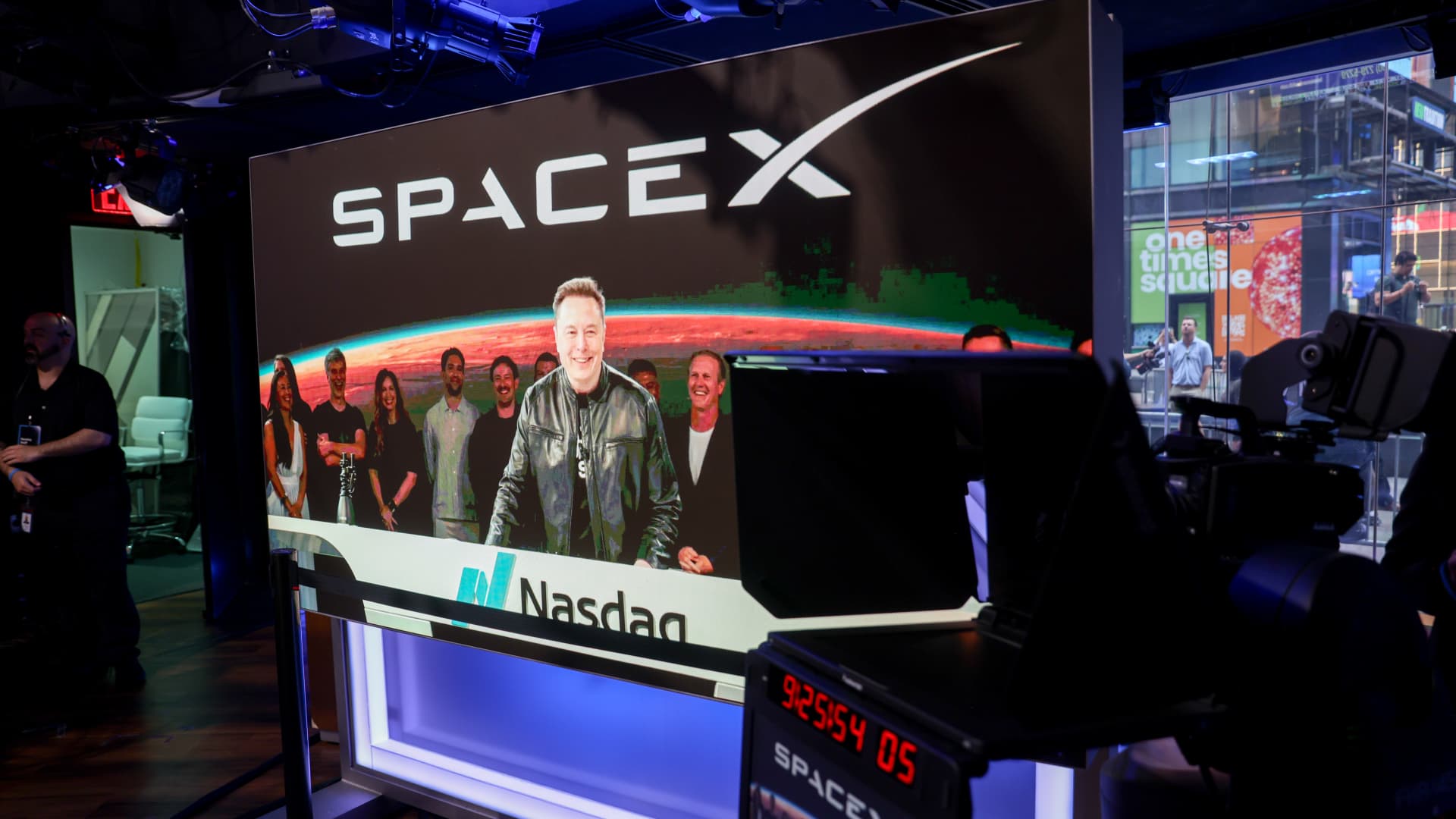
Video shows SpaceX founder Elon Musk after SpaceX’s initial public offering on June 12, 2026 on Nasdaq Marketsite in New York.
Michael Nagle | Bloomberg | Getty Images
Shortly before Nasdaq trading opened on Friday, Elon Musk appeared before a cheerful crowd at SpaceX’s corporate district in Texas. His rocket maker is about to go public at a valuation of about $2 trillion, quickly becoming the sixth-highest-valued company in the United States.
Musk, who was weeks away from his 55th birthday, told staff when the company was first founded that the company had “less than a 10% chance of success.”
“If people had told me this was going to happen, I would have thought, ‘Hey, you must be smoking some really good crack,'” said Musk, who founded SpaceX in 2002 and grew it to 22,000 full-time employees. “I think this company will go bankrupt.”
Musk is now the world’s first trillionaire after his company successfully raised $75 billion in the largest IPO in history. alibaba’s There are 10 companies in the United States worth at least $1 trillion. Musk runs two of those companies.
Whatever uncertainty Musk professed to feel as SpaceX took off, he showed no such anxiety in the days leading up to the IPO. SpaceX priced its IPO at $135 during an abbreviated roadshow and told investors they could go in or get out. There were no price ranges to gauge demand and no haggling with prospective shareholders.
That’s even though SpaceX’s revenue is a fraction of that of the tech giant, and it posted a $4.9 billion loss last year. After Friday’s close, SpaceX was worth $2.1 trillion, 112 times its sales last year.
“This was not a transaction that was priced based on market forces,” said Lloyd Greif, an investment banker at Greif & Company in Los Angeles. “This was a deal based on what one man wanted. And when one man wanted it, one man would get it, and if that one man was Elon Musk.”

Meanwhile, any mention of trillions has added fuel to the debate over wealth inequality as consumers grapple with crippling inflation, largely due to the Iran war. Vermont Sen. Bernie Sanders, a self-described democratic socialist, wrote on social media that Musk’s new position was “a call to action to address the unprecedented income and wealth inequality that currently exists.” And California Democratic Gov. Gavin Newsom wrote about SpaceX-owned
None of that dampened the mood on Wall Street. Wall Street was eager for initial public offerings after a historically weak period for IPOs dating back to late 2021. SpaceX’s IPO, which ended the day up 19% and consistently traded well above its offering price, boosted confidence in a potential deal later this year from artificial intelligence modeling giants OpenAI and Anthropic, each worth nearly $1 trillion in private markets.
former Nasdaq CEO Robert Greifeld said he is “definitely betting” that OpenAI and Anthropic will go public in 2026. The companies announced this month that they had confidentially filed IPO documents.
Making Facebook’s IPO look small
More than 500 million SpaceX shares changed hands over the course of the day on Friday, a number close to the time Facebook made its market debut in 2012, when about 580 million shares were traded. Facebook’s IPO set a record at the time, raising $16 billion. At the close of trading on the first day, Facebook was worth about $100 billion, or one-twentieth of SpaceX’s current market capitalization.
One of the big similarities between the two companies is that they are controlled by their founders. But even there, SpaceX is on another level. At the time of Facebook’s IPO, CEO Mark Zuckerberg had the ability to control 56% of the company’s voting rights. For SpaceX’s Musk, that number is over 82%.
Musk is not the only one hoping for financial gains from SpaceX’s IPO.
Offering pushed of the alphabet After the company invested about $900 million in SpaceX in 2015, its stake rose to more than $100 billion. Valor Equity Partners, run by Musk’s longtime friend Antonio Gracias, holds more than $80 billion worth of stock, much of it owned by its clients.
And beyond institutional investors, the IPO reportedly created about 4,400 billionaires among current and former SpaceX employees.

The stock sale was led by Wall Street heavyweights. goldman sachs and morgan stanleyWith the help of bank of america, citygroup, JP Morgan Chase Also included is a long roster of other major banks and specialty companies. Underwriters now have access to additional equity, or greenshoe overallotments, on certain colorful terms.
“If only all bankers wore green shoes,” Steve Jurvetson, a venture capitalist who invested in SpaceX in 2009, wrote in a post about X. Jurvetson posted a photo of a pair of green and white Nike sneakers emblazoned with the company’s logo.
Throughout the morning, some of Mr. Musk’s top investors and friends joined CNBC to talk about this historic event. Gracias was also one of the guests.
Valor’s founder and CEO said he met Musk more than 20 years ago through a mutual friend, venture capitalist David Sachs, who until recently served as President Donald Trump’s AI and crypto czar. Gracias said he invested. paypal “Back in the day,” when Musk and Sachs were founding members and invested in early investments in Tesla and SpaceX. In both cases, he said, his company “tackled difficult problems to help these companies succeed.”
Gracias and Musk’s relationship extends beyond business. He spent some time last year working with Musk as part of the Trump administration’s DOGE effort to cut government spending. As for SpaceX, Gracias said he plans to continue owning the stock “for as long as possible.”
Sequoia partner Sean Maguire, who invested in SpaceX in 2019, called Musk a “generational entrepreneur” and likened Musk’s planned delivery of Starship launch vehicles to the introduction of railroads. He said he believes the company has the potential to generate hundreds of billions of dollars in revenue in 2030.
Mr. McGuire said Sequoia would distribute some shares to investors “if we feel the valuation is going much further than expected,” but added, “Personally, I intend to hold the stock forever.”
“We rely heavily on Starship.”
Skeptics of SpaceX’s lofty valuation questioned the logic of it all. The company relies on its Starlink satellite internet service for most of its revenue, making it the only profitable part of its business. But investors won’t pay historically high multiples for broadband service, no matter how good it is.
The space launch sector is wasting money and hoping that Starship rockets can achieve far better economics than the Falcon fleet. And the AI sector, which Musk entered with his acquisition of xAI, is now a cash cow focused on leasing large amounts of capacity to the likes of Anthropic and Google.
Financial research firm CFRA gave SpaceX a sell rating and a $115 price target minutes after the company listed on the Nasdaq. Analysts said SpaceX’s “valuation expectations have increased,” and to meet those expectations, the company will need to prove Starship’s viability, expand Starlink, generate revenue from its AI infrastructure and ultimately generate steady free cash flow.
“Our biggest concern is that SpaceX’s long-term strategy remains heavily dependent on Starship,” CFRA analyst Keith Snyder said in a note to clients, adding that the Starship rocket could become a “bottleneck” for SpaceX’s various efforts.
Additionally, SpaceX announced a total addressable market of $28.5 trillion across space, connectivity, and AI. This number doesn’t include literal moonshots like space tourism, asteroid mining, or in-orbit manufacturing. That doesn’t even include transport to Mars.
New York University finance professor Aswath Damodaran told CNBC’s “Squawk on the Street” on Friday that addressable market numbers provided by SpaceX made him wonder if the prospectus was written by the xAI chatbot Grok rather than by a banker.
“This is a hallucination,” Damodaran said. “It would be embarrassing to even publish that number.”
Mr. Maguire, of Jack Permable, said he supports the projection.
“I’d even argue that’s an underestimate,” he says.
After SpaceX’s initial public offering on June 12, 2026, SpaceX President and Chief Operating Officer Gwynne Shotwell celebrates with family and other SpaceX employees at the Nasdaq Marketsite in New York.
Spencer Pratt | Getty Images News | Getty Images
Musk is the face of SpaceX, but the company’s rise to this point is largely due to the work of Gwynne Shotwell, the company’s executive director and one of its first employees.
In an exclusive interview with CNBC ahead of the IPO, Shotwell answered a question about whether his boss might merge SpaceX and Tesla. This is a potential deal that has been rumored for a long time, and has become even more rumored since Musk merged SpaceX and xAI after previously doing something similar with xAI and X.
Shotwell, whose SpaceX stock is now worth more than $2 billion, did not rule out the possibility, but made it clear it was not on her priority list.
“There’s no question there’s going to be synergy between Tesla and SpaceX in our future,” Shotwell told CNBC’s Morgan Brennan at Starbase. “What we’re all trying to accomplish in the future is coming together, but right now I’m focused on keeping the lights on here, continuing to produce rockets, flying rockets, flying people, getting to the International Space Station, and getting broadband to people who don’t have access.”
Musk spent a lot of time on Friday, and seemed to be enjoying the moment. When his company’s IPO dominated the news cycle, Mr. Musk was active on social media, reposting messages, videos and photos touting his company’s success, mostly from supporters. He didn’t write much, but there was one message he wanted to share about X.
“I love the wonderful people at SpaceX more than words can express,” he wrote.
WATCH: Cramer: No IPO has captivated Wall Street like SpaceX

