

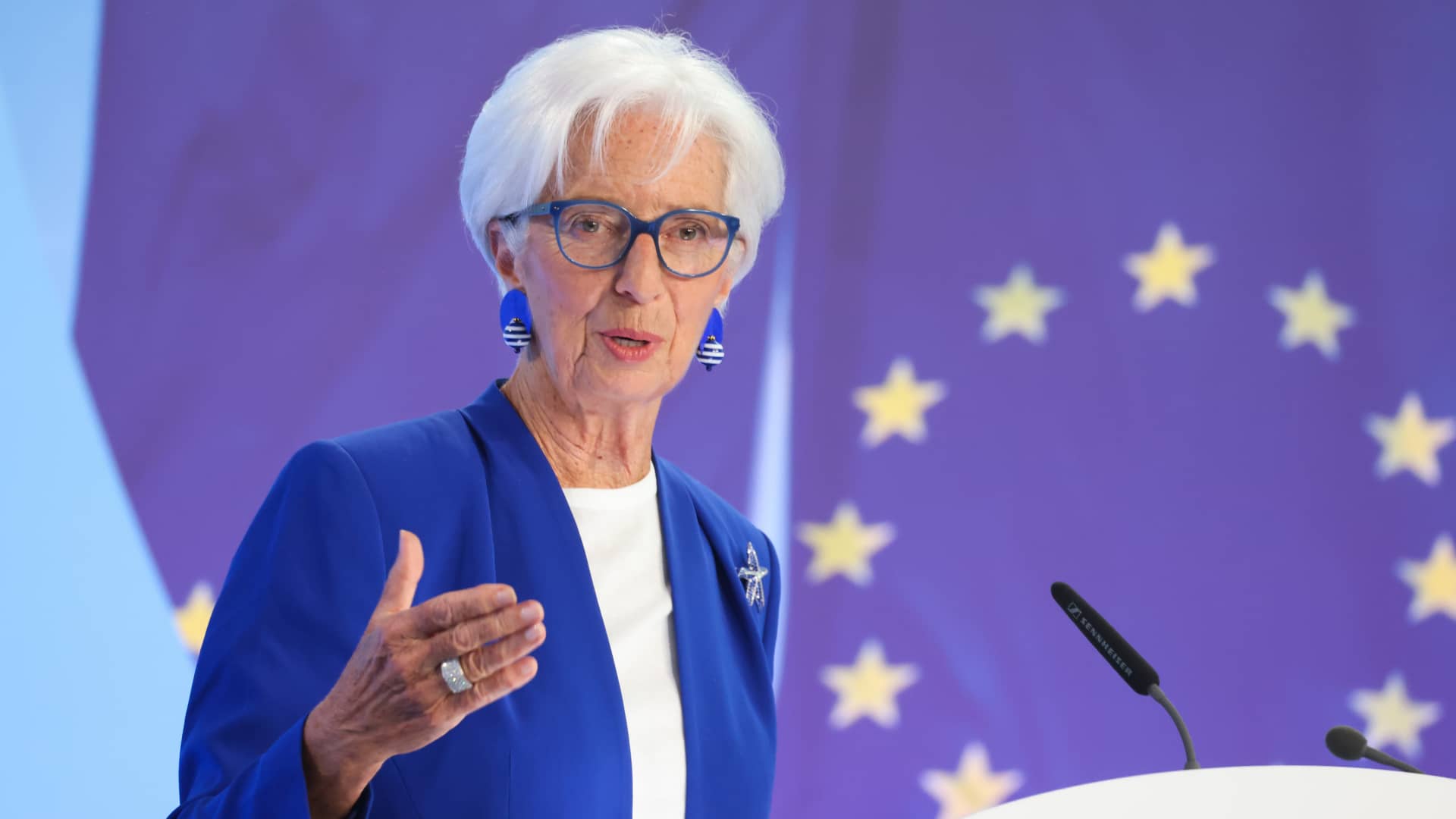
European Central Bank (ECB) President Christine Lagarde attends a press conference on interest rate decisions in Frankfurt, Germany, on Thursday, June 11, 2026.
Alex Kraus | Bloomberg | Getty Images
The European Central Bank announced a quarter-point rate hike on Thursday, taking its key interest rate to 2.25% as the Iran war continues to blow inflation targets.
Markets had priced in a nearly 100% probability that the ECB would raise interest rates by at least 25 basis points ahead of its June meeting, according to LSEG data.
The ECB Governing Council said the decision was taken to avoid inflationary pressures caused by the US-Iran war.
“The decision to raise interest rates is prudent given the war in the Middle East, which is creating inflationary pressures, and the different scenarios that paint a picture of how the shock could develop and affect the euro area’s medium-term outlook,” the government said in a statement announcing the decision.
The central bank also raised its inflation outlook, saying it now expects headline inflation in the euro zone to average 3% in 2026, falling to 2.3% next year and 2% in 2028.
It said the outlook had been revised due to expectations of higher energy prices, which are expected to impact the prices of food, goods and services.
Meanwhile, economic growth forecasts for this year and next have been revised downward. The ECB currently expects growth in the euro area to average 0.8% in 2026, 1.2% in 2027 and 1.5% in 2028.
Officials said the growth outlook had been lowered to reflect the “more pronounced impact of the war on commodity markets, real incomes and confidence.”
ECB President Christine Lagarde reiterated to reporters on Thursday afternoon that the Middle East wars were creating inflationary pressures.
“The outlook remains uncertain, with upside risks to inflation and downside risks to economic growth. We are not committing to any particular interest rate path in advance,” he said.
“The full impact of the war on inflation and growth in the medium term will depend on the intensity and duration of the energy price shock and the magnitude of its indirect and secondary effects.”
The Iran war, which recently exceeded 100 days, has caused a global energy price shock as the closure of the Strait of Hormuz waterway and the destruction of energy production facilities in the Middle East have created severe supply constraints. Although a fragile ceasefire remains in place, tensions between Washington and Tehran have increased in recent days.
The ECB said on Thursday that the board “remains well-positioned to overcome the uncertainties caused by the war” and would closely monitor the situation, but stressed that officials “are not committing in advance to any particular interest rate path.”
Preliminary data earlier this month showed eurozone inflation rose to 3.2% in May, as rising energy costs pushed the region’s inflation rate further above the ECB’s 2% target.
The euro zone economic growth rate in the first quarter of this year was only 0.1%.
Mark Wall, chief European economist at Deutsche Bank, said the ECB’s interest rate hike was a “pivotal moment”.
“This is not only the first rate hike by the ECB since 2023, but also the first time one of the world’s major central banks has raised interest rates in response to an energy shock,” he said in a note. “The ECB insists that a ‘look-through’ strategy is not a strong response. The question is how long this tightening cycle will last. Our answer is not far away. There are upside risks to inflation, but there are also downside risks to growth. One more rate hike in September and that’s it.”
Neil Birrell, chief investment officer at Premier Mitten, said in a note after the ECB’s announcement on Thursday that the decision was not surprising given the inflationary backdrop.
“Growth expectations are already slowing, but it’s encouraging that they don’t see the risks to GDP as high,” he said. “Further rate hikes are likely this year, depending on the data, but this is unlikely to be the end of policy action.”
The yield on the 10-year German Bundestag, the eurozone benchmark, fell by 2 basis points (bp) in Frankfurt by 2:50 p.m. of EUR It is flat against the dollar, british pound.
