

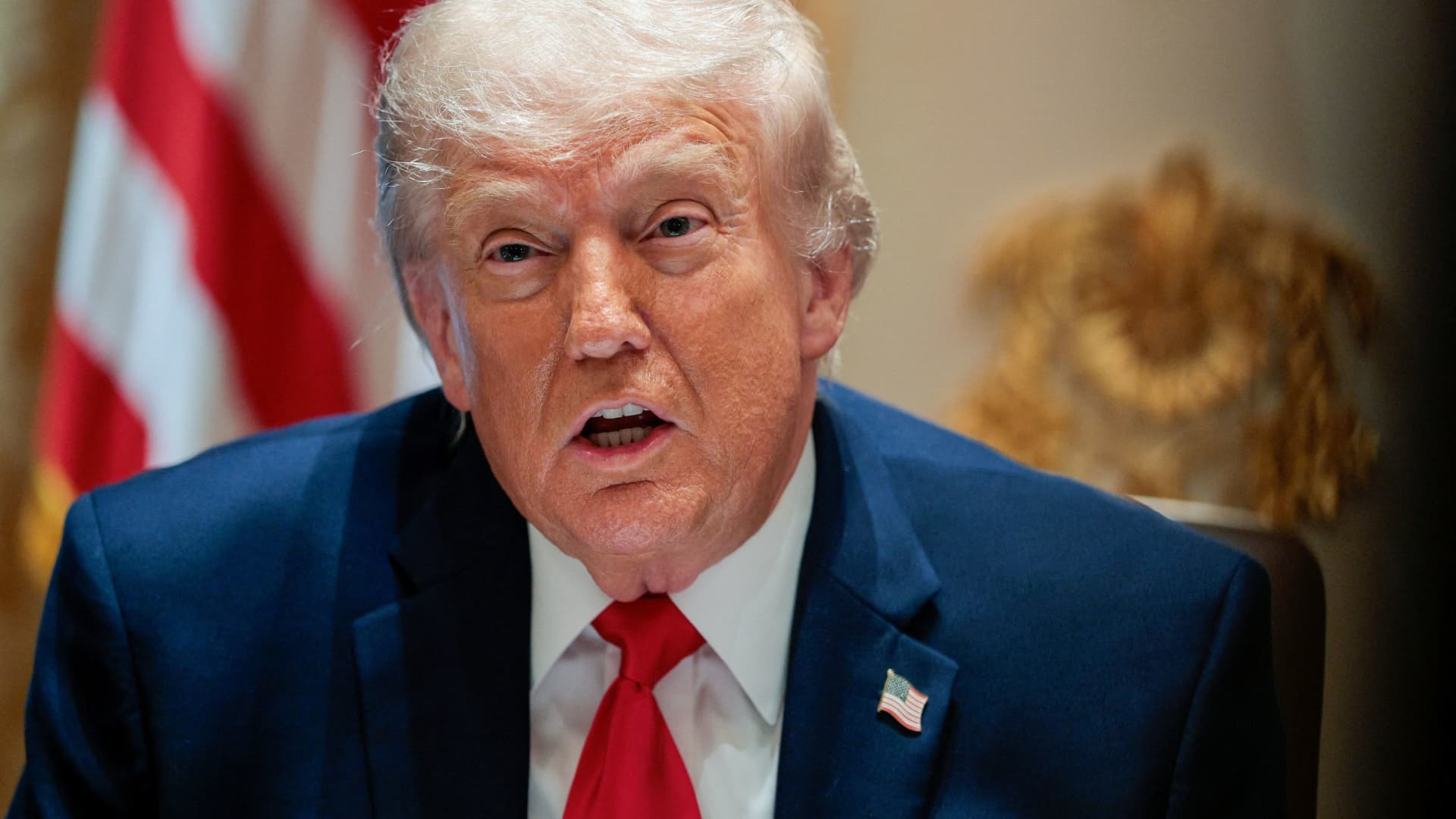
President Donald Trump addresses a Cabinet meeting in the Cabinet Room of the White House on May 27, 2026 in Washington.
Evan Vucci | Reuters
President Donald Trump said this week that a comprehensive peace deal with Iran could be signed soon, repeating similar claims he has made dozens of times over the past three months.
This latest example may not resonate with the average listener. After all, there is no consensus on any of President Trump’s dozens of claims to date. But despite delays in implementation, markets continue to react to the president’s repeated promises.
Trump has hinted or made public statements that a deal is near on more than 30 occasions, according to a CNBC analysis of the president’s social media posts and public statements.
Stock and oil markets, reeling amid the war’s global energy supply shock, continue to pay close attention to President Trump’s signals about a future deal, even if it doesn’t pan out. Meanwhile, more than 100 days into the war, Washington and Tehran appear to be further from a deal than they were in mid-April, when they began a fragile ceasefire that had been heralded as a path to a final deal within two weeks.
“The market has always held out hope that this would end at any time, any time,” Peter Boockvar, chief investment officer at One Point BFG Wealth Partners, told CNBC. “I think I’m still holding on to that hope.”
The White House did not immediately respond to CNBC’s request for comment on this report.
President Trump said early Tuesday that the United States and Iran could reach a “very good deal” within “a few days.” Oil prices fell in the next trading session, but reversed course on Wednesday as President Trump vowed to attack Iran “very hard” if there was no diplomatic breakthrough.
Oil and markets responded positively to President Trump’s stoking of optimism that an end to the war is on the horizon with a deal favorable to both the United States and Iran.
That has remained the case in recent weeks, as the fragile cease-fire agreement between the United States and Iran has been repeatedly undermined by military escalation in the Persian Gulf, and peace talks have been further strained by Israeli attacks in Lebanon.
The moves are fueled by market and analyst assumptions that despite ongoing conflicts in the Middle East, a deal will eventually be reached to end the war and reopen the Strait of Hormuz, a vital oil shipping route.
“While geopolitical developments continue to trigger large oil movements, there is also optimism that the US and Iran will reach a peace deal this month,” Deutsche Bank researchers said in a June analyst note.
Both countries say they want to show they can survive a long war, but observers believe the deal has incentives in their favor, as Iran’s economy has suffered and President Trump’s approval ratings have declined amid the conflict.
“Trump’s need for an off-ramp means détente bias remains prevalent and could send stocks to a rock bottom,” Barclays analysts said in a June 3 equity research note.
“Every time he tweets about it, oil sells and the market gets more optimistic,” Boockvar said of President Trump. But “in recent months, we’ve been getting closer and closer to the finish line.”
To be sure, President Trump’s social media posts are not the only factor influencing oil and stocks. For example, the AI trading that drove the stock market to record highs has little to do with the Iran conflict. Crude oil prices, which soared after the start of the war but have remained flat since then, have been affected by various global factors, including a sharp decline in China’s oil imports.
But while Trump’s wartime updates have come under intense scrutiny, even some of the president’s allies appear to be growing irritated by his claims about the status of negotiations.
“It’s starting to feel like we’re Charlie Brown and Iran is Lucy, and every time we go to kick the ball, they’re taking it away from us,” Rep. Carlos Gimenez, R-Florida, said in an interview on FOX Business on Tuesday. “You’re thinking, ‘We’re so close to a deal, two days to a deal, three days to a deal,’ and that hasn’t happened.”
President Trump’s insistence on a deal began in March.
As early as mid-March, less than three weeks after the United States and Israel first launched attacks on Iran, President Trump began claiming that Iran had opened talks in hopes of finding a diplomatic solution.
“They want a deal. They’re talking to the people,” President Trump said at the White House at noon on March 16.
West Texas Intermediate crude oil fell 5.28% in that session, but the decline at the time was related to perceived progress in lifting the blockade of the Strait of Hormuz.
A week later, President Trump announced in an all-caps Truth Social post that he was suspending military strikes, citing “very helpful and productive conversations” about a complete cessation of hostilities. Following the announcement, stock prices rose and oil prices fell by more than 10%.
Three days later, the situation reversed when Trump mixed messages, warning Iranian negotiators to “get serious now, before it’s too late,” and later insisted at a Cabinet meeting that Iran was “not the one asking for a deal.”
On March 29, President Trump said negotiations were going “very well” and claimed that Iran had agreed to most of the 15-point proposal presented by the United States, but the Iranian government publicly rejected the proposals and oil prices rose in the next trading session.
President Trump insisted on March 31 that the war would not last much longer, and the next day he wrote on Truth Social that Iran’s president had asked the United States for a ceasefire. WTI crude oil prices fell on both days.
But a cease-fire agreement failed to reach a deal that week, and President Trump began to ratchet up his rhetoric against Iran, dampening traders’ prospects.
April’s argument: 2 weeks until agreement is reached
On the night of April 7, the two countries announced they had reached a two-week cease-fire, after President Trump threatened to bomb Iran “back to the Stone Age” and warned that Iran’s “entire civilization would be destroyed” if a deal was not reached.
His announcement strongly suggested that the temporary ceasefire would be replaced by a permanent agreement. “The United States and Iran have reached an agreement on nearly all of the issues of the past, and the agreement will be finalized and signed over a two-week period,” Trump wrote.
Stocks soared on the news, and oil prices plunged more than 16%. But as two weeks passed and Trump continued to insist that negotiators had resolved most of their differences, no deal was reached.
Instead, each side accused the other of violating ceasefire terms, and on April 21, President Trump unilaterally extended the ceasefire until Iran sent the United States a “unified offer” to end the war.
May: “Final decision”
Over the next month, President Trump issued repeated updates predicting progress on a full deal or short-term memorandum of understanding with Iran.
President Trump said on May 1 that ending the war “should not take too long.”
“I think this problem will end soon,” he said of Iran on May 19. “Then they won’t have nuclear weapons.”
Although no agreement was reached during this period, both the United States and Iran reportedly launched attacks on each other.
On May 29, President Trump said he would head to the White House Situation Room to make a “final decision” on the deal. However, he ended the meeting without making a decision. Oil prices have fallen anyway.
June: “2 or 3 days”
On June 1, President Trump reiterated that Iran “really wants a deal” and advised critics to “just sit back and relax, because everything will work out in the end.” Because “It always works!”
However, Iranian state media reported later in the day that negotiators had ceased communications with the United States and that Iran was moving toward a complete blockade of the Strait of Hormuz.
President Trump later told CNBC that he didn’t care whether the negotiations were finished or not. But he later insisted that talks with Iran were continuing “at a rapid pace.” Nevertheless, WTI crude oil rose nearly 6%.
Iran and Israel exchanged strikes over the weekend for the first time since the ceasefire began.
After leaving the NBA Finals game in New York City on Monday night, President Trump told reporters that the United States and Iran are in the final stages of a “very, very good deal” and that a deal could be reached within “a few days.”
A U.S. Army helicopter crashed while on patrol over the Strait on Monday evening. President Trump on Tuesday blamed Iran for shooting it down, prompting Iran’s military response as the U.S. launched a retaliatory strike.
On Wednesday, President Trump said at the White House that the United States would attack Iran again.
“We’ll see what happens with this agreement,” he added. He did not say a deal was close.
—CNBC’s Bria Cousins, Ashlee Trujillo, Irit Skulnik and John Melloy contributed to this report.
