

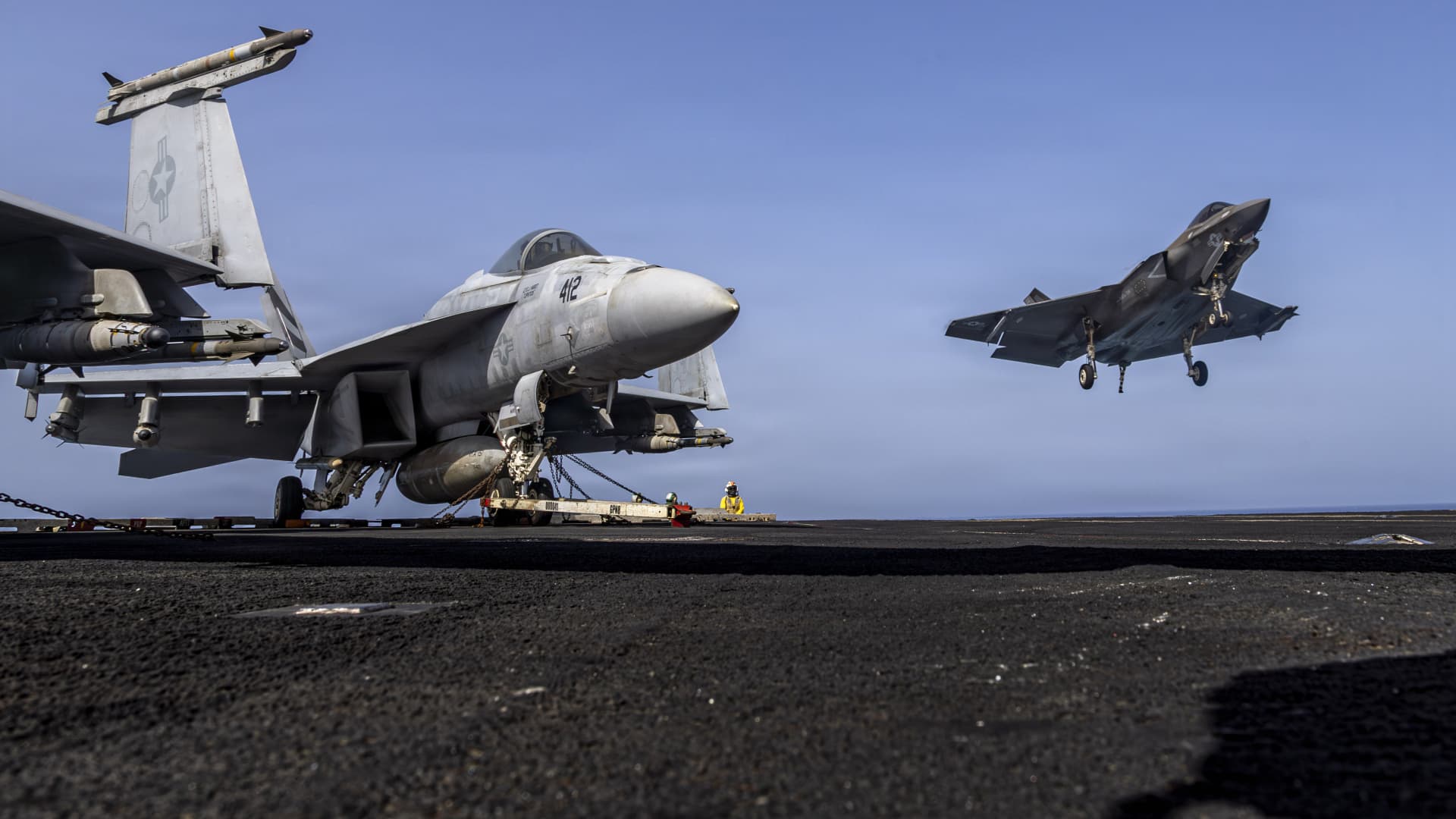
On May 25, 2026, an F-35C Lightning II assigned to Marine Fighter Attack Squadron (VMFA) 314 prepares for an emergency landing on the flight deck of the Nimitz-class aircraft carrier USS Abraham Lincoln (CVN 72).
centcom usa
Iran targeted Gulf states after the United States launched attacks on Middle Eastern countries early Tuesday.
Jordan’s military said Wednesday local time that it had intercepted five Iranian missiles, while Bahrain issued an alert and Kuwait activated its air defenses to intercept “hostile air targets,” according to state media.
U.S. Central Command announced Tuesday night that U.S. forces had launched an attack on Iran “in response to yesterday’s downing of a U.S. Army Apache helicopter.”
The “self-defense strike” was a “proportional response to Iran’s unwarranted aggression,” Centcom said on XPost.
In a post on the U.S. side late Tuesday, Centcom said it had completed the military operation by attacking Iranian air defenses, ground control posts and surveillance radar sites near the Strait of Hormuz.
“Iran continues its systematic hostile approach through criminal missile and drone attacks targeting civilians,” the Bahrain Defense Forces said on Wednesday.
“The air defense systems of the Bahrain Defense Forces successfully intercepted and destroyed the Iranian air attack,” the paper said in a post on X.
The clash could undermine the US ceasefire with Iran, which remains nominally active despite multiple outbreaks of fighting, and could push even a tentative peace deal further away.
The airstrike was ordered by President Donald Trump, who said earlier Tuesday that Iran shot down an American helicopter patrolling the Strait of Hormuz and that the United States would retaliate.
In a post on Truth Social, President Trump wrote that the two pilots involved in the attack were “safe and uninjured.” “Nevertheless, the United States must necessarily respond to this attack.”
Iranian state media reported the sounds of explosions at multiple locations around the strait late Tuesday night.
Iran’s Tasnim news agency reported that Iran would counter the US military action.

Iran did not directly claim responsibility for the downing of the helicopter, and Iranian state broadcaster IRIB reported that there had been no offensive military operations in the strait in the past 24 hours.
“Foreign forces in close proximity to our territory are always at risk due to their own human error, simple accidents, or the possibility of being caught in crossfire,” Iranian Foreign Minister Abbas Araghchi said in a statement published in X on Tuesday afternoon ahead of the US strike.
“To reduce the risk, the best solution is for them to leave,” Araghchi said, adding: “We prefer diplomatic language, but we also speak other languages.”
Less than a day later, President Trump claimed that a deal with Tehran could be reached as soon as this week.
President Trump said late Monday night after an NBA Finals game in New York City that the two countries are in the final stages of a “very, very good deal” that will prevent Iran from acquiring nuclear weapons and fully reopen the Strait of Hormuz “as soon as it is signed.”
Such an agreement could be signed “within a few days,” Trump added. But he has repeatedly insisted during the war, which surpassed 100 days on Sunday, that the United States and Iran are on the brink of a deal. No agreement has been reached.
Trump’s late-night comments came hours after the helicopter crash, in which a U.S. military AH-64 Apache crashed “near the coast of Oman” at 7:33 p.m. ET Monday night, according to Centcom.
Centcom initially did not blame Iran for the downing, saying the incident was under investigation in a statement Tuesday morning.
The two soldiers involved in the crash were rescued within about two hours by U.S. Navy Central Command and the 82nd Airborne Division, Centcom said.
Iran’s state broadcaster Press TV responded to President Trump’s truthful post, mocking his frequent claims that Iran’s military was destroyed by the United States.
“It’s enough that the Iranian military has been ‘annihilated’!” Press TV on Telegram.
Iranian Parliament Speaker Mohammad Bagher Ghalibaf made a mysterious threat similar to Araghchi’s statement on X-Post.
“While we prefer the language of diplomacy, we speak other languages much more fluently,” Ghalibaf wrote. “Break your promise, and we’ll switch to what speaks best. You ride the horse in your own saddle!”
Defense Secretary Pete Hegseth announced Wednesday that he will visit Guantanamo Bay, Cuba, and Tampa, Florida, to “engage GTMO and CENTCOM forces,” according to the Pentagon.
—CNBC’s Emma Graham and Megan Cassella contributed to this report.
